
Protein bar companies have focused heavily on finding better proteins, cleaner labels, and improved nutrition. But our analysis using Slate shows that a quieter shift is happening behind the scenes.
Patent filings and research activity show that the real competition is moving toward manufacturing capabilities such as extraction, extrusion, and stabilization. While some traditional forming approaches are seeing declining innovation activity, specialized technologies are creating new opportunities for companies that know where to look.
Extraction and extrusion technologies continue to expand, while binder-integrated forming has seen a sharp decline, dropping from 95 publications in earlier periods to only 3 in 2025–2026.
This shift creates new opportunities for companies that can access the right technologies through partnerships, licensing, and targeted investments. In this article, we will explore seven white spaces where players can build differentiated protein bar offerings without replicating the infrastructure of industry giants.
#1: Accessing Advanced Protein Extraction Without Building Expensive Infrastructure
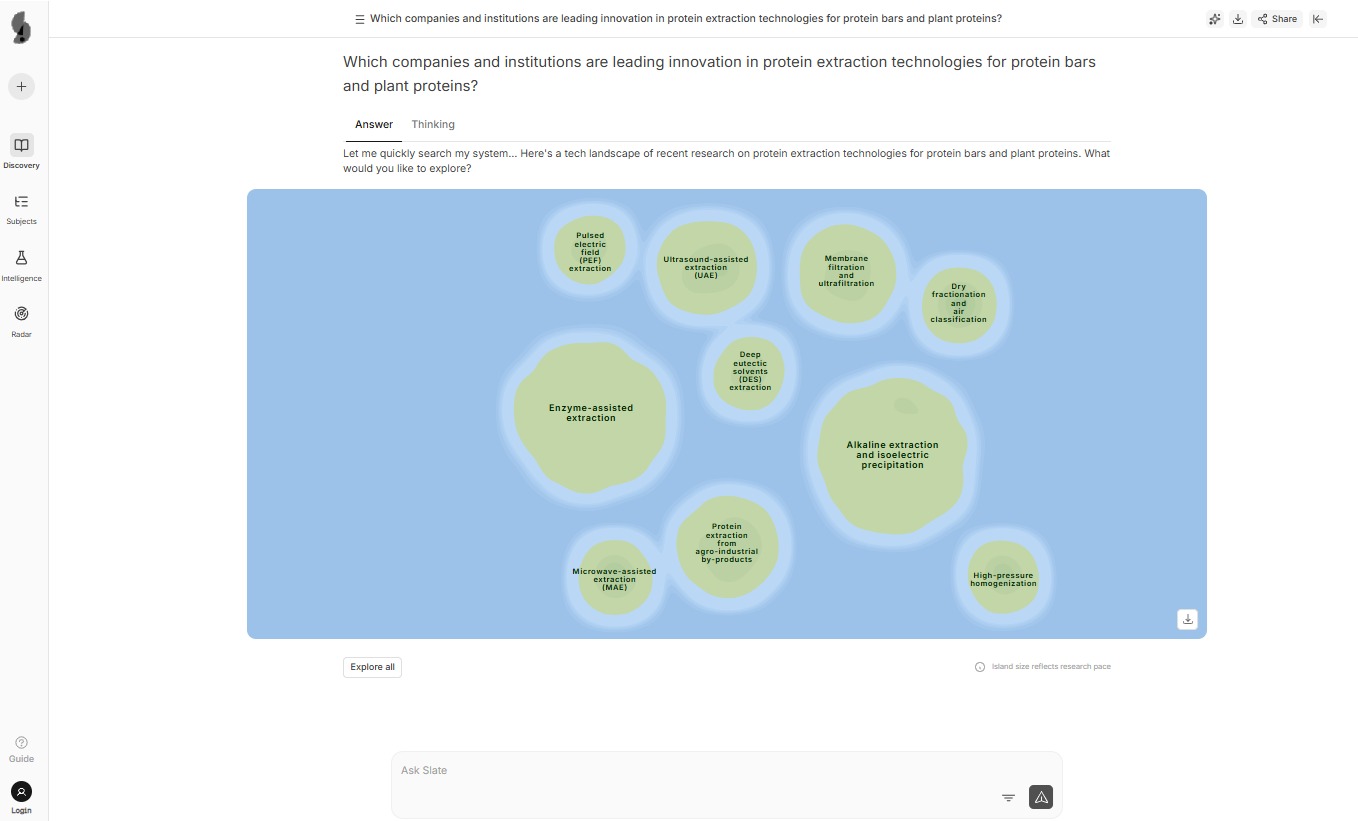
High-purity protein extraction is becoming concentrated among a small group of specialized players. Companies such as Louis Dreyfus Company, Burcon NutraScience, and Roquette Frères are building strong positions through advanced extraction technologies. This creates a gap for companies that need differentiated protein ingredients but cannot justify building their own facilities.
Slate’s analysis identified 214 innovations across this extraction landscape, with major activity around processes such as ethanol-based sunflower protein extraction and calcium-assisted hemp protein isolation. Louis Dreyfus Company has developed sunflower protein concentrate methods using 30–70% ethanol extraction, while Burcon NutraScience has explored calcium salt solutions followed by ultrafiltration to improve hemp protein functionality and sensory performance.
This creates an opportunity for mid-market players to access advanced protein isolates through toll manufacturing agreements rather than investing $10M+ in extraction infrastructure. By partnering with specialized processors, companies can secure access to clean-label protein ingredients while directing internal R&D resources toward formulation and product differentiation. However, as the protein ingredient market expands, companies may need to secure these partnerships early before specialized extraction capacity becomes more constrained.
#2: Building Proprietary Textures through Equipment Partnerships
Texture remains one of the biggest challenges in protein bar development, but the technology shaping texture is often controlled outside the food industry. While brands focus on formulations, equipment manufacturers are building the extrusion systems, nozzles, and process controls that determine the final product experience.
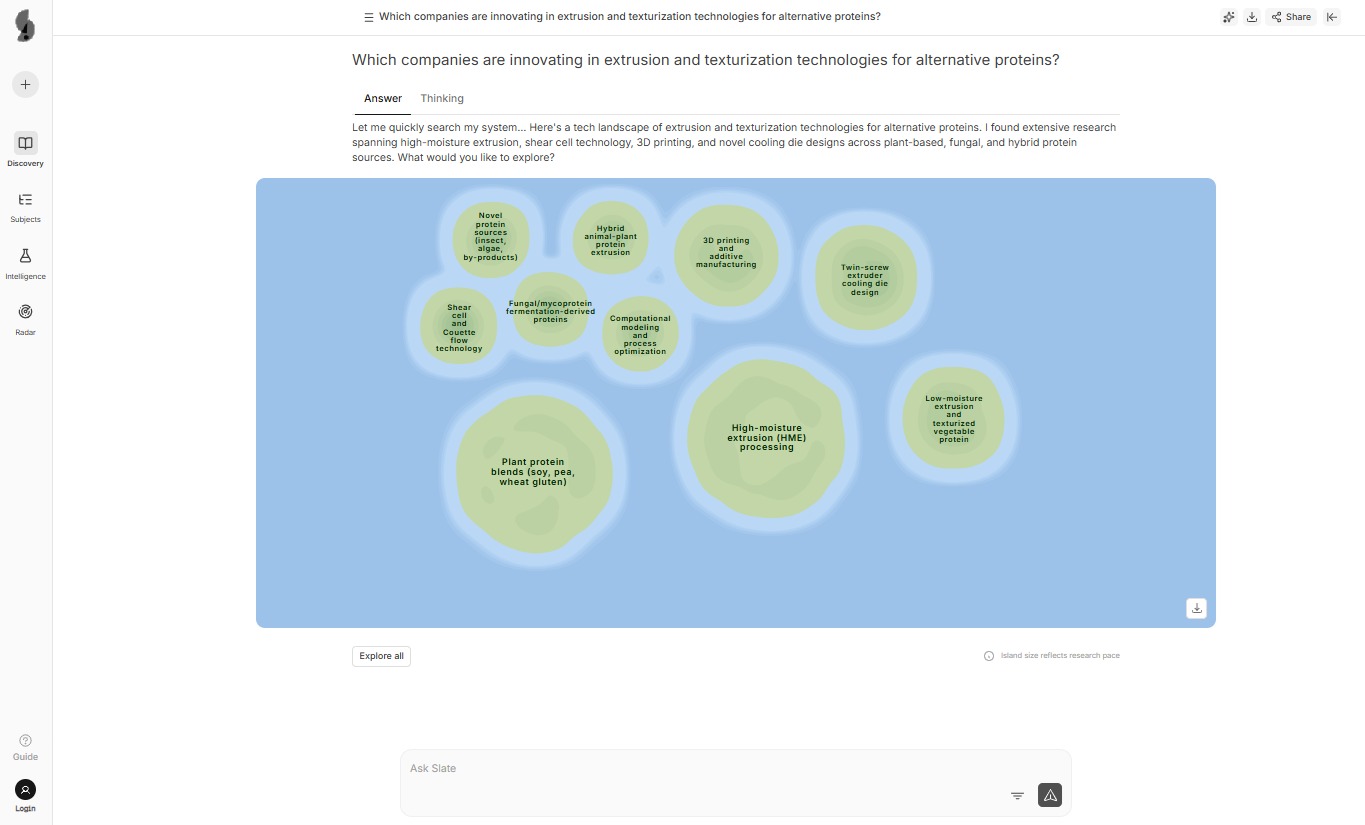
Slate’s analysis identified a 34-innovation cluster around extrusion technologies, revealing a gap between equipment developers and food brands. Companies such as Clextral are developing diverging-branch nozzle systems for continuous high-moisture extrusion. While Planted Foods has explored controllable valve systems to improve texturization consistency. TNO’s modular shear channels and DST Holding’s high-shear transport stages further highlight how equipment design is enabling better protein alignment without relying heavily on chemical additives.
This creates a white space for mid-market players to collaborate directly with equipment manufacturers and secure differentiated processing capabilities without investing in extrusion hardware development. Through co-development agreements, companies can gain access to exclusive nozzle configurations, valve systems, or manufacturing processes tailored for formats such as soft-baked protein cookies and layered bars.
The strategic challenge is balancing access and exclusivity. Equipment vendors typically prefer broad licensing models to maximize returns, while emerging brands need differentiated processes to build market advantage. As the alternative protein equipment market is projected to grow from $2.7 billion in 2025 to $6.5 billion by 2035, companies that establish early partnerships with technology providers may secure unique texture capabilities before these innovations become widely available.
#3: Licensing Stabilization Systems to Bypass the Long Shelf-life Development Cycle
Maintaining the right texture over time remains one of the biggest technical challenges in protein bar development. As protein content increases, brands often face issues such as hardness, dryness, and texture breakdown, requiring years of formulation trials to achieve the right balance.
Slate’s analysis identified 145 innovations focused on texture hardening within a 242-innovation hybrid protein cluster, showing the scale of R&D effort being directed toward moisture management and stabilization.
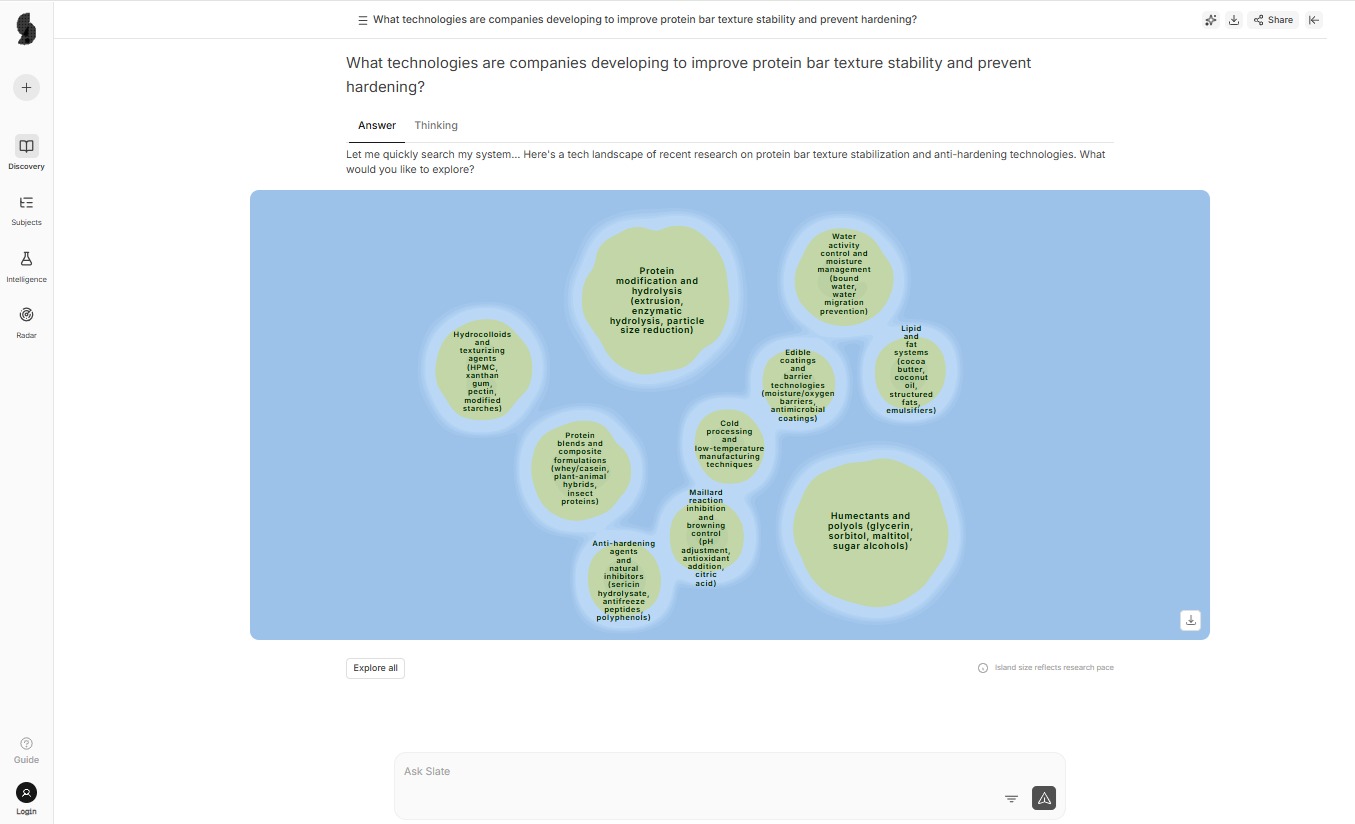
Companies such as General Mills have explored approaches using hydrolyzed collagen, soluble fiber syrups, and optimized syrup-to-dry-matter ratios to maintain soft, moist textures during storage. Sobinsky Khlebokombinat has also published more than 30 innovations around glazing systems and binder ratios.
This creates a white space around pre-optimized stabilization technologies. Rather than investing years into developing moisture-control systems from scratch, mid-market players can explore licensing opportunities for binder systems designed around specific protein levels, formats, and storage conditions. These solutions could help companies shorten development cycles while focusing R&D efforts on areas such as flavor, nutrition, and product positioning.
However, licensing also creates a strategic trade-off. While ready-to-use stabilization systems can accelerate commercialization, they may reduce differentiation if competitors access similar technologies. Companies must decide whether to prioritize faster market entry through licensed solutions or invest in proprietary stabilization approaches that may take longer to develop.
#4: Building Differentiated Protein Bars through Regional Botanical Ingredient Ecosystems
Most protein bars compete using widely available protein sources and standardized ingredients. This creates a challenge for companies trying to differentiate because the same formulations and ingredients can often be replicated by larger players. A potential opportunity lies in developing products around regional botanical ingredients that are harder to source and scale globally.
Slate’s analysis identified a 171-innovation cluster around cereal, nut, and grain-based formulations, with significant activity from Southeast Asian academic institutions. Indonesia alone contributed 64 publications in this cluster.
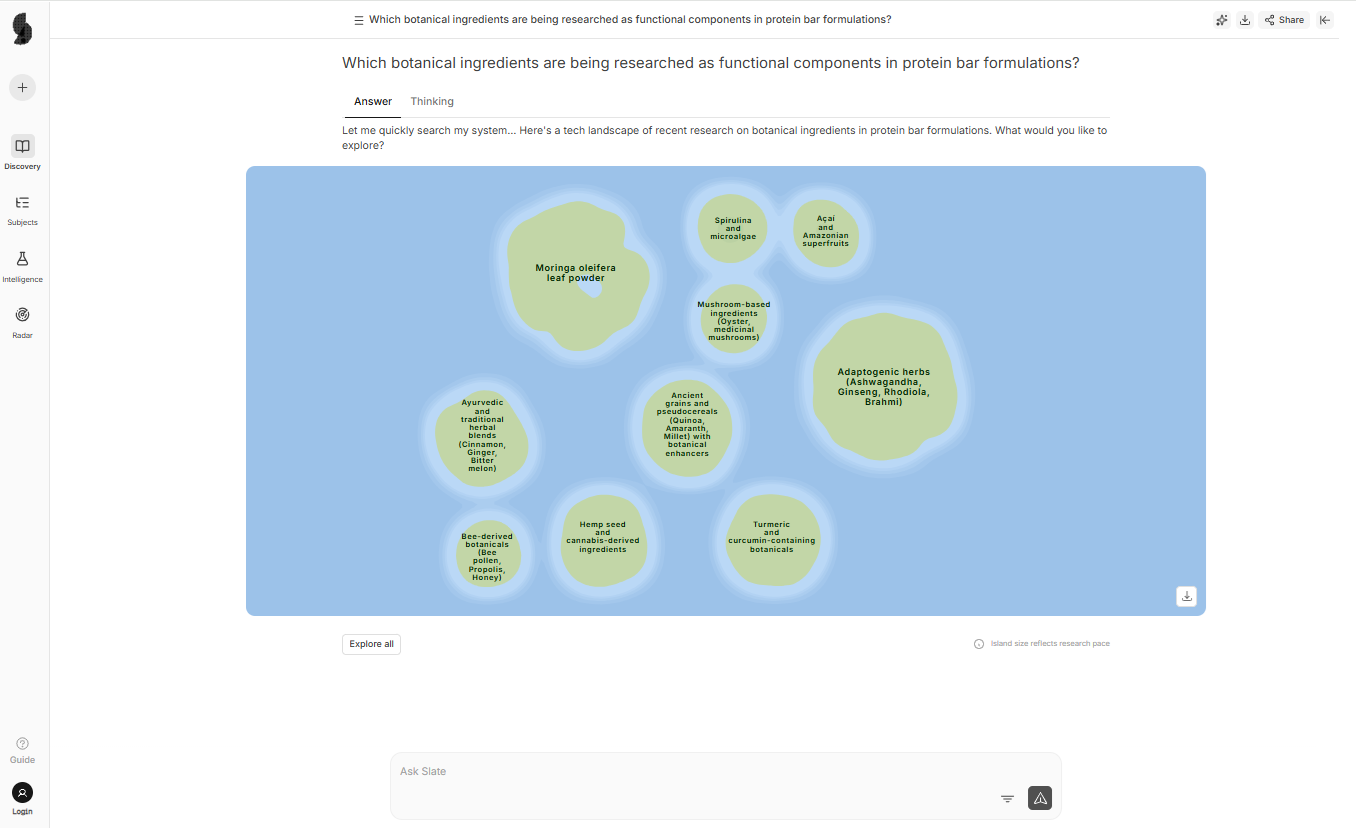
Researchers are exploring unconventional botanical inputs such as yacon tubers, date matrices, germinated peanut sprout flour, Moringa leaves, and snake fruit seed flour to improve nutritional value, functionality, and formulation performance.
These ingredients can provide multiple benefits beyond basic binding. Indonesian research has explored Moringa leaves for iron and protein enrichment, yacon tubers as a source of fructooligosaccharides, and germinated peanut sprouts for improved bioavailability. For companies with regional manufacturing capabilities, similar approaches could create unique protein bar formulations built around locally available ingredients such as sprouted grains, regional fruits, or specialty plant inputs.
The opportunity comes with a trade-off. Regional botanical sourcing can create strong product differentiation and supply chain advantages, but it may limit rapid global expansion. Companies must decide whether to build a regionally differentiated brand with unique ingredient networks or move toward larger-scale distribution using more easily available commodity inputs.
#5: Accessing Integrated Extraction and Extrusion Innovation Before Competitors
Protein bar manufacturing is becoming increasingly specialized, with different players solving different parts of the process. However, one gap remains largely unresolved that is combining upstream ingredient processing with downstream texture engineering into a single integrated system.
Northeast Agricultural University is one of the few entities showing activity across multiple innovation layers, including extraction, blending, and extrusion. While corporate players often focus on individual technical areas, academic institutions are exploring more integrated approaches that connect protein extraction chemistry with texturization processes.
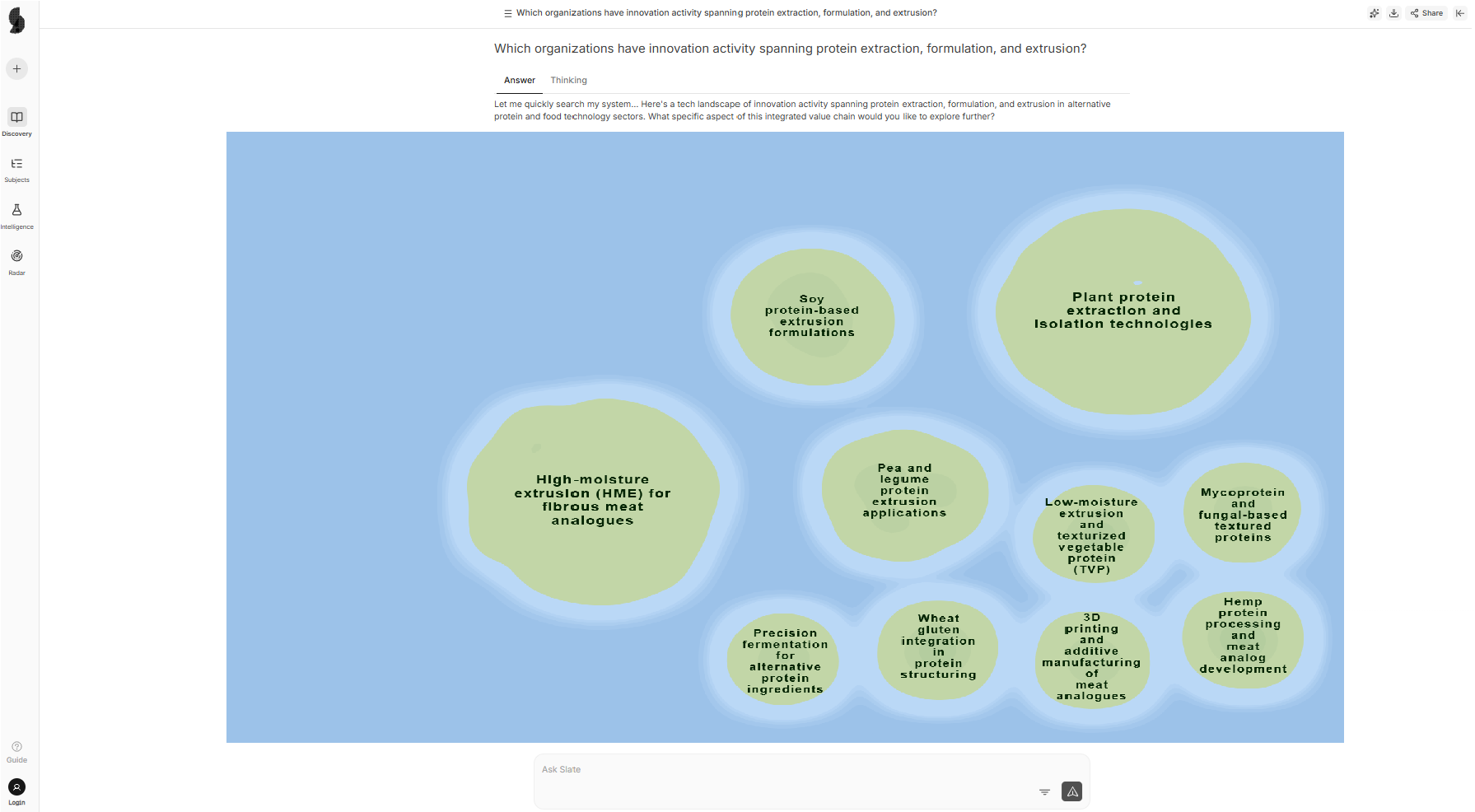
This creates an opportunity for companies to access cross-layer innovation before it becomes part of established corporate portfolios. Mid-market players can explore exclusive licensing agreements or sponsored research partnerships with universities developing integrated processes, potentially gaining access to capabilities that combine extraction methods with extrusion technologies.
Academic innovations can offer a more complete technical solution, but they still require industrial validation and scale-up. Companies must decide whether to invest early in emerging integrated platforms with higher uncertainty or combine proven commercial technologies from separate suppliers with lower technical risk.
#6: Creating Fresh-format Protein Bars by Moving Beyond the Shelf-Stability Race
The protein bar industry has largely optimized around one goal that is achieving long shelf life. But this focus on 12-month stability may be limiting innovation by forcing companies to prioritize storage performance over product experience.
Slate’s analysis identified an opportunity around high-moisture extrusion technologies that enable softer, more fibrous textures with 60–70% moisture content. Companies such as Planted Foods and Clextral are developing extrusion approaches that improve texture quality while supporting fresh formats with shorter shelf lives of around 14–21 days.
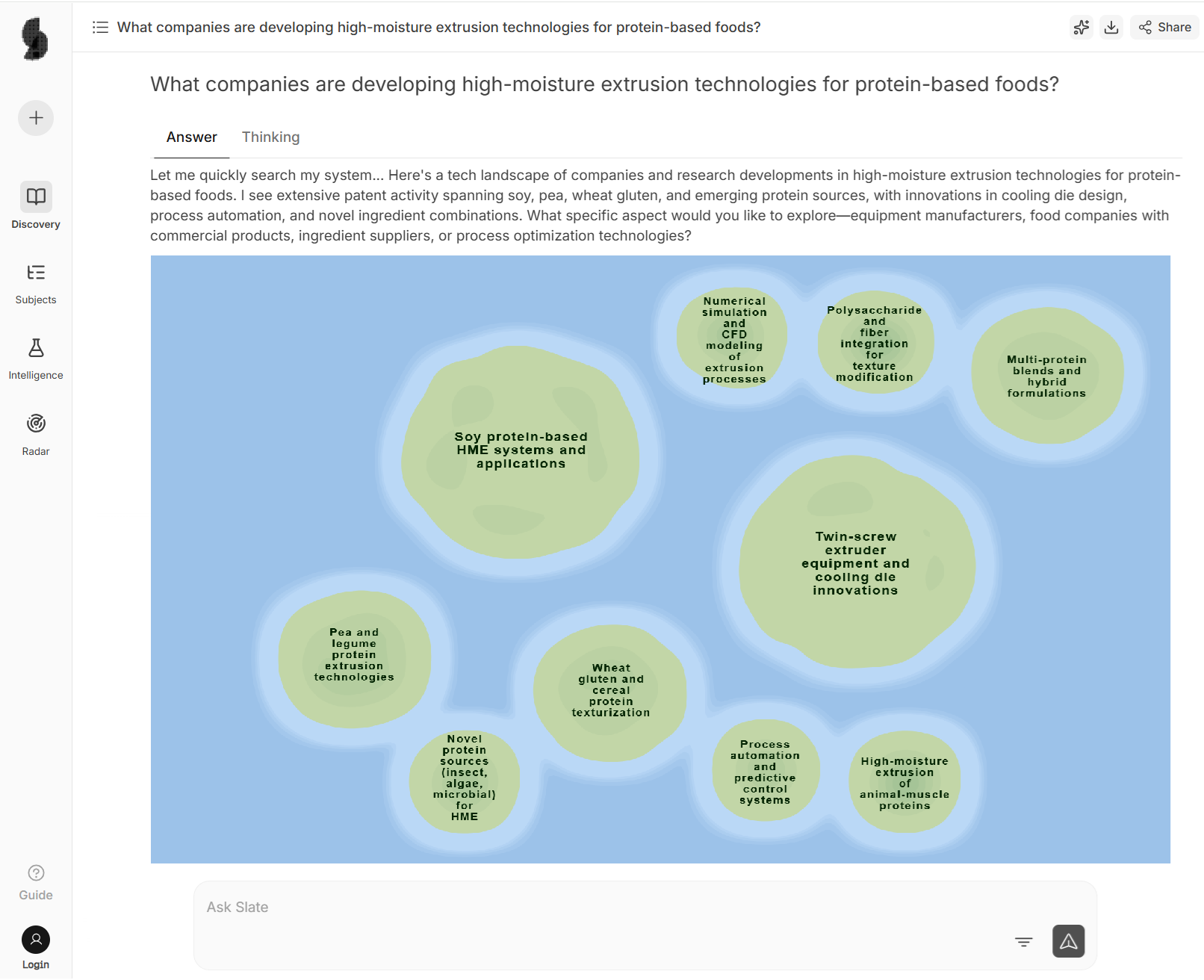
This creates a white space for companies willing to rethink the traditional protein bar format. By launching refrigerated products through channels such as prepared foods sections, grab-and-go coolers, and specialty grocery, mid-market players can compete on superior texture and eating experience rather than entering the long shelf-life optimization race dominated by larger brands.
High-moisture extrusion could allow companies to reduce years of stabilization development and bring fresh-format products to market faster. However, this approach requires a different operating model, including cold-chain infrastructure, faster inventory turnover, and the ability to achieve sufficient retail velocity to justify refrigerated distribution costs.
#7: Building Ultra-Premium Protein Bars through Small-Scale Vertical Integration
Large players have traditionally won through specialization. Ingredient companies control extraction, equipment providers develop processing technologies, and food brands focus on formulation and distribution. However, declining costs of modular processing equipment are creating an opportunity for smaller players to combine these capabilities at a focused scale.
Slate’s analysis identified emerging access to compact extraction and extrusion systems that reduce the barriers to owning a vertically integrated production setup. Equipment manufacturers such as Shandong Qiteng and Henan Shuguang are offering modular processing systems priced below $500K, making small-scale green chemistry extraction and twin-screw extrusion more accessible.
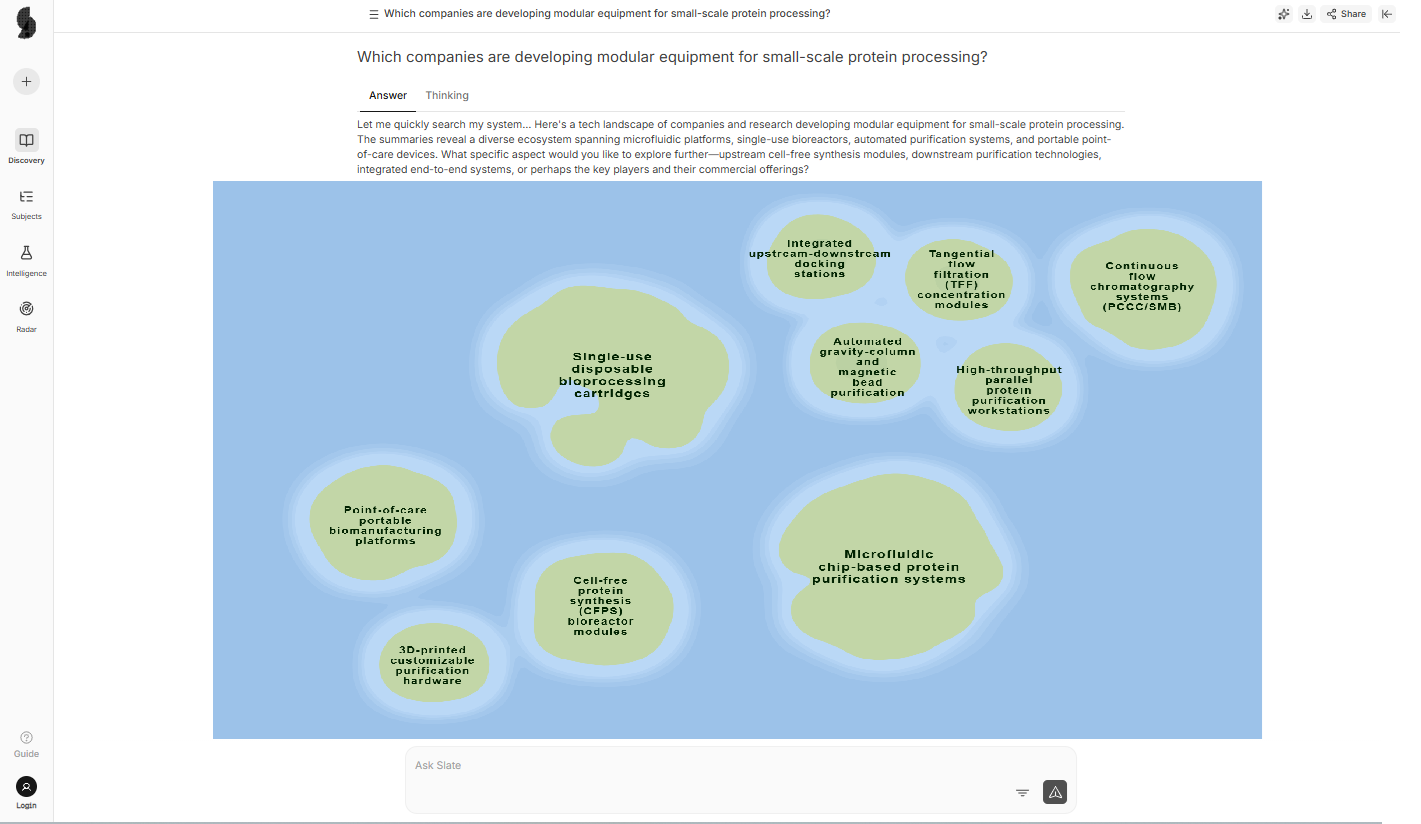
This creates an opportunity for mid-market companies to build captive micro-facilities combining aqueous extraction and extrusion within a 5,000–10,000 square foot footprint. By controlling the full process, companies can develop ultra-premium, single-origin protein bars with stronger supply chain transparency, unique product stories, and pricing advantages in specialty channels.
A vertically integrated model can enable production of 200–500 kg per day with an estimated capital investment of $1.5–2 million. However, this approach comes with a strategic trade-off. While owning the full stack can improve differentiation and margins, it may limit scalability. Companies must decide whether to build a high-margin premium brand around controlled production or pursue larger volumes that eventually require a more standardized manufacturing model.
How Slate Helps Identify the Next Manufacturing Opportunities
Finding the next innovation opportunity requires more than tracking market trends. Companies need visibility into where technologies are emerging, which players are building capabilities, and where gaps exist across the value chain.
Slate, AI-powered R&D intelligence platform for F&B, helps R&D teams uncover these signals by analyzing patents, research publications, company activity, and innovation patterns across industries. It can identify emerging technology clusters, track who is investing in specific capabilities, and reveal opportunities that may remain hidden in fragmented technical data.
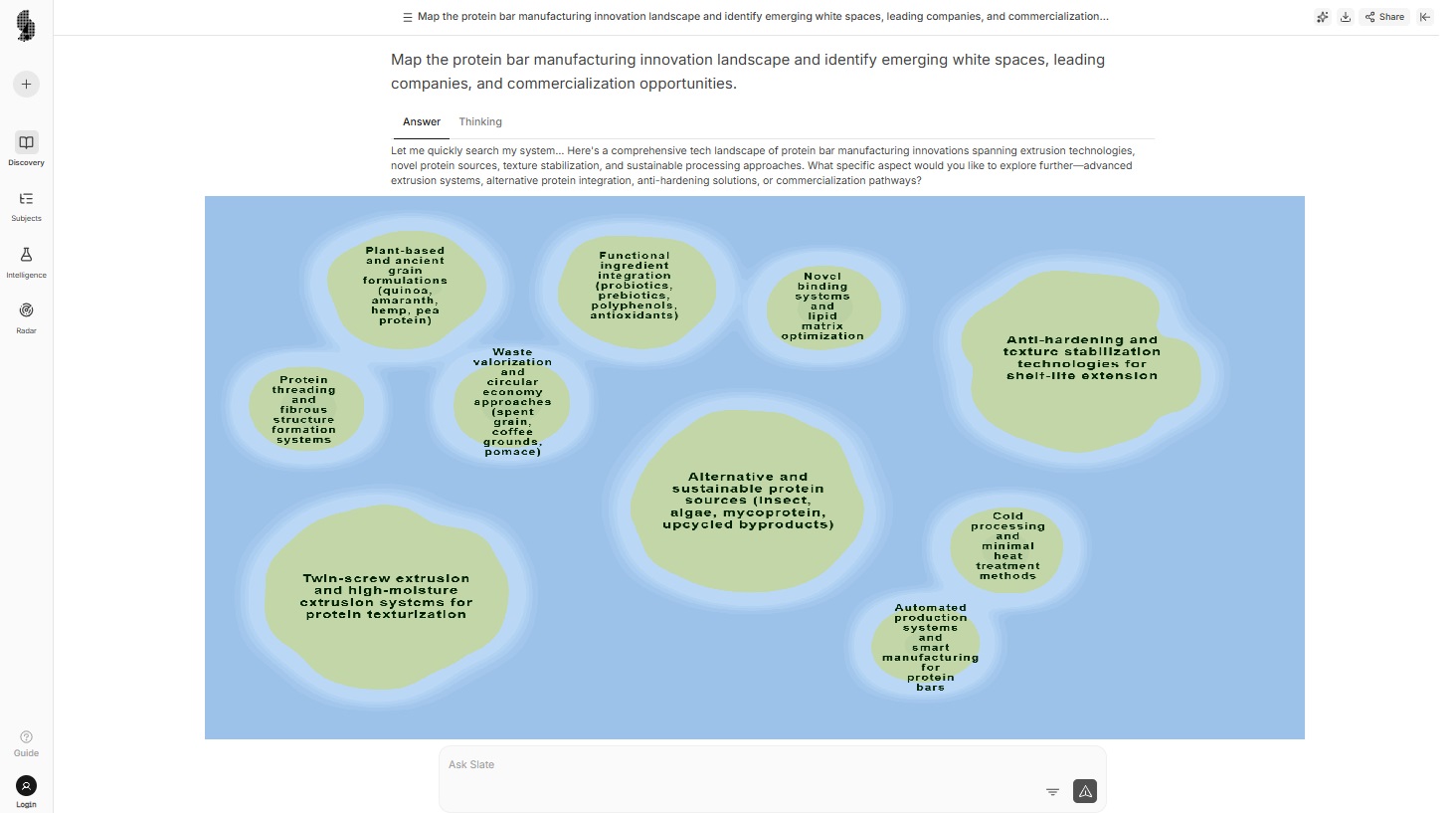
In protein bar manufacturing, Slate helped map the innovation landscape across extraction, extrusion, stabilization, and formulation to identify where activity is accelerating and where gaps are forming. This enabled the discovery of opportunities such as accessing specialized extraction capabilities, partnering with equipment innovators, licensing stabilization technologies, and exploring academic technology transfer pathways.
For R&D teams evaluating new product strategies, partnerships, or investment opportunities, Slate provides the technical intelligence needed to assess emerging technologies, identify relevant players, and make faster, evidence-backed decisions.
Frequently Asked Questions
What is the primary barrier to entering the protein bar market for mid-sized manufacturers?
The primary barrier has shifted from ingredient sourcing to controlling specialized extraction infrastructure and precision extrusion capabilities. High-purity aqueous and ethanol extraction methods that eliminate hexane while maintaining clean-label claims require either proprietary chemistry IP or toll manufacturing agreements with specialized processors like Louis Dreyfus Company or Burcon Nutrascience.
Can smaller manufacturers achieve the same texture quality as major brands without owning extrusion equipment?
Yes, through equipment vendor partnerships. Companies like Clextral and Planted Foods control the IP for high-precision rheological control through specialized nozzles and valves, and are seeking first-commercial-application partners. Mid-market players can negotiate co-development agreements for exclusive access to specific texture configurations without capital investment in hardware R&D.
How long does it typically take to bring a new protein bar to market using traditional R&D methods?
Traditional development cycles that include shelf-life stabilization R&D typically require 24-30 months. This includes 18-month shelf-life studies to optimize moisture systems and prevent protein-induced hardening. Licensing pre-validated binder formulations from specialists like Sobinsky Khlebokombinat can compress time-to-market to 12 months.
What are the capital requirements for a small-scale vertically integrated protein bar facility?
Capital costs for captive, small-scale facilities combining aqueous extraction and twin-screw extrusion have declined to $1.5-2M due to modular equipment design from Chinese manufacturers like Shandong Qiteng and Henan Shuguang. Such facilities can produce 200-500 kg per day in 5,000-10,000 square feet, sufficient for ultra-premium positioning in specialty channels.
Are fresh-format protein bars economically viable compared to shelf-stable products?
Fresh-format bars using high-moisture extrusion can command premium pricing ($4.99 versus $2.99 for ambient products) that offsets cold chain costs, but require achieving 8-12 inventory turns annually. The 14-21 day shelf life necessitates distribution through refrigerated channels where turnover velocity is already normalized, such as prepared foods sections and grab-and-go coolers.
How do regional botanical binders create competitive advantage?
Regional botanical ingredients like sprouted lentil flour, hemp hearts, or elderberry concentrate create defensible supply chains that are relationship-driven rather than commoditized. Global incumbents operating commodity procurement systems cannot easily replicate these localized sourcing networks without building entirely new infrastructure, giving regional manufacturers a sustainable moat.
What is the opportunity window for academic tech transfer in protein bar manufacturing?
The integration of extraction chemistry with extrusion mechanics remains largely in the academic phase, creating a 12-24 month commercialization window. Institutions like Northeast Agricultural University span full-stack capabilities but have not yet transferred IP to corporate players, offering mid-market entrants the opportunity to license integrated processes before vertical consolidation occurs.