The textile industry isn’t waiting for one sweeping dye ban to hit. Instead, several regulatory clocks start to overlap.
Regulators in Europe, the US, and China are all tightening the screws on legacy dye chemistries, and brands are turning sustainability commitments into hard contractual requirements. Together, they add up to something dye houses can’t ignore; a genuine, multi-year deadline to reformulate before the window closes.
That window is roughly 2027 to 2030. Here’s what’s driving it, what it’s going to cost, and what it means if you’re the one deciding whether to keep patching the old chemistry or bet on something new.
Europe Is Narrowing the Azo Dye Pool, Not Banning It Entirely
Europe is moving on several tracks simultaneously. As of February 2026, the REACH Candidate List of Substances of very high concern hit 253 substances and the list already includes dye-related entries like Reactive Brown 51.
Layered on top of that, REACH Annex XVII restricts azo colourants that release banned aromatic amines; substances like benzidine, o-toluidine, o-anisidine, and 4-aminoazobenzene among the above set concentration limits in textile and leather goods.
That distinction matters more than it might seem. “Azo-free” gets used constantly as a broad marketing claim, but it doesn’t tell an R&D or compliance team what they actually need to know: the exact dye structure, what it breaks down into, and whether that breakdown product shows up above the threshold under the prescribed test conditions. A supplier’s word that something is “azo-free” isn’t the same as data showing it passes the test, and increasingly, that gap is where the real risk sits.
It’s worth noting this doesn’t touch every azo dye: roughly 5% of the ~3,600 known azo dyes are estimated to release these restricted amines under reductive conditions, so the restriction is targeted, not blanket.
PFAS Exposure May be Hiding Outside the Dye Molecule
PFAS creates a different kind of reformulation problem.
In March 2026, ECHA’s Risk Assessment Committee adopted its hazard opinion and the Socio-Economic Analysis Committee opened a 60-day public consultation, real movement toward a restriction that could eventually cover roughly 10,000 PFAS substances, though the final rule likely won’t land before 2027. A narrower rule is already locked in: PFHxA gets capped at 25 ppb in textiles and footwear starting October 10, 2026.
The difficult part is that PFAS may not appear in the colourant name.
It can enter a textile process through wetting agents, dispersants, printing formulations, stain-resistant treatments, coatings, binders, and processing auxiliaries. A dye molecule may pass a restricted-substance review while the complete formulation still fails.
This changes how companies need to conduct substitution work. Reviewing the safety data sheet for the named pigment is not enough. Teams need visibility into the full recipe, including low-concentration additives and substances used earlier in the supply chain.
For many suppliers, that information is difficult to obtain because formulations are proprietary and different tiers of the supply chain may only see part of the chemistry.
Cr(VI) Action Puts Chromate Systems on a Shorter Clock
Chromium(VI) is another major pressure point.
The EU restriction work covers eleven Cr(VI) substances already included in the REACH Authorisation List, as well as barium chromate. This places restriction-entry window in late 2027 or early 2028, followed by an expected transition period. Because the final legal text and dates may still change, companies should treat this as a developing timeline rather than a fixed prohibition date.
The technical challenge is not simply finding a pigment with a different chemical name.
Chromate-based systems have historically been selected for properties such as brightness, opacity, heat resistance, weather stability, and durability. A replacement may meet the regulatory requirement but change shade strength, processing conditions, outdoor performance, or cost.
Lead chromate and cadmium pigments already face extensive restrictions in Europe and in product-specific rules. It estimates that replacement raw materials can cost two to six times more, depending on the application and alternative chemistry.
This is why waiting for the final Cr(VI) restriction could be risky. A legal transition period may appear sufficient on paper, but shade development, laboratory screening, mill trials, customer testing, and supplier qualification can consume much of that time.
The United States is Adding Another Layer of Scrutiny
The US regulatory track is narrower than the EU’s proposed PFAS and chromium actions, but it points in the same direction.
In December 2024, the US Environmental Protection Agency changed its new-chemicals regulations so that PFAS and certain persistent, bioaccumulative, and toxic substances could no longer qualify for low-volume exemptions. These substances must go through the full review process even when planned production volumes are small.
The EPA has also pursued risk-management action involving C.I. Pigment Violet 29 under the Toxic Substances Control Act. This does not represent a broad US ban on textile pigments, but it shows that established pigments can face renewed scrutiny based on workplace exposure, manufacturing conditions, and downstream uses.
The wider message is important for chemical suppliers: low volume, long market history, or use in a specialist application should not be treated as permanent protection from regulatory action.
China is Widening the Detection Net
China, meanwhile, isn’t just following the EU’s lead in some ways it’s gone further. The GB/T 45518-2025 adds another dimension.
The standard covers analytical determination of 53 prohibited and restricted dyes using liquid chromatography and high-resolution mass spectrometry. That is much broader than the traditional focus on 22 aromatic amines commonly associated with azo-dye compliance testing.
There is an important distinction here.
GB/T 45518-2025 is an analytical standard. It improves the ability to detect and identify specified dyes. It should not be described as a standalone ban on every substance included in the method. Mandatory Chinese product-safety requirements, including GB 18401-2010, provide the legal controls on prohibited aromatic amines and textile products placed on the market.
Still, stronger detection changes enforcement in practice.
A formulation that passes a limited aromatic-amine test may not pass a broader screen that looks directly for a larger set of restricted dyes. Exporters may therefore need to expand their testing protocols rather than assuming that REACH-oriented documentation will cover every Chinese requirement.
China’s position in the supply chain makes this more significant. It supplies an estimated 44% of global organic pigments and more than 60% of dye intermediates. The top four Chinese producers also control roughly two-thirds of the country’s disperse- and reactive-dye capacity.
China is therefore both a major source of colourant chemistry and a major compliance jurisdiction. Changes in testing, plant-level environmental enforcement, or production availability can affect buyers far beyond the Chinese market.
Brand Procurement May Move Faster than Regulation
Legal deadlines are only part of the picture.
The Zero Discharge of Hazardous Chemicals programme has more than 350 signatories, and its Manufacturing Restricted Substances List has become an important reference for chemical formulations used in textile, leather, apparel, and footwear production.
MRSL Version 3.1 became the only certifiable formulation standard within the programme in June 2024.
This matters because an MRSL focuses on chemicals used during manufacturing, not only restricted substances present in the finished garment.
A product may comply with a consumer-product limit while the chemical formulation used to make it still fails a brand’s manufacturing requirement. Large brands are also asking suppliers for more evidence. Levi Strauss requires selected factories to achieve ZDHC Supplier to Zero certification and submit chemical and wastewater reports.
H&M reported 97% MRSL compliance across 557 chemical-scope factories. Misto Holdings, the parent of FILA, has stated that it confirmed PFAS non-use with Tier 1 suppliers. That does not mean brands immediately terminate every supplier after one failure.
Corrective action plans, remediation, and continued monitoring remain common. It notes that public data does not support the idea that chemical non-compliance routinely leads to instant termination across the industry.
But the direction is clear. Chemical compliance is moving from a sustainability statement to a condition of doing business. For many dye houses, the practical deadline will be set by their largest customer before it is set by a regulator.
Compliance Costs Extend Beyond the Replacement Pigment
It is easy to describe substitution as a purchasing decision: remove one dye and buy another. In reality, the new raw material may be the smallest part of the cost.
A replacement can require reformulation work, shade matching, repeated dye-lot trials, changes to pH or temperature, new binders, revised wastewater treatment, customer approval, and new analytical testing. Where wastewater requirements push a facility toward zero-liquid-discharge systems, the report estimates capital expenditure of approximately $1.1 million to $1.9 million. This sits alongside the two- to six-fold raw-material increases possible for some restricted pigment replacements.
Supply concentration adds another cost.
If a compliant alternative is available from only one region or a small number of producers, companies may need to hold more inventory, qualify a second source, or accept longer lead times. This estimates that concentration and disruption risk can raise safety-stock requirements by 15% to 30%.
The cheapest alternative per kilogram may therefore be the more expensive option once process changes, quality risk, working capital, and customer requalification are included.
So Who Actually Wins This Window?
Here’s the tension at the center of all this: regulatory pressure is creating real forced-substitution demand, but that demand only gets captured by alternative dye technologies if those technologies are ready in time.
If they’re not, incumbents will simply reformulate their existing synthetic chemistries around the new restrictions and keep the market as-is.
Bio-based indigo platforms are the farthest along companies like Huue, Pili, and Stony Creek Colors have already demonstrated drop-in compatibility with existing denim dyeing equipment, and Pili shipped roughly 100,000 commercial units back in January 2025.
Structural color technologies (think VIAVI’s ChromaFlair or newer photonic crystal approaches) are compelling on durability grounds but remain mostly pre-commercial for textiles, held back by capital intensity that’s 10–40x higher than a conventional dye plant. Both of those are worth their own deep dive but the short version is: the alternatives exist, they’re just racing the clock.
What This Means If You’re Making the Call
If you’re sitting in an R&D or procurement seat right now, the useful way to think about this isn’t “is my dye chemistry currently compliant?”
It’s “will it still be compliant in 2028, and what’s my plan if it isn’t.”
The 2027–2030 window isn’t a single soft deadline you can push back informally. It’s a stack of hard ones: PFHxA in October 2026, Cr(VI) sometime in late 2027/early 2028, PFAS universal restriction likely 2027 or later, and China’s expanded standard already in force. Waiting for total clarity before acting means waiting until several of these deadlines have already passed.
The companies that come out ahead here probably won’t be the ones with the most elegant compliance strategy, they’ll be the ones that started evaluating alternatives early enough to have real options when the window actually closes.
What to Follow Next?
The first step is not selecting an alternative, but its about understanding the full exposure.
Companies should map dyes, pigments, dispersants, surfactants, carriers, binders, mordants, coatings, printing agents, and finishes at the substance and formulation level.
They should then separate the portfolio into four groups:
- Substances already restricted
- Substances with a confirmed future effective date
- Substances under active regulatory review
- Substances still legal but excluded by customer standards
This distinction prevents teams from treating every regulatory signal as an immediate ban. It also prevents them from postponing work on substances that may remain legal but are already commercially difficult to sell.
Alternative screening should begin on the final substrate, not only in a laboratory solution. Researchers need to measure shade consistency, colour strength, wash and rub fastness, light stability, fibre compatibility, process conditions, wastewater impact, and total production cost.
Supplier evidence matters as much as technical performance. Teams should request formulation-level disclosure, test certificates, MRSL conformance, manufacturing location, capacity, and advance notice of formulation changes.
Finally, companies should avoid replacing one regulatory dependency with a supply dependency. An excellent compliant pigment is still a weak solution when it comes from one plant, one country, or one protected manufacturing pathway.
The Deadline is Regulatory, But the Opportunity is Competitive
The 2027–2030 window is not one universal deadline.
Some restrictions are already active. Others have fixed implementation dates. Several are still progressing through regulatory review. Brand procurement rules may move sooner than all of them.
What makes this period important is the overlap.
Companies that begin early have more room to compare alternatives, negotiate with suppliers, run production trials, and reserve capacity. They can also decide where compliant synthetic reformulation is sufficient and where a bio-based or structural-colour platform could create a longer-term advantage.
Companies that wait for every rule to become final may still meet the legal date, but miss the commercial one.
Use SLATE to Find Which Alternatives are Ready for your Application
Dye substitution is a cross-source research problem. Regulations show which chemistries are coming under pressure. Patents show where suppliers and startups are protecting new pathways.
Research papers show whether the performance claims hold up. Product and supplier data show which alternatives have moved beyond the laboratory. Using SLATE, an AI-powered R&D intelligence platform we connected these scattered signals to identify which dye alternatives are commercially ready, which still need validation, and where the strongest opportunities lie.
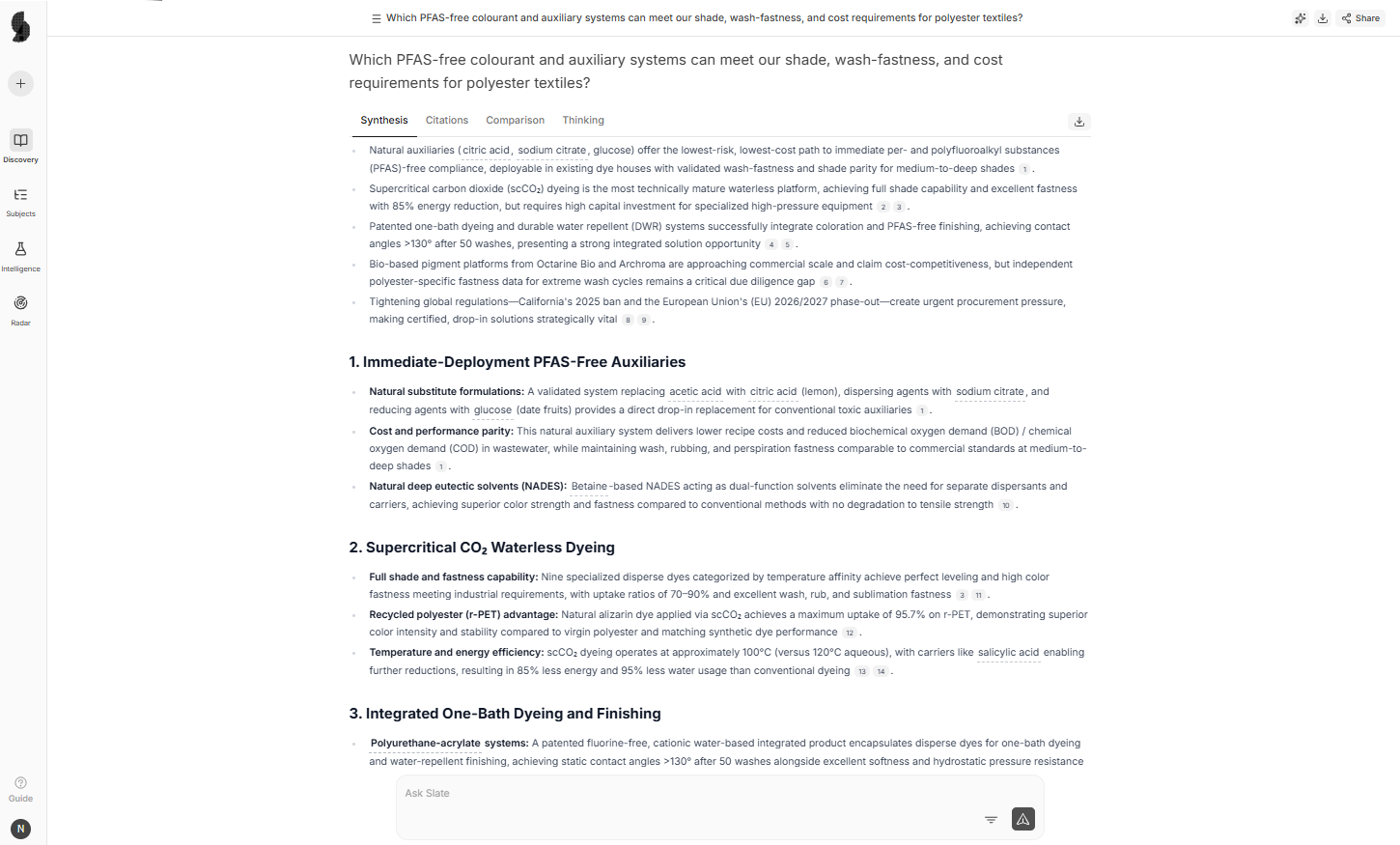
SLATE brings these sources into one research environment, helping R&D teams connect patents, technical literature, product evidence, and competitive activity instead of reviewing each source in isolation.
Book a demo and see how Slate can map the regulatory risks, technical alternatives, suppliers, and supporting evidence around your own dye reformulation challenge.