
The FDA’s December 2024 final rule has changed what beverage brands can call “healthy.” By February 25, 2028, fortified fruit punch and vitamin-spiked beverages that lack real food-group content may no longer qualify for the claim.
In Europe, the pressure is different but related. EFSA’s preservative re-evaluations have flagged flavored drinks as key contributors to sorbate and benzoate intake in children. In one scenario, children aged 3–9 reached 3.7 mg/kg body weight per day for sorbates, above the temporary group ADI of 3 mg/kg body weight per day.
These are not identical deadlines. Only the FDA rule carries a February 2028 compliance date. But together, they point to the same reformulation problem: beverage brands can no longer rely on fortification for a health halo while depending on high preservative loads for ambient shelf life.
For R&D teams, this is not a label update. It is a formulation, processing, and packaging decision.
Why the pressure is shifting from claims to formulation design
The FDA’s updated “healthy” rule shifts the qualification logic. Fortification alone is no longer enough. Products must contain required Food Group Equivalents from at least one food group and meet limits for added sugars, sodium, and saturated fat.
This matters for beverages because many “better-for-you” drinks sit in a grey zone. They may contain vitamins, minerals, electrolytes, botanicals, or functional ingredients. But they may not contain enough fruit, vegetable, dairy, grain, or protein food content to meet the new rule.
Beverages with fewer than 5 calories per RACC have a clearer route. This benefits plain water, unsweetened RTD tea, and similar low-calorie formats. But sweetened functional drinks, fortified punches, and vitamin-led refreshment beverages face a harder test. If the product does not contain meaningful food-group content, the “healthy” claim becomes harder to defend by 2028.
The EU side creates a different kind of pressure. EFSA has not created a matching 2028 deadline for beverage preservatives. But its exposure assessments show why regulators and retailers may keep tightening scrutiny around sorbates and benzoates, especially in products consumed by children.
For beverage brands, the message is clear. The old model of “add vitamins, add preservatives, and claim better-for-you” is getting weaker. The new model needs real food-group content, lower preservative dependence, and proof that the product remains safe and stable over shelf life.
The EU preservative signal matters, but it is not a 2028 deadline
The EU side should be framed with care. It is not correct to say that EU preservative limits create the same February 2028 deadline as the FDA rule.
The stronger argument is this: EU additive reviews show that preservatives remain under active review, and beverage brands should expect closer scrutiny around preservative use, exposure, and technical specifications.
For sorbates, EFSA first set a temporary group ADI of 3 mg/kg bw/day in 2015. But after new data, EFSA later changed that to a group ADI of 11 mg/kg bw/day for sorbic acid and potassium sorbate, with exposure estimates below the new ADI for all population groups. The European Commission’s 2024 regulation then updated specifications for sorbic acid and potassium sorbate, including tighter limits for certain impurities.
Benzoates remain a more relevant exposure signal for flavored beverages. EFSA’s re-evaluation of benzoic acid and benzoates found that the group ADI was exceeded in brand-loyal scenarios, especially for toddlers and children who regularly consume flavored drinks.
So the EU story is not “reformulate by 2028 or lose access.” It is more practical than that. If a brand sells flavored drinks for children or family consumption, it should review preservative exposure and reduce avoidable dependency where possible.
Why preservative reduction cannot be treated as a drop-in swap
Removing benzoate or sorbate may look like a clean-label win. Technically, it shifts the entire stability burden onto the rest of the system.
Synthetic preservatives help control yeasts, molds, and spoilage bacteria over long ambient storage periods. Once they are reduced or removed, R&D teams must depend on pH, thermal processing, HPP, aseptic filling, oxygen control, UV protection, and biopreservative hurdles.
This is where many reformulation plans break down.
Cultured dextrose, for example, can inhibit yeasts such as Zygosaccharomyces bailii at pH ≤4.2. But it shows only static effects against mold spores such as Aspergillus brasiliensis, Byssochlamys nivea, and Penicillium roqueforti. Natural glycolipids at 5–15 ppm show strong effects against Z. bailii and some spoilage lactic acid bacteria, but fungal spores remain a gap.
That means biopreservatives should not be treated as drop-in replacements for benzoate or sorbate. They are supporting hurdles. They may work well in one matrix and fail in another.
There is also a supplier transparency problem. Commercial cultured dextrose products can vary from 10% to 50% propionate content. Propionate is one of the key metabolites linked to mold inhibition. Yet many technical data sheets do not clearly state the active metabolite concentration. Without batch-level certificates of analysis, two products both labeled “cultured dextrose” may behave very differently in a challenge study.
Sensory limits reduce the usable range further. Cultured dextrose can be detected at 0.1%, with tart, astringent, and mildly bitter notes. Fermented whey is harder to use in low-pH beverages. In one study, 77.5% of panelists rated the off-flavor in unflavored fermented whey beverages as “too much,” and the issue worsened during storage.
The practical takeaway: do not select a biopreservative before validating it in the actual beverage system. Test against mold, preservative-resistant yeast, and spoilage LAB. At minimum, challenge studies should include Aspergillus niger, Z. bailii, and Lactiplantibacillus plantarum.
Where HPP works, and where it creates new risks
High Pressure Processing remains a strong option for high-acid beverages. It protects sensory quality better than many thermal processes and can deliver strong microbial reductions in the right matrix.
But HPP is not universal.
For low-acid beverages, especially products above pH 4.6, HPP should not be treated as a standalone validated lethality step unless the brand has product-specific validation and controls for the relevant hazards. FDA enforcement history shows why this matters.
In the Liberty Fruit/Carol’s Cuts case, formulation changes affected pH and Brix, but the process was not revalidated. In the Barsotti Juice case, the HACCP plan was found inadequate for addressing Clostridium botulinum risk in low-acid carrot juice. The lesson is simple: even small pH, Brix, or water activity changes can affect microbial resistance and trigger the need for revalidation.
There is also a commercial constraint. HPP tolling capacity is consolidating. Universal Pure now controls 23 HPP machines across seven US sites after acquiring Texas Food Solutions and Dora’s Naturals. That gives larger operators more influence over scheduling, pricing, and access.
For emerging brands, this matters. Reformulation timelines are already tight. If tolling slots become harder to secure, HPP may move from a technical option to a supply chain bottleneck.
Why acidified hot-fill may be the most practical near-term route
For many beverage brands, the most practical near-term route is still acidified hot-fill-hold.
At pH ≤4.6, acidified beverages can operate under the established framework of 21 CFR Part 114. A hot-fill-hold process, typically around 180–200°F for 2–5 minutes, is not new. But that is exactly why it matters. It is commercially proven, widely understood, and easier to validate than many emerging clean-label systems.
The trade-off is sensory impact. Heat can affect color, vitamins, polyphenols, flavor, and aroma. For premium fresh-positioned beverages, this may be unacceptable. For many RTD teas, juices, and acidified functional drinks, it may be the fastest way to reduce preservative dependence without overcommitting capital.
The key is discipline. The formula must stay within validated pH, Brix, and water activity ranges. Any reformulation, new sweetener system, fruit base change, or acidulant change should trigger a fresh review of microbial and chemical stability.
Packaging now has to carry part of the shelf-life burden
Preservative-free shelf life is not only about killing microbes. It is also about preventing oxidation and light-driven degradation.
Standard monolayer PET is not enough for many 12-month ambient claims. The report notes that a 0.5 L PET bottle can accumulate about 10 mg/L oxygen over four months. That level of oxygen ingress can degrade vitamin C, polyphenols, colorants, and flavor compounds.
For preservative-free beverages in PET, active packaging becomes part of the preservation system. Brands may need oxygen scavengers embedded in the PET matrix, targeting OTR values below 0.001 cc/pkg/day. UV absorbers may also be needed, especially when vitamins, botanicals, natural colors, or polyphenols are part of the claim structure.
This is not a supplier-spec exercise. Brands should commission MOCON-certified OTR testing on the specific bottle design, resin, scavenger loading, closure system, and process condition. Packaging claims that work in a brochure may not hold after HPP, hot-fill, transport, and retail storage.
Aseptic PET can enable preservative-free shelf life, but the economics are harder
Aseptic PET is often positioned as the cleanest answer: no preservatives, ambient distribution, and longer shelf life.
But the economics are not simple.
The public evidence base for 18-month zero-preservative aseptic PET beverages remains thin. The longest documented customer reference in the reviewed material is nine months for UHT dairy at RJ Corp in India, using Sidel Combi Predis equipment. That does not mean 18 months is impossible. It means brands should demand product-specific challenge studies and accelerated aging data before using 18-month assumptions in the business case.
The total cost of ownership is the bigger concern. Sterile water generation can cost $0.15–0.40 per cubic meter. Over a 15-year operating life, that OPEX can exceed the original CAPEX by 2–3×. Reverse osmosis systems add capital and replacement costs. Biofilm management adds another variable, especially as gaskets, valve seats, and other rubber components age.
Dry aseptic systems can reduce some of this burden. Sidel Predis uses less than 0.7 liters of hydrogen peroxide per hour and avoids water rinsing. GEA ECOSpin2 can reduce water use through closed-loop peracetic acid recovery. But the key question remains: does the TCO advantage hold at lower volumes and higher SKU complexity?
For large brands with high-volume, stable SKUs, aseptic PET may be the right investment. For smaller brands or innovation SKUs, it can lock capital into a system before demand is fully proven.
Which reformulation route fits which beverage type?
| Product Type | Likely Pathway | Main Risk |
| Unsweetened RTD tea or coffee | FDA “healthy” claim route is clearer if calorie criteria are met | Differentiation may depend more on claims, format, and functionality |
| Acidified RTD tea, juice, or functional drink | Hot-fill-hold + active PET | Heat impact on flavor, color, and actives |
| Premium fresh-positioned beverage | HPP tolling | Capacity access, cost, and revalidation after formula changes |
| Low-acid functional beverage | Aseptic/UHT | CAPEX, TCO, and long validation timelines |
| Biopreservative-led formulation | Multi-hurdle system | Mold gap, sensory limits, and supplier variability |
| Pediatric family flavored drink in EU markets | Preservative exposure review + reformulation planning | Retailer scrutiny and tighter internal risk thresholds |
What R&D teams should do now
Start with a claim audit. Identify every SKU that uses or may use the “healthy” claim in the US. Check whether it has enough qualifying food-group content. Do not assume added vitamins or minerals will protect the claim after February 2028.
Then run a preservative exposure review. Prioritize flavored drinks, RTD teas, juices, and family-positioned products using sorbates or benzoates. The EU does not create a matching 2028 deadline, but EFSA’s child exposure findings create a strong reason to reduce dependency on these preservatives where possible.
Next, map the portfolio by pH. Products already at or below pH 4.6 have more near-term options. Products above pH 4.6 need a harder decision: reformulate into the acidified zone, move toward aseptic/UHT, accept refrigeration, or reconsider the claim and channel strategy.
After that, validate the preservation system. Do not rely on supplier data sheets for cultured dextrose, fermented whey, nisin, natamycin, or other biopreservatives. Ask for batch-level COAs. Run product-specific challenge studies. Confirm mold, yeast, and spoilage LAB control over the target shelf life.
Finally, validate the package. Preservative-free beverages need oxygen and UV control. Active scavenger PET, UV absorbers, nitrogen flushing, or other barrier systems should be tested in the final bottle and closure format.
The Real Bottleneck is Not Regulation. It is Validation.
The 2028 deadline belongs to the FDA’s “healthy” rule. The EU preservative issue is not the same kind of deadline. But both signals push beverage brands toward the same strategic question: which products can be reformulated with real food-group content, lower preservative dependence, and validated shelf-life stability before the market moves?
There is no single winning route. Biopreservatives help, but they do not close every microbial gap. HPP works well for high-acid beverages, but capacity and revalidation matter. Aseptic PET can support preservative-free ambient products, but only when the volume and TCO make sense.
For many brands, the most de-risked near-term pathway is pH ≤4.6 acidified formulation with hot-fill-hold processing, paired with active oxygen and UV barrier packaging. It is not the most novel route. It is the route with the clearest commercial validation.
The brands that move early will have time to test, fail, adjust, and validate. The brands that wait may find that the real bottleneck is not the regulation. It is the time needed to prove that the new formula is safe, stable, scalable, and still worth buying.
How Slate Helps Beverage R&D Teams Choose the Right Reformulation Path
Beverage teams already know the 2028 FDA “healthy” deadline is coming. The harder question is what to do next. Which SKUs are most exposed? Which claims need to change? Which formulas can be fixed through food-group content or sugar reduction? Which products need a deeper preservation rethink? And which clean-label technologies are actually validated beyond supplier claims?
SLATE, an AI-powered R&D intelligence platform helps answer these questions with evidence. It connects regulatory updates, patents, scientific papers, ingredient supplier activity, startup movement, competitor launches, and market signals in one place. This gives R&D and innovation teams a clearer view of which reformulation paths are mature, which are still experimental, and which ones fit their product constraints.
For example, if a beverage team is evaluating alternatives to benzoate or sorbate, Slate can help compare cultured dextrose, nisin, natamycin, enzymatic systems, HPP, hot-fill, aseptic PET, active oxygen scavengers, and UV barrier packaging. It can show where each route has evidence, where it has organism-specific gaps, and where commercial validation is still weak.
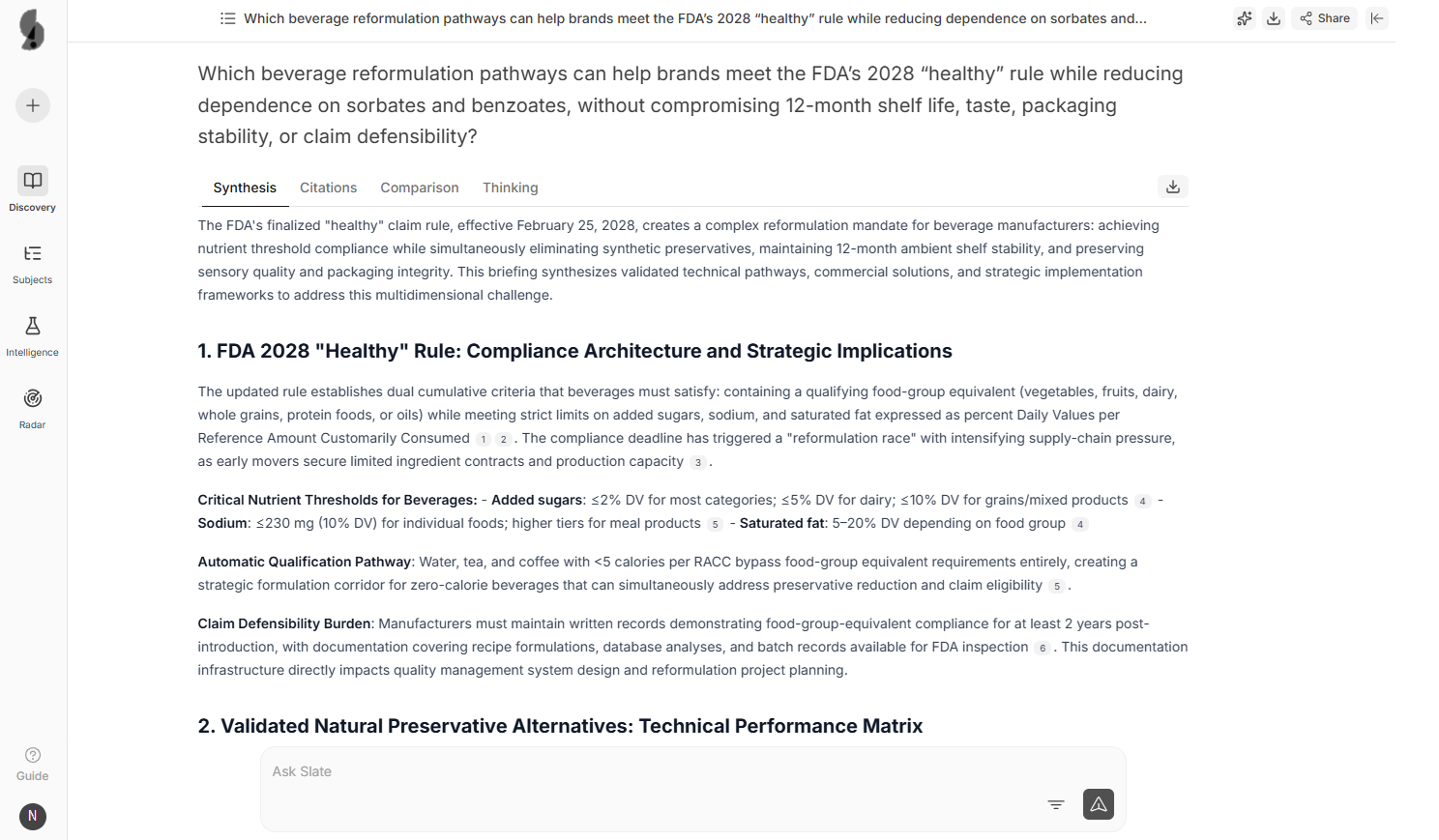
That matters because clean-label reformulation is not only about replacing one ingredient. It affects shelf life, taste, packaging, process conditions, supplier selection, capital investment, and claim defensibility. A wrong bet can waste months in challenge studies or force a late-stage pivot when the product fails mold, yeast, oxidation, or sensory testing.
Slate helps teams move faster by turning scattered evidence into a practical reformulation roadmap. It can help identify which products need urgent review, which technologies deserve testing, which suppliers should be shortlisted, and which claims need regulatory caution. Instead of treating reformulation as a late-stage compliance task, Slate helps teams identify the right technical route early, before shelf-life failures, supplier gaps, or claim risks force a costly pivot.