
Technology scouting is supposed to give R&D teams a head start from spotting emerging technologies to solving technical problems. Yet a lot of scouting projects land in the same place: a deck of patents, papers, companies & technology concepts but no clear decision.
Companies have more research, patents, funding, and external innovation available to them than ever. But more information doesn’t automatically make scouting better. The problem isn’t a shortage of innovation but turning fragmented technical information into clear, evidence-backed choices.
That requires a more connected approach, one that combines precise problem framing, cross-industry discovery, technical and commercial evaluation, traceable evidence, and continuous monitoring. Platforms such as Slate are designed around this need, helping teams move beyond disconnected search results and toward research that supports a decision.
So, why do most technology scouting projects still fail, and what can R&D teams do differently? Let’s get into details.
Technology Scouting Usually Fails After Discovery
A scouting project has not succeeded simply because it identified 50 startups, 200 patents, or a promising new material.
Those findings are useful, but they are still inputs.
Successful technology scouting should help the organization answer questions such as:
- Which technology best fits our technical requirements?
- Is it mature enough to test?
- Who owns the relevant intellectual property?
- Can it work with our equipment and processes?
- What evidence supports its claimed performance?
- Should we develop it internally, license it, partner with its developer, monitor it, or reject it?
The real output of technology scouting is not a landscape. It is a defensible next action.
Here is where that process most often breaks down.
1. The Scouting Brief Defines a Topic, Not a Decision
Suppose your stakeholder asks the team to look into “sustainable packaging technologies.” It may sound reasonable but it’s far too broad.
- What kind of sustainability improvement does the company need?
- Is the priority recyclability, compostability, lower material consumption, renewable feedstock, or reduced production emissions?
- What barrier performance is required?
- Which machinery must the solution work with? What cost increase is acceptable?
Now without those details, almost every result can appear relevant.
The team may spend weeks examining bio-based polymers, barrier coatings, mono-material structures, chemical recycling methods, reusable systems, and lightweighting technologies. All of them relate to sustainable packaging, but only a small number may address the company’s actual challenge.
A better way to frame the brief
Turn the topic into a decision statement:
“We need to identify recyclable barrier solutions for food packaging that meet specified oxygen and moisture transmission requirements, tolerate our existing sealing conditions, comply with target-market regulations, and can enter pilot testing within 12 months.”
That version gives the team something concrete to evaluate against: application, constraints, success criteria, and the decision the research needs to support.
A strong scouting brief should make five things clear:
- The problem being solved
- The conditions under which the solution must work
- The non-negotiable requirements
- The acceptable trade-offs
- The decision the research must support
The difference between a weak scouting project and a strong one usually isn’t the search tools. It’s the quality of the starting question.
2. Teams Assume More Search Results Mean Better Scouting
Scouts naturally want comprehensive coverage. Nobody wants to discover later that an important patent, startup, or technical approach was overlooked.
But that instinct is exactly what creates the breadth trap.
The team pulls in more results, expands the taxonomy, adds another database, tacks on another batch of companies. The landscape grows. The recommendation doesn’t get any clearer.
A 2025 study in Scientometrics, covering 268 listed high-tech companies and 1,482 firm-year observations, found that both search breadth and search depth have an inverted-U relationship with innovation performance. In other words, broader and deeper searching helped up to a point, after which additional search activity produced diminishing or negative returns. The study does not describe every scouting project, but it supports a familiar practical reality: beyond a certain point, search complexity can grow faster than decision value.
A better way to structure search breadth
Instead of attempting to map everything equally, divide the research into three rings:
- The core search covers technologies that directly address the stated problem and satisfy most of the mandatory requirements.
- The adjacent search covers approaches developed for related applications or industries that may be transferable.
- The frontier search covers early-stage or unconventional approaches that do not yet meet every requirement but may become relevant later.
This structure preserves the possibility of unexpected discovery without allowing exploratory results to overwhelm the technologies that are ready for action. The objective is not the maximum number of results. It is enough coverage to make a confident comparison.
3. Patents, Papers, Products, and Companies Get Researched Separately
Technology scouting rarely depends on one source.
A research paper may explain why a technology works. A patent can reveal who is protecting the underlying method. A product page may show that the technology has reached the market. A funding announcement can indicate whether a developer is preparing to scale. Regulatory information may determine whether the technology can be used in the target application.
Yet these sources are often researched separately.
One analyst searches patents. Another reviews scientific literature. Someone else maps startups, suppliers, and products. The findings are eventually combined in a spreadsheet or presentation.
That manual consolidation creates several problems:
- The same technology may appear under different names.
- A patent owner may not match the company’s current name.
- Scientific evidence may not be connected to commercial claims.
- Product launches may not be linked to the underlying intellectual property.
- Contradictions between sources may be missed.
- Researchers spend more time organizing documents than interpreting them.
A list of papers and a list of patent owners do not automatically create a technology assessment.
Build an evidence chain instead
For every shortlisted technology, connect the information in one sequence:
| Scientific mechanism → performance evidence → intellectual property → active developers → commercial use → adoption barriers → recommended action |
This evidence chain helps the team understand not only what the technology is, but also how far it has progressed, who controls it, and what would be required to use it.
4. Keyword Search Only Finds What You Already Know to Look For
Keywords help, but they’re limited to whatever terminology the researcher happens to type in.
That becomes a problem when different industries use different terminology for the same function. A packaging company, pharmaceutical manufacturer, electronics business, and medical-device developer may all work on moisture protection, surface adhesion, thermal stability, or controlled release but describe those problems in completely different ways.
A scout searching only for familiar industry terms may therefore miss a technically relevant solution from an adjacent sector.
This is one reason cross-industry scouting often looks obvious in hindsight. The solution existed, but nobody searched using the language of the industry in which it was developed.
Search for functions, not only technology names
Instead of beginning with a fixed list of solution terms, start with what the technology must do.
For example, a search for “sustainable barrier film” could be expanded into functional questions such as:
- How can oxygen transmission be reduced?
- How can moisture migration be controlled?
- How can incompatible materials be bonded without permanent multilayer structures?
- How can barrier performance be maintained after recycling?
- How can a coating be removed or separated at the end of use?
Functional searching creates more pathways into patents and research from other industries. It also makes it easier to discover technologies that solve the underlying problem through an approach the team had not considered.
5. A Promising Technology Gets Mistaken for a Usable One
Scouts naturally gravitate toward impressive technical performance, a material with exceptional barrier properties, a catalyst that boosts reaction efficiency, a manufacturing method that cuts energy use under controlled conditions.
But technical promise is only part of the picture. A technology can perform beautifully and still be a dead end because:
- It depends on raw materials that aren’t readily available
- It requires major equipment changes
- It can’t scale to commercial volumes
- The cost outweighs the value it creates
- The IP is hard to license
- It runs into regulatory limits
- Performance drops under real operating conditions
- It doesn’t fit the existing product portfolio
The real question isn’t “does this technology work?” It’s “does this work well enough, under our conditions, at an acceptable cost and risk?”
How to fix it
Score every shortlisted technology across multiple dimensions instead of giving it one overall rating. A practical model might look like this:
| Evaluation Area | Suggested Weight |
| Strategic Fit | 20% |
| Technical Performance | 20% |
| Evidence Quality | 15% |
| Maturity & Scalability | 15% |
| IP & Regulatory Position | 15% |
| Commercial & Operation Fit | 15% |
Adjust the weights to the project. A regulated industry might weigh safety and regulatory evidence more heavily; a manufacturing-heavy project might prioritize scalability and equipment fit.
6. Conclusions Show Up Without Traceable Evidence
A polished summary isn’t the same thing as reliable intelligence.
This matters more now that R&D teams lean on generative AI to speed up research. General-purpose AI is genuinely useful for brainstorming search directions, getting up to speed on unfamiliar concepts, and drafting an initial list of possibilities. But a fluent answer can still hide weak evidence, outdated information, missing context, or a misread patent.
If scouting conclusions are going to support an investment, licensing, regulatory, or stage-gate decision, the evidence needs to hold up under scrutiny. Decision-makers should be able to ask:
- Which patent backs this ownership claim?
- Which experiment backs this performance number?
- Was it demonstrated in a lab, a pilot, or a commercial setting?
- Is the source current?
- Is there contradictory evidence?
- Does the paper actually test the same material, process, or application in question?
How to fix it
Tie every material conclusion back to its source, and separate:
- Verified facts: directly supported by reliable evidence
- Interpretations: reasonable conclusions drawn from multiple sources
- Assumptions: points that still need validation
- Unknowns: gaps that could change the decision
That makes uncertainty visible instead of burying it in polished language.
7. The Final Output Is a Static Report
Many technology landscapes are treated as one-time projects.
The research is conducted, the presentation is delivered, and the project is closed. Meanwhile, new patents are published, research results appear, companies change direction, and early-stage technologies move closer to commercialization.
The report may still be accurate, but it gradually becomes less useful.
This is especially risky when a field is moving quickly or when the decision will not be made immediately. A technology rejected because it was too immature may become viable. A previously open intellectual-property position may change. A new regulatory decision may alter the attractiveness of an approach.
ISO 56006 treats strategic intelligence as a managed capability supporting innovation activities, rather than merely an isolated information-gathering exercise. That framing is useful for technology scouting: intelligence should continue to inform decisions as conditions change.
Convert the landscape into a monitoring system
At the end of the initial project, identify what should be watched:
- New patent families
- Patent ownership changes
- Research milestones
- Clinical or performance evidence
- Pilot and manufacturing announcements
- Partnerships and licensing agreements
- Regulatory developments
- Competitor product activity
- Funding and expansion signals
Monitoring should also include decision triggers.
For example, a technology could return for review when it reaches pilot scale, receives approval in a target market, demonstrates a required performance threshold, or gains a manufacturing partner.
That turns “monitor this technology” from a vague recommendation into a defined future action.
8. Nobody Owns the Opportunity After Discovery
This is where many strong scouting projects lose their value.
The research team identifies a promising opportunity. Stakeholders agree that it looks interesting. The presentation is circulated.
Then nothing happens.
There is no named owner, no pilot budget, no outreach plan, and no date for the next decision. The opportunity must compete with internal programs that already have teams, resources, and executive support.
External technologies are particularly vulnerable during this handoff because they often sit between departments. R&D may expect business development to make contact. Business development may wait for technical validation. Procurement may need clearer specifications. Legal may not become involved until much later.
Without ownership, even a well-supported recommendation becomes another item in the innovation backlog.
Every opportunity needs a disposition
A shortlisted technology should end with one of four clear outcomes:
- Advance: Move into technical validation or a pilot.
- Engage: Contact the developer, owner, supplier, or research group.
- Monitor: Track defined signals until the technology reaches a threshold.
- Reject: Record why the opportunity does not fit.
Each outcome should include a named owner, a next milestone, a decision date, and the evidence still required.
A documented rejection is valuable too. It prevents another team from repeating the same search without understanding why the technology was previously excluded.
What a Decision-Ready Technology Scouting Process Looks Like
Better technology scouting simply means designing the research around the decision from the beginning.
Step 1: Start with a Decision
Define what the business must decide and when.
The project may need to support a build-versus-buy decision, identify candidates for a partnership, select a process for pilot testing, or determine whether an emerging field deserves continued monitoring.
The clearer the decision, the easier it becomes to determine what evidence is relevant.
Step 2: Define the Constraints
Separate the requirements into four groups:
- Mandatory criteria
- Preferred characteristics
- Acceptable trade-offs
- Reasons for immediate rejection
This prevents the evaluation criteria from changing every time the team finds an exciting technology.
Step 3: Search Across Connected Evidence Sources
Research patents, scientific papers, developers, products, regulatory records, and commercial activity as parts of the same question.
The purpose is not to produce six separate lists. It is to understand how the technical, legal, and commercial evidence fits together.
Step 4: Map Supporting & Opposing Evidence
Scouting teams often collect evidence that supports an opportunity while giving less attention to its limitations.
A stronger process actively searches for:
- Failed experiments
- Poor performance conditions
- Scale-up problems
- Conflicting research
- Expired, abandoned, or narrow patents
- Supply-chain constraints
- Regulatory concerns
- Commercial attempts that did not succeed
Contradictory evidence is not noise. It is often the information that prevents a costly decision.
Step 5: Build a Defensible Shortlist
For every selected option, spell out:
- Technical approach
- Evidence of performance
- Development stage
- Active organizations
- Relevant IP
- Advantages
- Limitations
- Fit with internal requirements
- Main uncertainties
- Recommended next step
That gives stakeholders enough to compare options without reading every source document.
Step 6: Connect Scouting to Validation
Technology scouting should not attempt to eliminate every uncertainty through desk research. Some questions can only be answered through experiments, samples, supplier discussions, expert interviews, or pilot work.
The scouting process should therefore conclude by identifying the smallest practical action that reduces the most important uncertainty.
That could mean requesting technical data, testing a sample, conducting an IP review, interviewing an expert, or running a limited manufacturing trial.
Use Case: From One Week to One Afternoon
In a Slate-published customer case study, the technology scouting team at a global beauty company was conducting separate patent and literature searches and manually filtering results for technology landscapes related to skincare mechanisms and active ingredients.
According to the case study, a top-level landscape previously required five to seven days. Using Slate’s integrated search, thematic clustering, company mapping, and citation-backed outputs, the team completed a landscape in one afternoon.
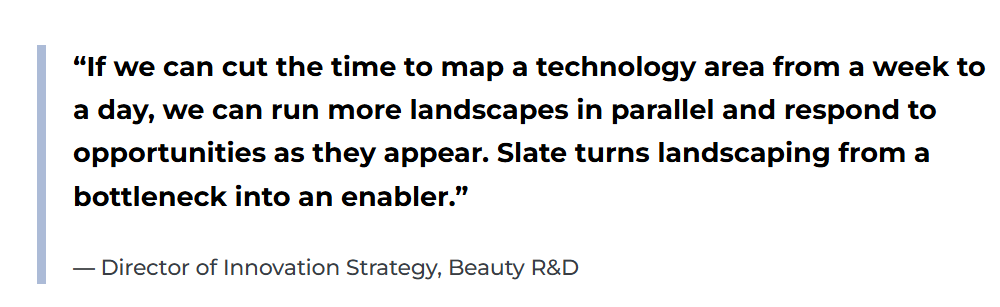
Because this is a vendor-reported customer result, it should be treated as an example rather than a universal performance benchmark. Its broader lesson, however, is relevant: when discovery, evidence, company activity, and output preparation occur in one connected workflow, researchers can spend more time evaluating opportunities and less time manually assembling the landscape.
Slate cannot fix a poorly defined business problem. It cannot replace laboratory validation, regulatory review, IP counsel, manufacturing expertise, or commercial judgment.
What it can do is improve the research layer beneath those decisions making discovery more connected, evidence easier to trace, and technical knowledge easier to reuse.
Where Slate Fits into a Modern Technology Scouting Workflow
Most technology scouting does not fail because suitable technologies are impossible to find.
It fails because the brief is vague, the search becomes too broad, evidence remains fragmented, evaluation criteria are inconsistent, and nobody owns the opportunity after discovery.
The strongest scouting processes begin with a decision, not a topic. They connect patents, papers, companies, products, and internal requirements. They examine evidence both for and against an opportunity. And they finish with a clear recommendation, owner, and next step.
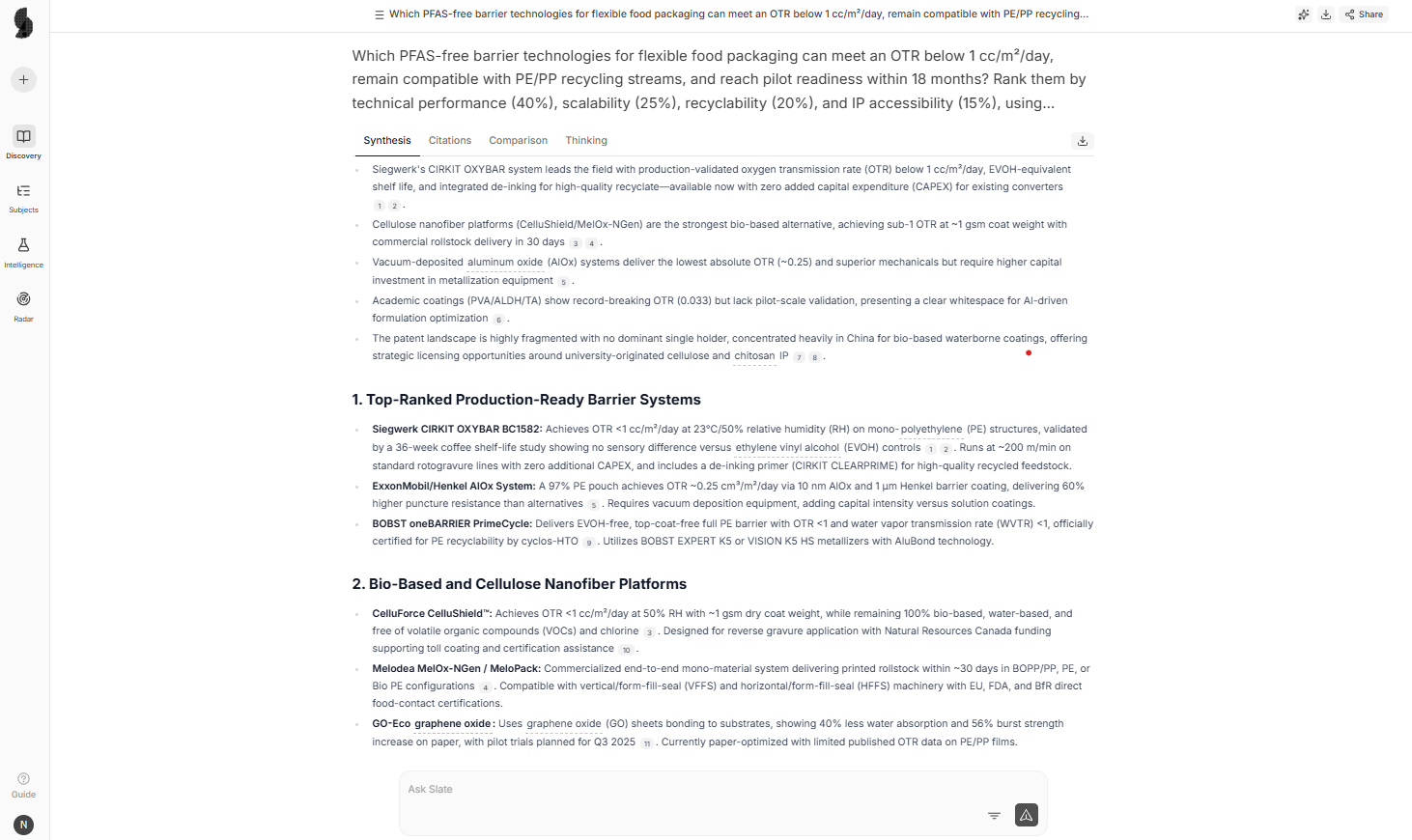
SLATE, an AI-Powered R&D intelligence platform can strengthen the process. By bringing technical research, intellectual property, competitive activity, monitoring, and organizational knowledge into one workflow, Slate helps teams move beyond lists of possibilities and toward traceable, decision-ready intelligence.
Because the goal of technology scouting is not to show how much information the team found.
It is to help the organization decide what deserves action.
See how SLATE can help your R&D team turn fragmented technical research into evidence-backed technology scouting decisions.