R&D teams are constantly facing a strange decision: whether to research with a general-purpose AI answer engine or a domain-specific R&D intelligence platform?
Now in 2026, it narrows down to two names – Perplexity and SLATE. Ask which one is better, and you’re already asking the wrong question. The right one is: better at what, for whom, and for which kind of research?
This article breaks down where each one genuinely helps an R&D team not in the abstract, but across the dimensions that actually matter when the research feeds a real decision.
Slate vs. Perplexity: What Does Each Platform Do?
What Is Slate and How Does It Support R&D Teams?
Slate, an AI-Powered R&D intelligence platform centralizes research papers, patents, product information, and company intelligence in one interface. This enables R&D teams to connect evidence across research areas.
Slate Prism, one of the most prominent feature, breaks a complex R&D question into smaller parts. It scans thousands of patents and research papers, compares supporting and opposing evidence, and explains what works, what does not, and why.
Teams can use Slate to create research reports and presentations, understand newly published patents and papers, and connect with industry experts for deeper technical guidance.
Slate also helps teams scout technologies. They can find and compare relevant companies, suppliers, startups, and emerging technology players based on their R&D needs.
Slate is built for enterprise R&D teams and is trusted by researchers at Honeywell, Sony, Tata Motors, LG, and many more.
What Is Perplexity and How Does It Support Research?
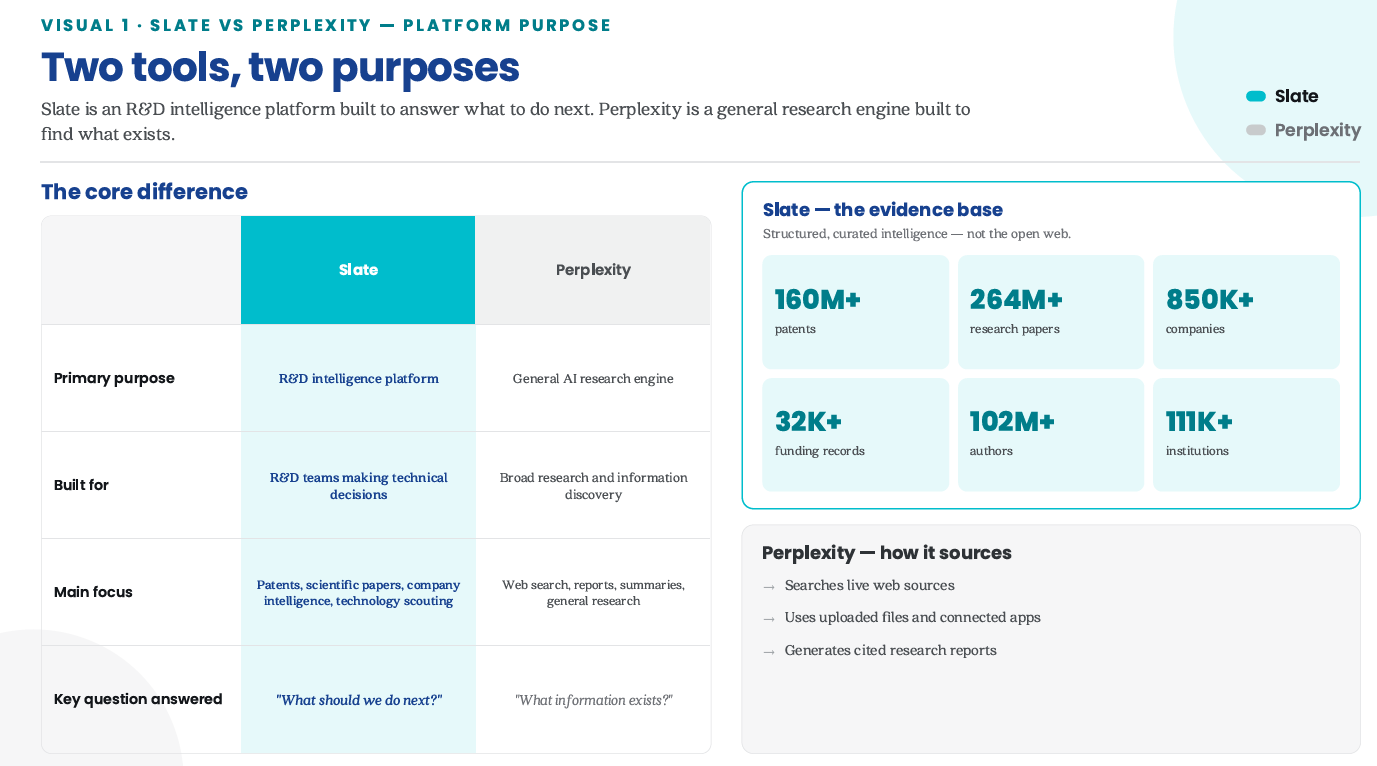
Perplexity helps users search the web, company knowledge, uploaded files, and connected apps. Teams can use it for everyday research, reports, analysis, and content creation. Its Deep Research mode runs multiple searches across many sources and combines the findings into a detailed report.
The main difference lies in how each platform works. Slate focuses on structured R&D, scientific research, product intelligence, and patents. On the other hand, perplexity covers a wider range of research. It combines live web results with uploaded files and connected company knowledge.
| Perplexity helps an R&D team learn about a technology. Slate helps the team decide what to do about it. |
Which Platform Provides More Reliable and Traceable Sources?
What does good research means? Of course, there are many versions to this question, but as per R&D team, it means something that holds up if someone challenges it. For an AI research tool, citations alone are not enough. The sources must also withstand review from technical experts, patent attorneys, and legal teams.
Slate and Perplexity approach this differently because they rely on different types of sources.
Slate gives teams access to more than 160 million patent documents across 100+ countries, 264 million research papers, 850,000 companies, 32,000 funding records, 102 million authors and publishers, and 111,000 institutions.
Slate helps R&D teams in three main ways. It tracks competitors by following their patents, market moves, and research activity. It finds promising technology areas with less competition. It also helps teams discover relevant companies and filter them by technology readiness or technical expertise.
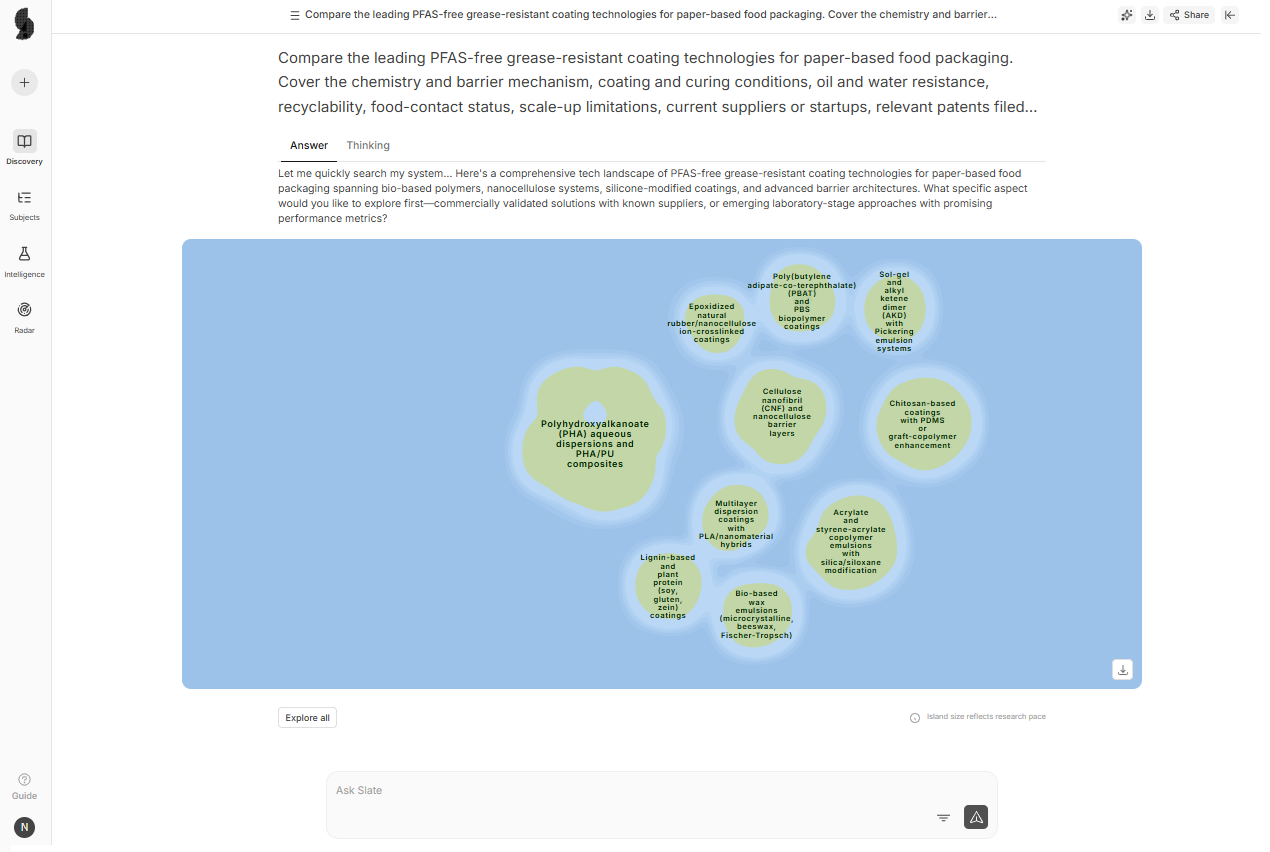
Slate gives teams direct access to patent PDFs and lets them export findings into CSV, PDF, and Excel. Here, the original documents remain stable and traceable. So, teams can use the findings in reports, presentations, and board discussions with confidence.
This curated approach has some limits. Slate may show only the abstract for paid journal articles. It also updates its database monthly, so very recent research may not appear straight away.
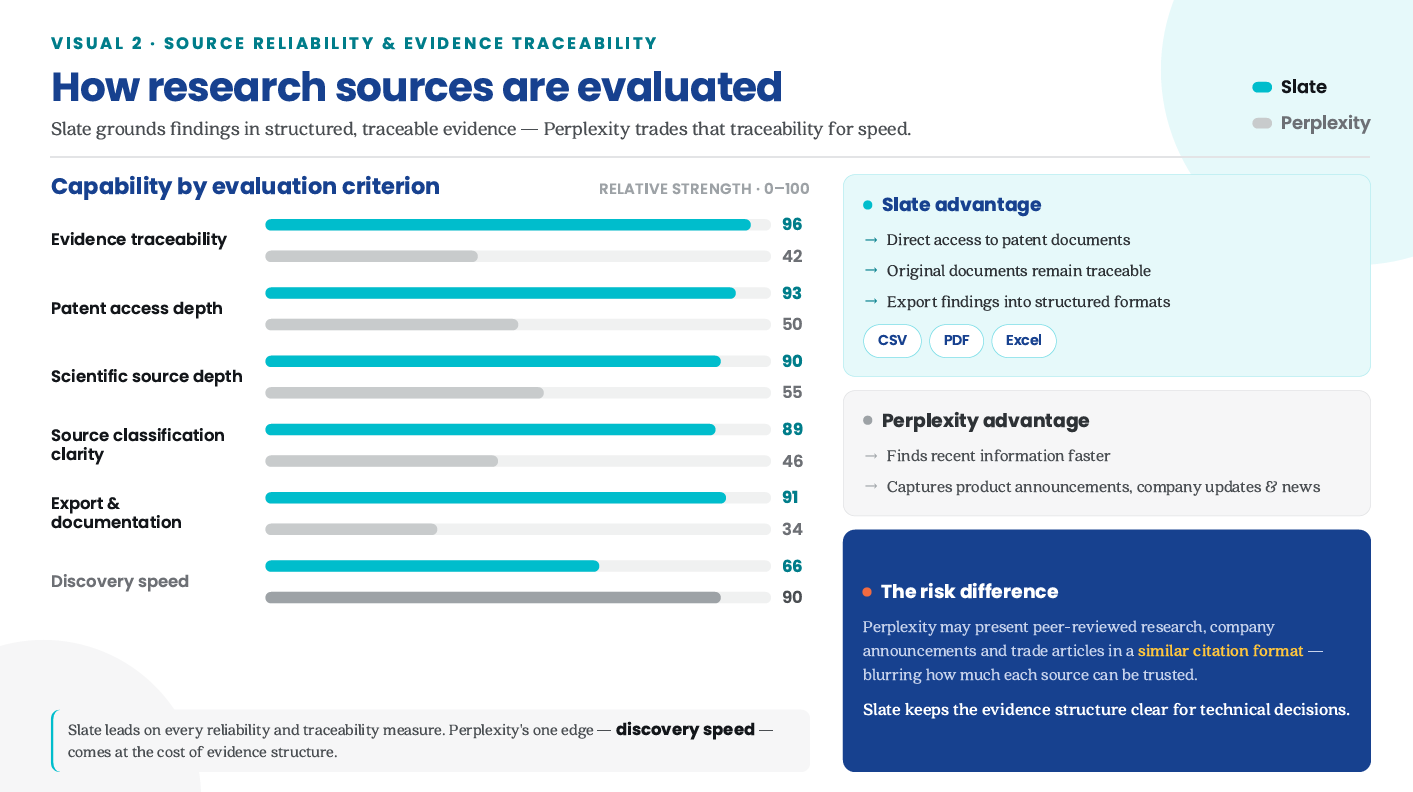
Perplexity works differently. It searches the live web and can quickly find recent product announcements, company updates, and news that may not appear in a curated database.
Perplexity usually provides citations for its claims. However, it does not clearly separate different types of sources. A peer-reviewed study, a company press release, and a trade article may all appear in the same format.
This creates a risk for R&D teams. A researcher may treat a company claim and an independently reviewed study as equally reliable. Perplexity may report the source correctly, but the source itself may not have gone through independent review.
That difference matters when teams use research to support technical, legal, or investment decisions. Slate gives them a clearer view of where the evidence comes from and how much trust they can place in it.
How Slate and Perplexity Handle Conflicting Research Evidence?
Most AI research tools do the basic thing: find sources, summarizes, and hand you the summary. This works best when the sources agree.
Now this won’t work when it comes to R&D questions: one paper claims a material degrades under heat, another claims it’s stable, and the honest answer would be “it depends on conditions X and Y that most summaries would flatten away.”
Slate Prism is built specifically for this scenario. So, this is what it exactly does:
- Breaks down a query
- Scans thousands of patents and papers
- Weighs supporting & opposing proof
- Delivers evidence-backed insight on what works & what doesn’t, and why
The key word is “weighs.” Slate Prism compares conflicting findings side by side and explains why both may be true under different conditions. It does not force them into one simple answer.
This goes beyond basic search and summarization. Prism works with a focused set of technical sources, so it can compare evidence in a clear and checkable way.
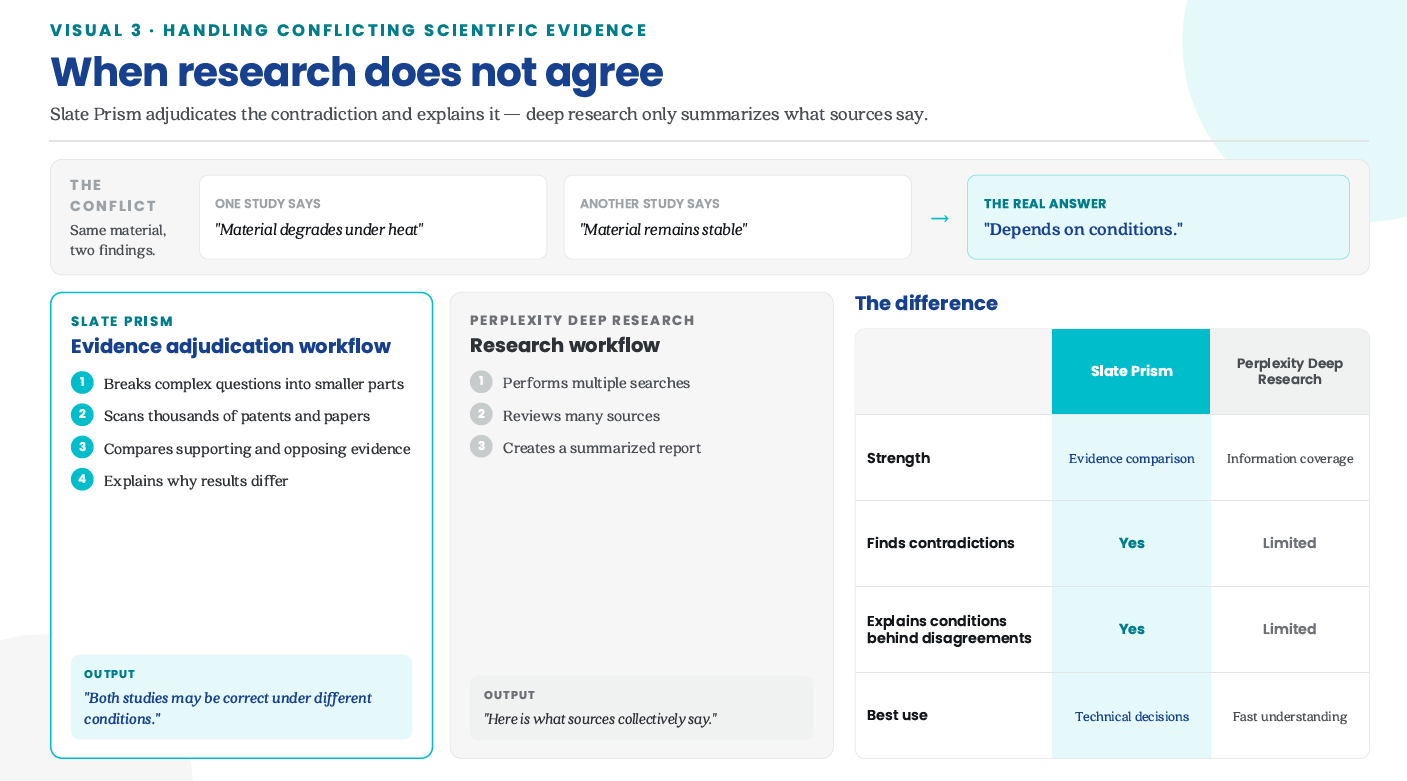
On the other hand, perplexity’s deep research is optimized for a different job – cover as much ground as possible but fast. Here’s what it exactly does:
- Performs a flurry of searches
- Reads through a wide array of sources
- Synthesizes them into a report (under three minutes)
However, the breadth and adjudication pull in opposite directions.
Perplexity searches across a wide range of sources and gives users a quick summary. However, it does not closely compare conflicting technical findings or explain the conditions behind each result.
It may give a clear answer, but it may not show why experts or studies disagree.
Neither approach is wrong. Each platform solves a different problem. Perplexity works well when you need a fast overview across many sources. Slate works better when you need to test whether the evidence truly supports a technical claim and understand why different studies reach different conclusions.
Which Platform Is Better for Patent Research?
Patent research works differently from general online research. Teams need to know who filed a patent, where they filed it, when they filed it, and how its claims differ from other patents. This requires more than keyword search.
Slate:
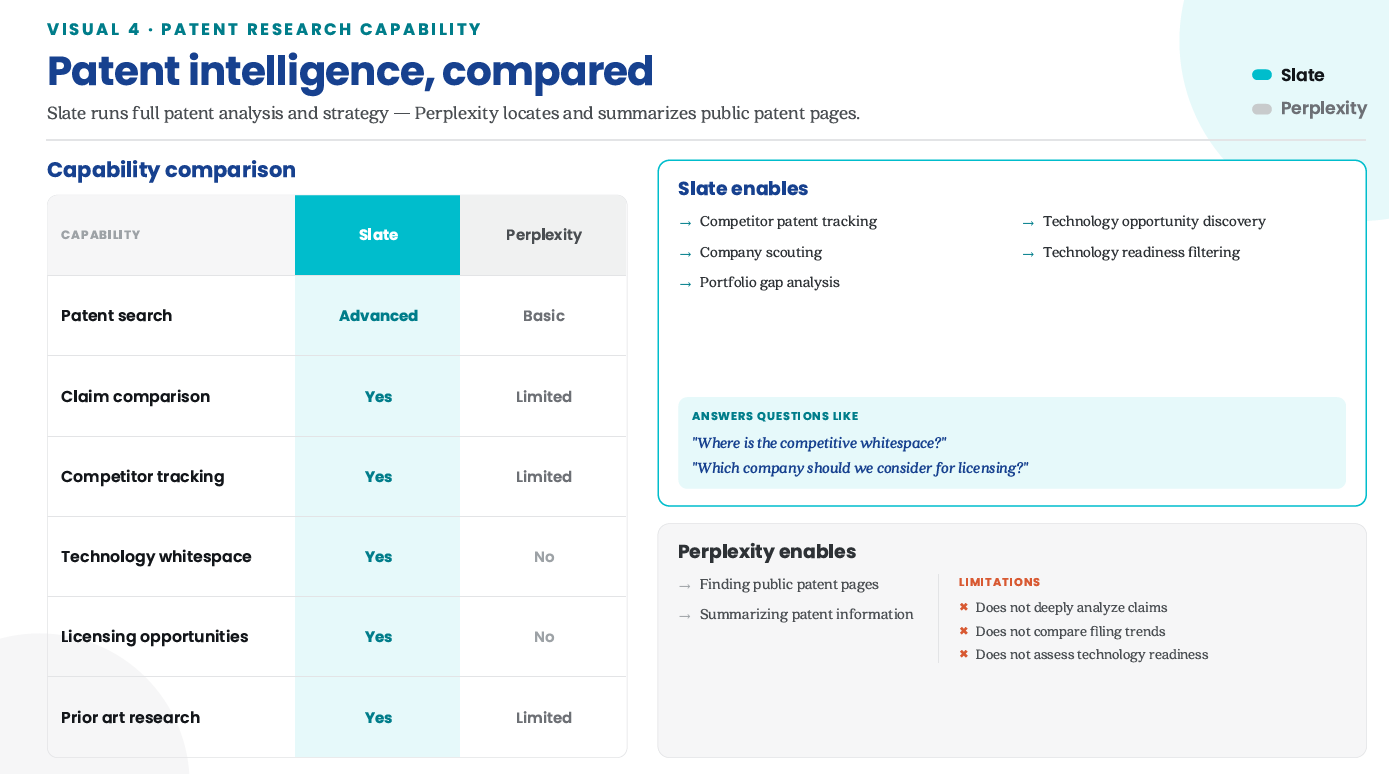
Slate helps teams track competitor patents, market moves, and R&D activity. It also identifies less crowded technology areas and helps users find companies working on specific technologies. Teams can filter these companies by technology readiness level or technical capabilities.
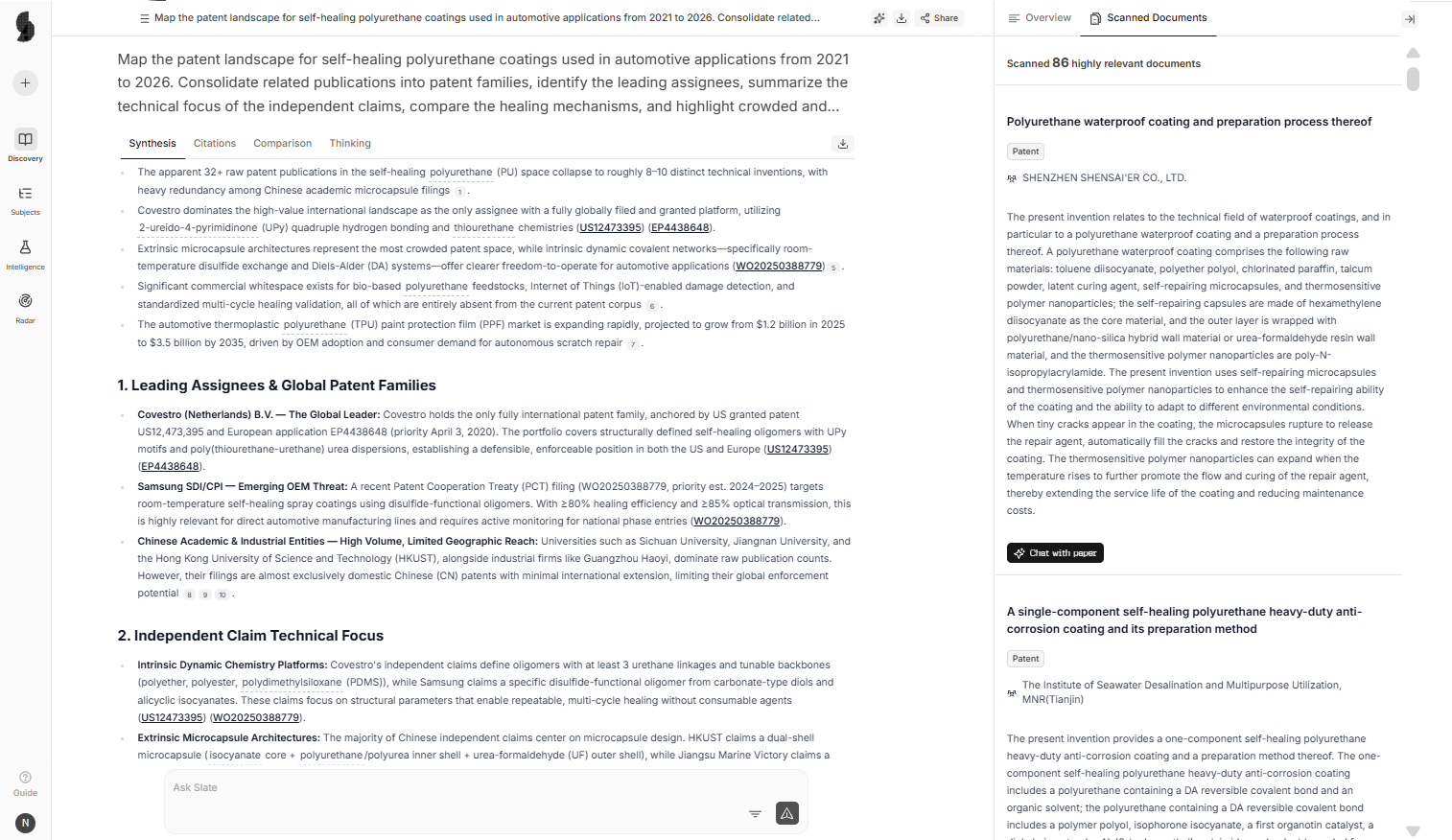
These features do more than retrieve patent documents. They help teams answer questions such as, “Where is the competitive whitespace?” and “Which company should we consider for licensing?” Slate compares claims and filing activity across many patents to support these decisions.
Slate gives teams the depth required for prior art searches, freedom-to-operate research, and portfolio-gap analysis.
Perplexity:
Perplexity can find a public patent page and summarize it. However, it does not analyze patent claims in depth, compare filing trends across competitors, or assess technology readiness and whitespace. Perplexity can help with an early scan, but it cannot match Slate’s detailed patent intelligence.
Which Platform Offers Stronger Enterprise Security and Data Privacy?
Slate:
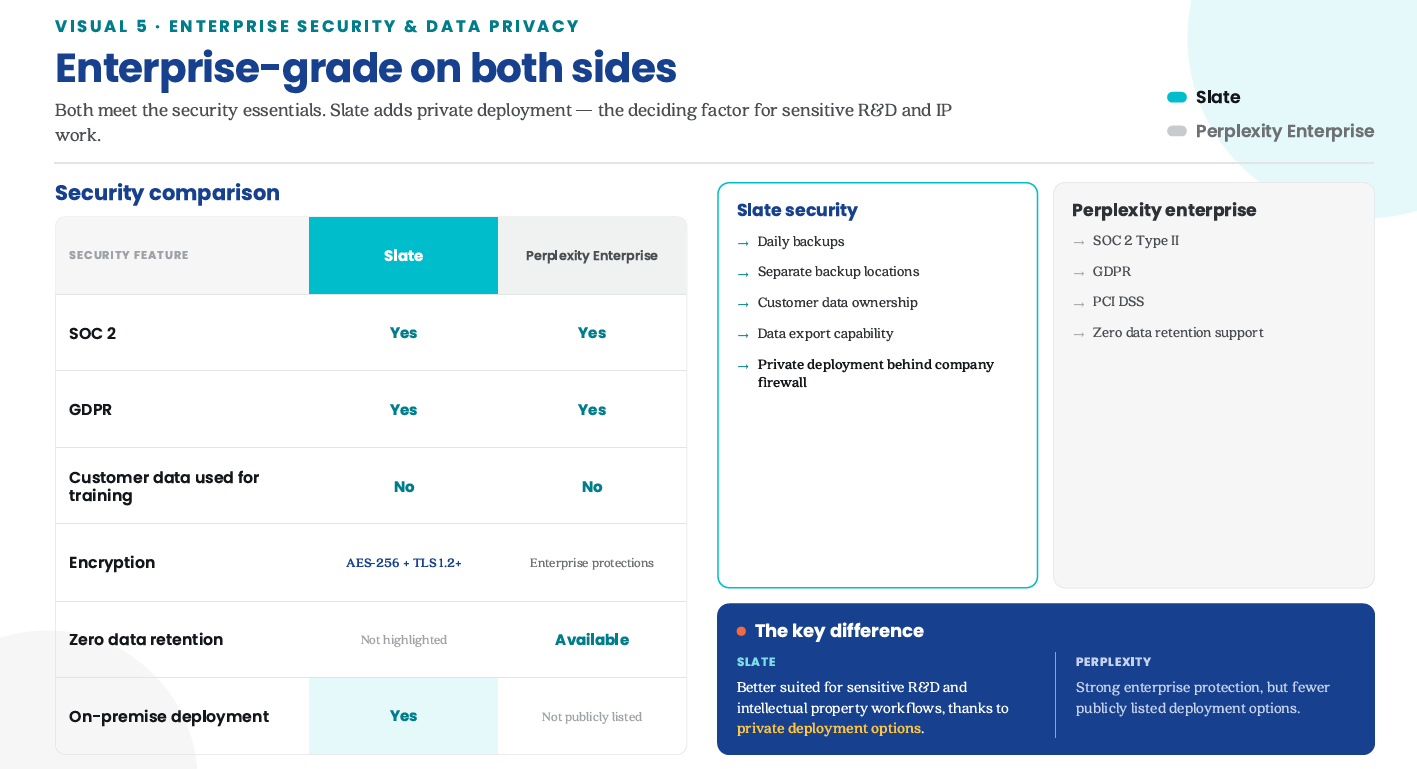
It complies with SOC 2 and GDPR. It uses AES-256 encryption for stored data and TLS 1.2+ for data in transit. Slate does not use customer data to train its AI.
Slate backs up customer data every day. It stores the backups in separate locations. Customers retain ownership of their data and can export it at any time.
Also, it supports private, on-premises deployment. Companies can run it behind their own firewall. This option helps teams protect sensitive research and intellectual property.
Perplexity:
Perplexity Enterprise Pro complies with SOC 2 Type II, GDPR, and PCI DSS. It does not use enterprise data to train or improve its models. This also applies to the external model providers it works with.
Enterprise Pro and the Sonar API support Zero Data Retention.
However, Perplexity does not publicly list ISO/IEC 42001 certification. Independent reviews have also raised concerns about the depth of its security disclosures. Its HIPAA support remained limited in early 2026. Teams cannot use protected health information without a signed Business Associate Agreement. Perplexity offers this option only on enterprise plans.
Both Slate and perplexity provide strong enterprise data protection. Slate stands out because it offers on-premises deployment. This matters when the research itself contains sensitive intellectual property.
Perplexity offers fewer publicly listed certifications. This may matter to teams that require ISO 42001 or HIPAA compliance. These protections apply mainly to paid enterprise plans. Perplexity’s free and individual Pro plans do not offer the same safeguards.
How Do Slate and Perplexity Turn Research Into Usable Deliverables?
Slate:
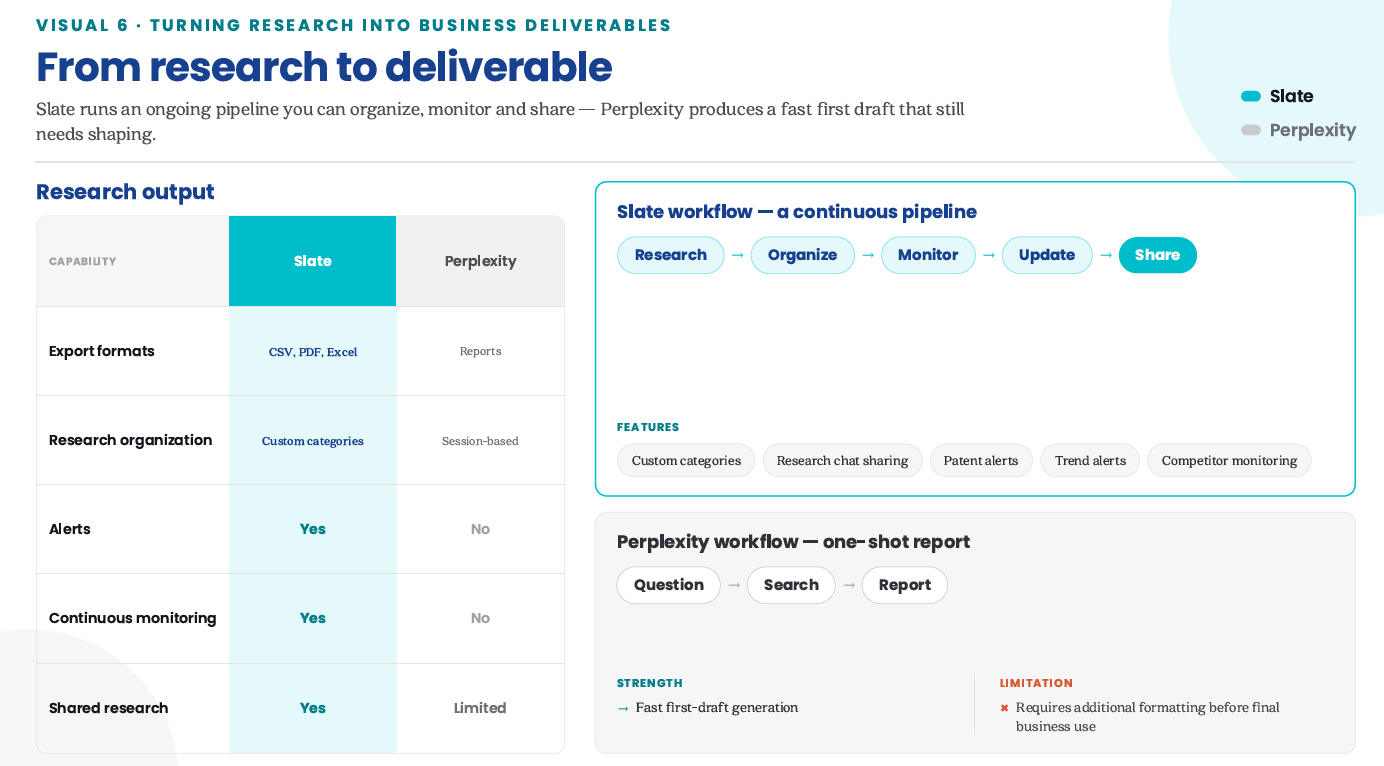
Slate creates tables that help teams compare solutions quickly. Users can export their findings to CSV, PDF, or Excel. They can also create custom categories and share research chats through public links.
Slate also lets teams set alerts for new patents, emerging trends, and competitor activity. These updates appear in a dedicated feed. This helps teams track a research area over time instead of starting a new search each time.
Perplexity:
Perplexity creates cited answers and detailed Deep Research reports. It also links each finding to its source. These reports work well as a first draft.
However, teams may still need to reorganize and reformat the content before sharing it. Perplexity does not offer persistent alerts or custom research categories. It also does not continue tracking a topic between research sessions.
Slate works better when teams need a research asset they can update, monitor, and export. Perplexity works well when users need a quick answer or an initial report. However, the team must still prepare the final deliverable.
When Should R&D Teams Use Slate or Perplexity?
| Reach for Slate when… | Reach for Perplexity when… |
| The question is a patent, prior-art, or whitespace question | You need fast situational awareness (news, funding, sentiment) |
| You need a persistent, structured R&D knowledge base | The question spans domains beyond pure science/IP |
| On prem/data residency is a hard requirement | Budget or procurement speed matters |
| You need evidence weighed across conflicting literature | You want a quick first-pass scan before deeper research |
| Deliverables must be exportable, tabular, and citable | You want agentic follow-through alongside research |
Many R&D teams end up running both in tandem: Perplexity for broad, fast sensing; Slate as the system of record for the IP work that needs to hold up under scrutiny.
How Do Slate and Perplexity Compare Across Key R&D Research Criteria?
The following scorecard compares both platforms for R&D, investment, and stage-gate decision-making. The ratings should be presented as findings from your team’s structured review rather than universal platform scores.
| Dimension | Perplexity | Slate |
| Source quality & traceability | ●●●●○ Well cited, but source quality varies | ●●●●● Curated, stable, and fully auditable |
| Open web breadth & freshness | ●●●●● Strong for recent news and market developments | ●●●○○ Focused corpus with less immediate coverage |
| Conflicting evidence analysis | ●●●○○ Summarizes different viewpoints | ●●●●● Weighs supporting and opposing evidence |
| Patent & IP intelligence | ●●●○○ Can find and summarize public patent pages | ●●●●● Built for patent landscapes, prior art, and whitespace |
| Scientific literature research | ●●●○○ Finds relevant research, but sources need review | ●●●●● Structured access to established scientific literature |
| Competitive monitoring & scouting | ●●●○○ Strong for quick market awareness | ●●●●● Structured competitor tracking, alerts, and company scouting |
| Enterprise security & deployment | ●●●●○ Strong enterprise protection | ●●●●● Enterprise controls with an on-premises option |
| Research deliverables & decision readiness | ●●●○○ Strong first draft that requires further validation | ●●●●● Structured, exportable, and designed for R&D decisions |
Which Platform Should R&D Teams Choose?
Slate and Perplexity do not solve the same problem. The right choice depends on the question.
Use Slate when the answer must stand up to scrutiny. This includes patent research, technical claims, investment decisions, whitespace analysis, and licensing strategy. Slate works with patents and peer-reviewed research. This gives teams a clear and defensible evidence trail.
Use Perplexity when speed and breadth matter more. It can quickly show what is happening in the market, what a competitor announced, or what recent sources say. Its live web access makes it useful for early research.
Many R&D teams can use both. Perplexity can help them understand the wider landscape. Slate can help them examine the technologies, evidence, and patent signals that matter most.