Hydration used to be simple. Replace fluids. Add electrolytes. Maybe add sugar for faster absorption. That playbook is now changing.
The next version of hydration is becoming a platform for gut health, cognition, energy, recovery, beauty, metabolic support, and eventually personalization. That’s why large beverage companies are no longer looking at hydration brands only as sports drink extensions. They are looking at them as high-margin functional beverage platforms that can create daily-use habits.
Here’s what the number states: functional hydration is projected to grow at 12.2% CAGR, reaching $8.54 billion in 2026, while the broader conventional electrolyte drinks market is expected to grow at 5.6–8.4% from a much larger base. The category also grew 32.8% year over year in U.S. measured channels, reaching $639 million in MULO channels, while powdered hydration mixes reached $1.5 billion in 2024 after four straight years of double-digit growth.
But growth isn’t really what these acquirers are paying for. They’re buying permission to compete in higher-value need states, repeat-use behavior baked into the product, clinical credibility, and platforms flexible enough to stretch across categories. Above all, they’re buying an exit from the commodity electrolyte game.
Why Hydration Suddenly Looks Defensible
The basic electrolyte market is enormous but fragile. Sodium, potassium, magnesium, sugar, the mechanics are well understood, and a brand can win on taste and distribution, but the formula itself is trivial to copy.
Functional hydration flips that economics. In conventional products, active salts cost as little as $0.08–$0.14 per liter. In functional formulations, bioactive ingredients can eat up 40–60% of COGS, with a typical 3–6 ingredient stack running $0.75–$2.00 per serving before liquid and packaging. Expensive but the category supports retail prices of $3.99–$12.99, versus $1.20–$3.50 for conventional RTD electrolytes, translating into 35–65% gross margins.
That’s the first thing acquirers are really buying: a better margin structure.
The second is need-state expansion. Hydration no longer means “for athletes” or “for dehydration.” The same shelf now supports claims around focus, mood, gut health, sleep, beauty, recovery, and metabolic health and cognitive or beauty-from-within products can command 2–4x the willingness-to-pay of conventional electrolytes.
That changes the math on acquisitions entirely. Big beverage companies don’t need “another electrolyte brand.” They need a platform that opens the door to daily wellness occasions.
What PepsiCo is Buying: Gut-health Permission and Daily Wellness Behavior
PepsiCo’s $1.95 billion acquisition of Poppi is not a hydration deal in the narrow sense. Poppi is a prebiotic soda brand. But it still matters for functional hydration because it signals where the category is headed.
PepsiCo paid for a brand with more than $500 million in sales, which the report estimates at roughly 3.9x revenue. The strategic rationale was entry into the gut-health functional beverage category, especially as Coca-Cola moved with SimplyPop.
That tells us something important.
PepsiCo is not just buying soda. It is buying the consumer habit around a beverage that feels better-for-you, tastes familiar, and fits into daily routines. That is the sweet spot functional hydration brands are also chasing.
The real acquisition target is not “prebiotic soda” or “hydration powder” alone. It is the ability to make wellness feel like a normal beverage habit.
This is why gut-health beverages sit close to the functional hydration opportunity. Both categories depend on repeat use. Both need simple claims consumers can understand. Both need to taste good enough for daily consumption. And both give large beverage companies a route into higher-margin functional platforms without asking consumers to behave like supplement users.
For PepsiCo, Poppi gives more than product revenue. It gives category permission.
What Unilever is Buying: Proof, Portability, and a Global Powder Platform
Unilever’s acquisition of Liquid I.V. is a cleaner hydration example.
Liquid I.V. gave Unilever entry into functional hydration through a powdered format. That matters because powder solves several problems at once. It is lighter to ship, easier to store, and more flexible for functional ingredient stacking than many RTD formats. The powder formats cost 60–70% of RTD transport cost, creating 30–40% savings, while offering ambient shelf stability.
But Unilever is not only buying logistics.
It is also buying clinical momentum. Liquid I.V. has emerged as the most active industry sponsor of hydration clinical trials, with four registered studies. These studies evaluate hydration formulas using endpoints such as plasma volume, osmolality, Beverage Hydration Index, deuterium oxide absorption, net fluid balance, and plasma copeptin.
That is a different kind of moat.
A basic hydration powder can be copied. A clinically tested hydration platform with product-specific evidence is harder to dismiss. It gives the parent company more confidence in claims, more credibility with retailers, and more room to take the brand global.
This is especially important because the category is moving from brand-driven growth to evidence-driven consolidation. In that world, the value of Liquid I.V. is not just that it sells well. It is that the brand can support a stronger evidence story than many copycat hydration products.
So, what did Unilever buy?
It bought a portable hydration format, a strong retail and DTC brand, a global expansion vehicle, and a clinical evidence engine.
What Celsius is Buying: Functional Adjacency
Celsius’ $1.8 billion acquisition of Alani Nu is another signal. This frames the deal as functional beverage portfolio consolidation, with Alani Nu joining Celsius and Celsius Hydration. It positions the combined entity across both energy and hydration segments.
This matters because the next hydration winner may not look like a traditional hydration brand.
It may start with energy or wellness or an active lifestyle or beauty or gut health. Then it stretches into hydration because the consumer already sees the brand as part of their daily performance routine.
That is likely what Celsius is buying with Alani Nu: a broader functional occasion map.
Alani Nu brings a lifestyle-led consumer base. Celsius brings scale in functional energy. Together, they create room to move across energy, hydration, fitness, and wellness occasions. This is useful because consumers do not think in strict category terms. They think in moments: “I need energy,” “I need recovery,” “I need hydration,” “I need something better than soda,” or “I want something that feels healthier.”
For strategic buyers, that flexibility matters.
A single-occasion brand can become a short-lived trend. A multi-occasion platform has more room to grow.
The Hidden Acquisition Filter: Retention
In functional hydration, a good formula is not enough. The real question is whether consumers come back.
A wide spread in LTV/CAC across functional hydration and adjacent beverage brands, ranging from 1.3x to 5.0x. The difference is not just formulation. It is retention architecture: habit-stacking, referral-led acquisition, community engagement, and use-case onboarding.
Hydrant is a good example. It achieved a 4.8:1 LTV/CAC by capping paid acquisition and building a 14,000-member Slack community. Referrals drove 31% of new subscribers at a blended CAC of $9.40, compared with $38 for paid social. Cure Hydration raised subscriber retention from 54% to 78% through a seven-day onboarding sequence tied to three daily rituals.
That is what buyers care about.
A strategic acquirer does not want to buy a brand that needs constant paid media just to hold revenue. It wants a brand with repeat behavior built in.
That is also why PRIME Hydration becomes a cautionary case. PRIME reached $1.2 billion in annual sales in 2023, but UK turnover collapsed 70.7% in 2024, U.S. sales declined about 40% in H1 2024, and 2025 revenue was projected to fall to about $300 million, a 76% drop from peak. Repeat purchase rates were only around 12%.
Celebrity heat generates trials. It rarely generates habits. The next wave of M&A will favor brands that can prove the opposite: fewer spikes, more repeat purchases, and less dependence on paid acquisition.
The IP Problem: Most Formulas Are Easy to Copy
Functional hydration may look science-heavy, but not all science creates defensibility.
An analysis of 600 patents found that the top 173 patent holders control only about 26% of filings, a fragmented landscape where composition patents alone don’t stop competitors. Many hydration patents are “me-too” formulations that rivals can design around using functionally equivalent substitutes.
The stronger defensibility sits in three places:
| Moat Type | Why it Matters |
| Delivery Technology | Harder to replicate, often requires specialized process knowledge or equipment |
| Mechanistic Transport Claims | Stronger when tied to a specific hydration mechanism and filed across markets |
| Clinically Backed Combinations | More credible when supported by product-specific evidence |
Examples cited include Maurten’s alginate-pectin hydrogel system, AnaBio’s fluidized-bed probiotic encapsulation, Unilever/Liquid I.V. ‘s allulose-based transport platform, and Axcess Global’s paraxanthine-BHB portfolio.
So the real diligence question isn’t “does this brand sell?” It’s “can this be copied in twelve months?”
Why Clinical Evidence Is Becoming Part of Valuation
Evidence doesn’t win the first sale. In a 2026 UK/US consumer survey, “benefit seems natural” was the top trust driver for 22% of UK consumers and 21% of U.S. consumers, while “backed by science” ranked lower, at 15% and 11% respectively.
But evidence matters more the longer a brand survives. The consumer journey seems to run in three phases: taste and sensory appeal drive trial and repeat purchase in the first 0–90 days; habit integration takes over from 90–180 days; and after 180 days, clinical evidence, transparency, and third-party certification become the dominant trust signals.
For acquirers, that timeline matters for two reasons. Evidence supports premium pricing once novelty wears off, and it reduces regulatory exposure. That exposure is real; products making cognitive, metabolic, or microbiome claims may need at least one product-specific RCT with validated biomarkers to satisfy both FDA and FTC standards. EFSA rejects more than 70% of health claims it evaluates, and a 2024 audit found 87.7% of sports drink claims on European e-commerce platforms fell short of EFSA’s criteria.
In other words, evidence isn’t just marketing support; it’s an acquisition asset that makes a brand easier to scale across markets.
What the Next Target Will Look Like
The next attractive functional hydration company probably won’t be judged on revenue growth alone. Buyers will be looking for a full platform story:
| Buyer Question | What a Strong Target Proves |
| Does it own a daily-use moment? | Repeat purchase, subscriber retention, clear use occasions |
| Can it command a premium? | A functional need state beyond basic hydration |
| Is the claim credible? | Product-specific or biomarker-backed evidence |
| Is the formula defensible? | Delivery technology, mechanistic claims, or process complexity |
| Can it scale? | Powder format, ambient stability, standard manufacturing fit |
| Can it expand globally? | A clean regulatory pathway across major markets |
| Can CAC stay controlled? | A clean regulatory pathway across major markets |
This is part of why postbiotic and nootropic hydration platforms look increasingly attractive: both map cleanly onto standard beverage manufacturing. Postbiotics are heat-stable, soluble, and flavor-compatible; nootropics like L-theanine and Alpha-GPC are water-soluble and process-friendly.
Other trendy ingredients come with friction. Collagen works, but needs molecular-weight control and off-flavor management above 5g per serving. Ketone esters are feasible but their 12.5–25g doses create volume and cost problems in RTD formats.
Ashwagandha carries elevated regulatory risk in Europe and ANZ. None of this rules these categories out, it just means buyers will ask harder questions before paying a premium.
Where the Next Deal Might Come From
Three places, most likely.
The first is another high-retention functional hydration brand with proven daily-use behavior, the easiest path, since strategics already know how to evaluate brand-led deals.
The second is a differentiated technology platform: probiotic encapsulation, liposomal ketone delivery, bioavailability systems, ultrafine bubble technology, or postbiotic ingredient platforms. These are strong candidates for licensing deals or outright acquisition because they make products genuinely harder to copy.
The third, and least mature, is personalized hydration. No company has yet commercialized a true closed loop where real-time sweat biomarker data drives on-demand formulation.
Epicore Biosystems has raised $32 million and holds partnerships with PepsiCo and the Department of Defense; Nix Biosensors and INFINIT Nutrition are closer to sweat-data personalization but haven’t closed the loop either.
This is the space to watch. The future of hydration may not be one more electrolyte sachet, it may be a system that reads sweat loss, tracks sodium depletion, factors in circadian timing, and recommends or dispenses a formula built for that exact moment.
The Bottom Line
PepsiCo, Unilever, and Celsius aren’t just buying drinks. They’re buying new ways to make beverages functional, repeatable, premium, and hard to copy.
PepsiCo’s Poppi deal shows the value of gut-health permission and daily wellness behavior. Unilever’s Liquid I.V. acquisition shows the value of a scalable powder platform backed by real clinical evidence. Celsius’s Alani Nu deal shows the value of functional adjacency across energy, hydration, and active lifestyle.
Going forward, the market will get more selective. Fast growth with weak retention will look risky. Trendy ingredients without evidence will look copyable. Vague claims will draw regulatory scrutiny.
The brands that win will combine four things: a genuine daily habit, a premium need state, credible evidence, and a defensible technical platform.
That’s not a hydration acquisition. That’s the next operating system for functional beverages.
How Slate Helps You Spot the Next Functional Hydration Winner
The real challenge is not seeing that functional hydration is growing. Everyone can see that now.
The harder question is:
Which hydration platforms are actually worth betting on? Is it postbiotic hydration? Nootropic hydration? Biosensor-led personalization? A new delivery technology? Or a brand with strong retention that strategics may acquire before the category gets crowded?
That is where SLATE, an AI-powered R&D platform, helps.
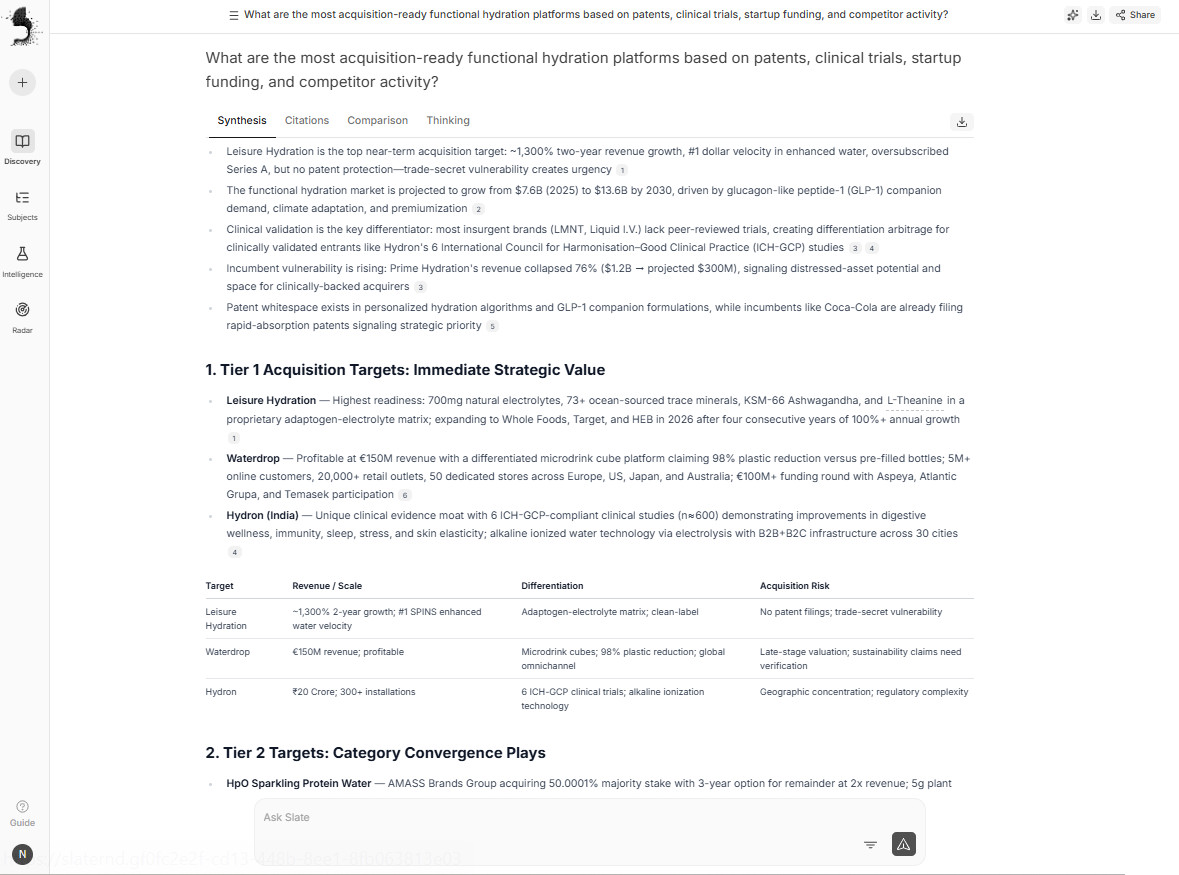
Slate brings scattered R&D signals into one place: patents, papers, clinical studies, startup activity, supplier moves, ingredient innovation, and competitor activity. Slate messaging also positions it as a platform that connects patents, papers, and clinical studies in one interface, helping teams see what is coming before it becomes obvious. It also supports teams in tracking emerging technologies, supplier activity, patent filings, material innovations, and competitor moves across markets. Slate helps R&D, innovation, and strategy teams find those signals early, before they show up in every trend. Get in touch with us today.


