Every formulator working on high-protein or high-fiber snacks runs into the same wall. Push the nutritional load up can lead to grittiness, poor solubility, weaker foaming & viscosity that drifts on the shelf.
The standard fix has been additive with gums, stabilizers or texturizers that help the final product behave the way consumers expect.
As clean-label expectations influence formulation choices, researchers are exploring another route. R&D teams are using enzymatic bioprocessing to change the structure and behavior of proteins, starches and fibers earlier in the process.
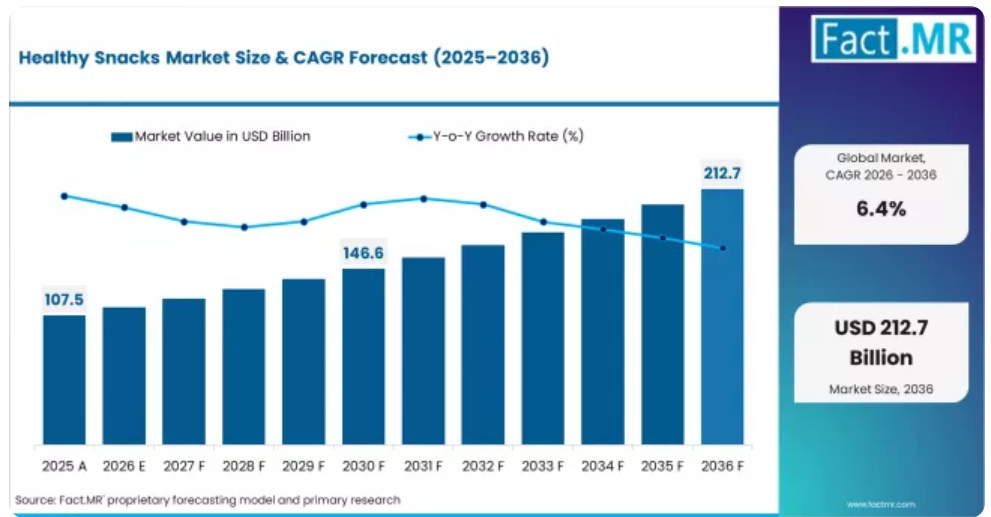
The commercial pull is already strong. The global healthy snacks market was valued at $107.5 billion in 2025 and is projected to reach $212.7 billion by 2036.
In this article, we use insights identified through Slate to examine how enzymatic bioprocessing is changing clean-label snack formulation. We will cover the technologies being used, the patents shaping this space, the companies developing these approaches, and what this shift could mean for texture, formulation flexibility, and future product development.
Why Can’t Clean-Label Hydrocolloids Fully Solve the Texture Problem?
Whole grains and plant proteins can create texture problems because of their structure. Cell wall polysaccharides can make products feel gritty. Plant protein isolates may struggle with foam stability in liquid formats. High-fiber extruded products can also lose viscosity during shelf storage. These are physical problems within the ingredient itself, which means simple ingredient substitution cannot always fix them.
The usual clean-label response is to add hydrocolloids such as guar or xanthan to improve texture. They can help mask some of these defects, but they may also make the ingredient list longer and create an additive-like perception, even when they come from plant-based sources.
Multi-stage enzymatic systems offer a different approach. Enzymes such as protein glutaminase, deamidase and amylase can modify ingredients at a molecular level, improving how proteins and grains behave before they enter the final snack matrix.
Growing interest in this approach is also reflected in innovation activity. Publication velocity for whole-grain bioprocessing increased by 67% between 2024 and 2026, showing that more companies and researchers are using biological processing to address these structural issues.
So if a formulation depends heavily on hydrocolloids to correct texture, it may be solving the visible problem rather than the underlying one. Enzymatic modification goes deeper by changing the substrate itself.
How Do Enzymatic Protocols Improve Texture Without Chemical Stabilizers?
The breakthrough is not simply adding enzymes to a formulation. It is executing a timed, multi-catalyst bioprocessing protocol that transforms the substrate before snack assembly.
Protein deamidase can improve protein solubility. Protein glutaminase enhances water-binding capacity. Amylase and beta-glucanase break down cell wall matrices to improve mouthfeel and viscosity.
These enzymes work in sequence, not as single-function catalysts. Novozymes deploys protein deamidase and arginine/lysine-specific endopeptidases to improve foaming in dairy substitutes. The protocol requires precise timing and pH control to achieve the structural results that previously required chemical stabilizers. Oatly’s two-stage system demonstrates that this level of process complexity is now commercially viable at scale.
Novozymes uses xylanase and beta-glucanase to break down cell wall matrices in plant-based formulations, improving yield and helping address the gritty mouthfeel inherent in seed bran.
Flora Food Global applies deamidating enzymes to mask off-flavors in plant proteins, replacing the sensory correction role traditionally filled by flavor systems or fat.
General Mills has also published on high-protein matrices that use hydrolyzed collagen and soluble fiber syrups to prevent the hardening commonly seen in shelf-stable high-protein products.
This is where the difference between basic enzyme treatment and advanced texturization becomes important. A supplier may offer a single enzyme such as amylase to improve yield. But achieving sensory improvements often requires a specific enzyme combination, used in the right order and under controlled processing conditions.
Your current enzyme suppliers may offer single-function catalysts to reduce costs, such as amylase to improve yield in grain processing. The texturization breakthrough requires proprietary multi-enzyme cocktails with precise sequencing.
This raises the question of whether you can formulate these protocols internally or must license them from enzyme specialists who control the specific combinations and timing parameters.
The enzymes themselves are established industrial biocatalysts. The protocols for combining them to achieve sensory parity are emerging as the new proprietary moat, turning a commodity input into a defensible process advantage.
Who Controls Enzymatic Texturization IP and How Could It Affect Formulation Freedom?
Enzyme specialists, major CPG companies and academic institutions are building positions around multi-stage processing methods, which could make independent formulation more difficult over time.
Novozymes, Oatly and Nestlé are among the companies developing enzymatic approaches that can deliver structural improvements without relying on synthetic additives.
In some cases, two-stage enzymatic systems have demonstrated viscosity increases of two times or more. This shifts the technical barrier from sourcing the right ingredient to accessing the right processing method.
Jiangnan University maintains innovations across 20 distinct technology clusters with 160 total publications. Northeast Agricultural University holds positions in 15 clusters with 85 publications. This breadth demonstrates that academic institutions control foundational IP across the full spectrum of functional snacking technologies, fragmenting freedom-to-operate for commercial entrants.
Publication velocity in protein and polysaccharide microencapsulation surged 138% between 2024 and 2026. Innovation in whole grain processing for low glycemic noodles jumped from 237 publications in 2023-2024 to 478 in 2025-2026. These acceleration patterns indicate a land-grab phase for foundational IP, where early movers are securing patents that will define formulation options for the next generation of clean-label products.
The strategic implication is that relying on co-manufacturers for clean-label texturization without verifying their process IP creates exposure. As enzymatic protocols become patent-protected and enforcement begins, brands may find their formulation options constrained by licensing terms they did not negotiate directly.
The choice is becoming binary such as build internal bioprocessing capabilities, license from enzyme specialists, or accept limited formulation flexibility through standard co-manufacturing relationships.
Academic institutions controlling IP across multiple technical categories means that commercial players face increasing licensing burdens. The alternative is collaborative research models to access foundational bioprocessing and encapsulation platforms.
The risk is that brands using standard co-manufacturing will find their formulation options governed by academic portfolios that bridge texturization, encapsulation, and glycemic regulation technologies.
Can Small and Mid-Sized Brands Access Enzymatic Texturization Through Existing Supply Chains?
The challenge is not only the cost of enzymes. Multi-stage enzymatic processing also requires precise control over pH, temperature and timing, and many standard co-manufacturing lines may not be equipped for that level of control.
This is pushing more value toward enzyme specialists and bioprocessors. Some suppliers are moving toward pre-processed ingredients that have already been enzymatically modified before they reach the manufacturer.
If this model becomes more common, suppliers that continue to offer only basic ingredients may struggle to compete with specialist bioprocessors that can deliver ready-to-use functionalized materials.
Patent activity could make access even more complicated. A growing share of processing patents is coming from Chinese and South Korean entities, including work around polyphenol-fiber complexes and high-pressure pea protein texturization. As these technologies become protected, global ingredient suppliers may need to move away from generic whole-grain flours and toward proprietary, pre-processed functional blends.
This makes supplier capability an important question for brands. Does your ingredient supplier provide enzymatically modified substrates, or do you still buy raw isolates and manage the processing yourself?
If the modification happens in-house, the formulation team also takes on the cost and complexity of controlling the process consistently. Building that capability can require significant investment in equipment and process control.
For smaller and mid-sized brands, the practical decision may come down to whether an experienced co-manufacturer can provide access to these processes or whether the capability needs to be built internally.
A broader clean-label question also remains. Brands want simpler, more transparent products, but the technologies used to achieve that result are becoming more complex and increasingly proprietary. That tension between a clean label and a highly engineered process is still unresolved.
Enzymatic Bioprocessing Is Moving from Early-Stage R&D to Commercial Deployment
Oatly’s integration of enzymatic processing into oat-based products shows that this technology has moved from R&D to commercial deployment.
The two-stage enzymatic protocol is operational in products on retail shelves, not confined to pilot facilities. Novozymes positions itself as the enzyme toolkit provider, supplying the multi-catalyst systems that enable these reformulations.
General Mills has published on high-protein matrices using hydrolyzed collagen and enzymatic texturization to maintain softness and prevent shelf-life hardening in nutritional bars. These publications signal that enzymatic bioprocessing is not speculative future technology. It is operational across multiple product categories and company scales.
Innovation activity in fermented functional powders increased by 83% between 2024 and 2026. The field is moving toward multi-stage processing involving enzymatic hydrolysis and specific microbial strains.
Nutrumami uses solid-state fermentation with Aspergillus to transform legume substrates into sweet-umami protein products, showing how hybrid enzymatic-fermentation strategies are now reaching commercial scale.
If your competitive set includes brands deploying enzymatic texturization, your sensory benchmarks are shifting. Consumers will begin to expect clean-label products to match the mouthfeel of chemically texturized incumbents.
This raises the bar for acceptable reformulation outcomes. Products formulated without enzymatic bioprocessing may land as acceptable for clean-label rather than indistinguishable from conventional, limiting premium positioning.
Early movers like Oatly are establishing consumer expectations for clear-label texture parity. This will force later entrants to match those sensory standards or accept positioning as compromise health products. Commercial deployments set the new performance baseline, which determines what constitutes competitive parity in clean-label reformulation.
How Enzymatic Processing Changes Your Formulation Strategy
Start by checking whether your co-manufacturing and ingredient partners can support multi-stage enzymatic processing, not just basic single-enzyme treatments.
Access to enzymatically modified ingredients such as oat beta-glucans and deamidated plant proteins could reduce the processing burden on your formulation team. This matters as more of the underlying process IP sits with enzyme specialists and academic institutions.
It is also worth reviewing upcoming high-protein and high-fiber launches that still depend heavily on hydrocolloids. As enzymatic approaches improve texture and stability, teams may need to consider licensing, stronger supplier partnerships or internal processing capabilities.
The clean-label conversation may also shift from simply having fewer ingredients to using biological processing to reduce dependence on synthetic stabilizers.
How Can Slate Help Teams Decide Whether to Build, License or Partner?
R&D teams working on enzymatic bioprocessing rarely struggle because they chose the wrong enzyme. The bigger risk is choosing the wrong way to access the capability.
A team may spend years building a process that a supplier has already scaled. It may license a route only to find that competitors already control the key process claims. Or it may depend on a co-manufacturer whose IP position limits how far the product can evolve.
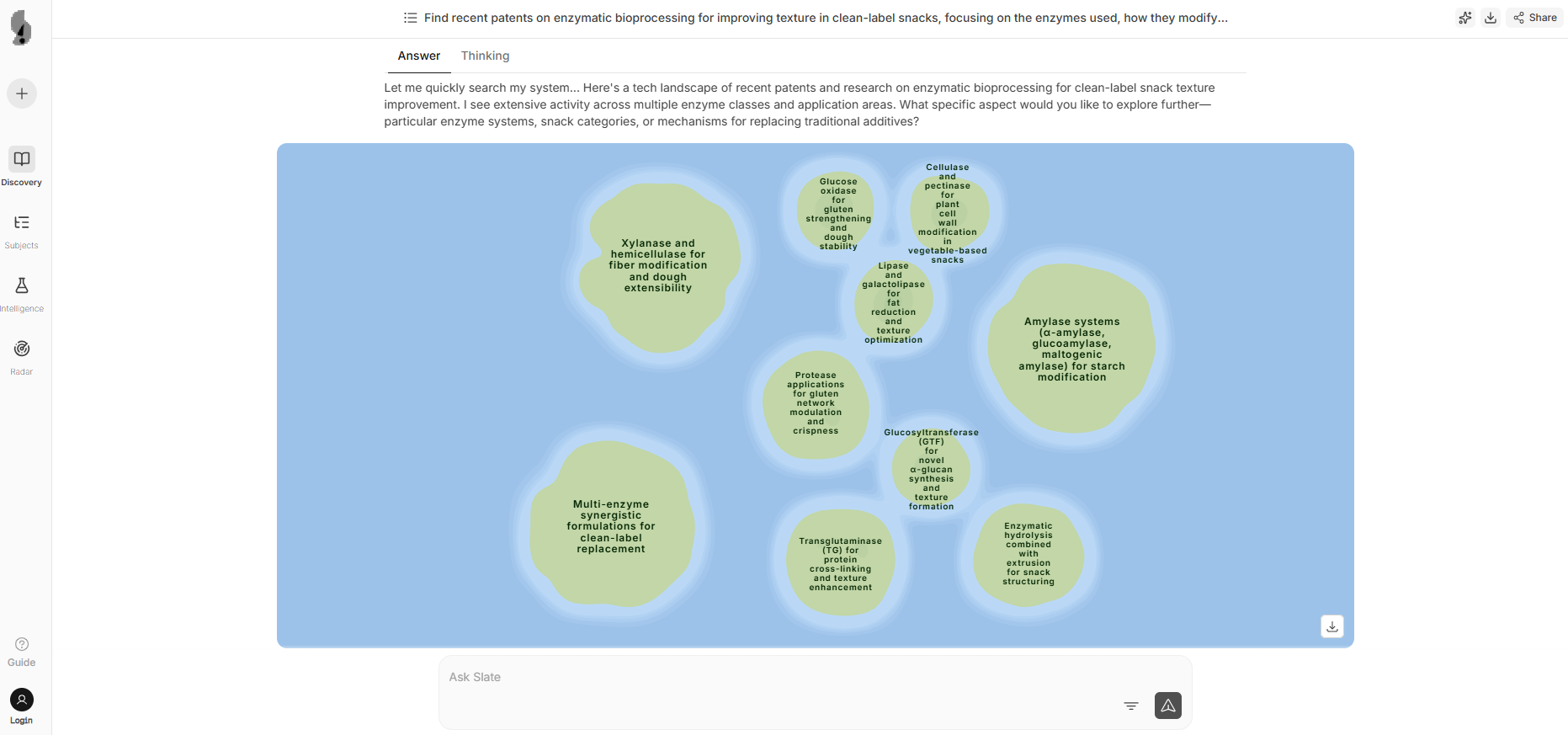
Slate, an AI-powered R&D intelligence platform for F&B, helps teams see these risks earlier. It connects patents, research activity and company developments so R&D heads can see which enzymatic approaches are gaining technical momentum, where IP is becoming concentrated and which routes still leave room to innovate. Innovation teams can identify licensing targets, technology partners and research groups before the space becomes crowded. Business leaders can see when control of a single processing step could affect future products across several categories.
For enzymatic texturization, the key question is not simply which enzyme works. It is who controls the process around it, how difficult that process is to replicate, and what alternative routes remain open.
That is the information teams need before deciding whether to build the capability internally, license the technology, or partner with someone who already has it.
Frequently Asked Questions
What is enzymatic bioprocessing in clean-label snacks?
Enzymatic bioprocessing uses multi-stage protocols with enzymes like protein glutaminase, deamidase, and amylase to modify plant proteins and whole grains at the molecular level. The process eliminates gritty mouthfeel and improves viscosity without synthetic stabilizers. Oatly’s two-stage system demonstrates that enzymatic protocols can double viscosity in oat-based products while maintaining clean-label status.
Why can’t hydrocolloids replace chemical texturizers in high-protein snacks?
Hydrocolloids like guar and xanthan mask texture defects rather than solving the underlying structural problem. Whole grains and plant proteins create gritty mouthfeel because of cell wall polysaccharides and poor foam stability at the substrate level. Adding hydrocolloids lengthens ingredient decks and triggers consumer perception of additive status. Enzymatic modification transforms the substrate before it enters the snack matrix, reducing ingredient count rather than expanding it.
Which companies control enzymatic texturization IP?
Novozymes, Oatly, and Nestle lead commercial deployment of multi-stage enzymatic protocols. Jiangnan University maintains 160 innovations across 20 technology clusters. Northeast Agricultural University holds positions in 15 clusters with 85 publications. Publication velocity in protein and polysaccharide microencapsulation surged 138% between 2024 and 2026, indicating a land-grab phase for foundational IP among enzyme specialists, CPG players, and academic institutions.
Can small brands access enzymatic bioprocessing through co-manufacturers?
Multi-stage enzymatic protocols require precise pH control, timing, and temperature management that standard co-manufacturing lines may not support. Ingredient suppliers are beginning to offer pre-processed, enzymatically modified substrates as functionalized intermediates. Brands should audit whether their co-manufacturers execute multi-enzyme protocols or only single-catalyst treatments. The gap determines whether products achieve sensory parity with synthetic texturizers or ship with residual texture defects.
How does enzymatic bioprocessing affect ingredient labeling?
Enzymatic bioprocessing often requires multiple enzymes in sequence, which may lengthen ingredient decks temporarily if enzymes are declared on labels. The outcome is the elimination of synthetic stabilizers and emulsifiers. The claim shifts from fewer ingredients to biological processing instead of chemical additives. Multi-enzyme cocktails like those from Novozymes represent a validated approach where the complexity is biological rather than synthetic.
What is the cost difference between enzymatic and chemical texturization?
Multi-stage enzymatic protocols require specialized bioprocessing infrastructure for pH control, timing, and temperature management. Capital expenditure is higher than for standard chemical texturization lines. The shift in value capture from ingredient suppliers to enzyme specialists and bioprocessors creates premium pricing for functionalized intermediates. Early licensing of enzymatic protocols may secure lower costs before the technology becomes industry standard and licensing fees increase.
Which product categories are deploying enzymatic bioprocessing now?
Oat-based beverages, high-protein nutritional bars, plant-based dairy analogues, and whole-grain snacks are operational categories. General Mills uses enzymatic texturization in high-protein matrices to prevent hardening during shelf storage. Nutrumami deploys solid-state fermentation with enzymatic hydrolysis in legume-based protein products. Innovation velocity in fermented functional powders accelerated by 83% between 2024 and 2026, indicating expansion across multiple snack formats.