
Botanical cortisol-blocking has helped shape the first wave of neurocosmetics. Recent patent activity suggests the next wave may look very different.
Shanghai Lebao Daily Chemical is exploring an anti-wrinkle composition that combines DNA sodium/PDRN with RNA as a neurotransmitter inhibitor. Shenzhen Readline Biotech is developing peptide-based compositions aimed at regulating neurotransmitter activity for anti-aging.
Botanical neurocosmetics have largely focused on mechanisms such as cortisol modulation through 11β-HSD1 inhibition. Newer nucleic acid and peptide systems are targeting neural signaling, structural repair, and gene-level responses.
Botanical formulations remain easier to develop, but the space is getting crowded, with 20 publications appearing in the 2025-2026 landscape. Nucleic acid actives are harder to formulate and validate, but they open the door to more differentiated claims and premium positioning.
That changes the R&D decision. The question is not simply which ingredient performs better. It’s about which technology route gives your team enough technical differentiation to justify the added development cost and complexity.
With Slate, an AI-Powered R&D tool for cosmetics we mapped patent and technology activity across PDRN and sodium DNA/RNA neurocosmetics to identify where innovation is accelerating and where competitive barriers are forming. The analysis reveals how delivery systems, validation requirements, and IP concentration are shaping this emerging category, giving R&D teams a clearer view of where opportunities and risks are developing.

How Do PDRN and Sodium DNA/RNA Differ From Botanical Neurocosmetic Actives?
Sodium DNA/RNA and polydeoxyribonucleotide (PDRN) function as dual-axis actives. They inhibit specific neurotransmitters such as acetylcholine at the receptor level while simultaneously promoting structural protein repair and modulating gene expression.
Botanical stress-relief actives work differently. They typically inhibit the 11β-HSD1 enzyme or provide surface-level soothing.
Shanghai Lebao’s sodium DNA and RNA as neurotransmitter inhibitors for rapid skin smoothing. A separate innovation details a high-elasticity serum combining PDRN with human collagen and RNA to achieve anti-wrinkle effects through both neuro-modulation and structural repair.
The technical focus is also becoming more specific. The field has shifted from 2024’s broader cortisol-gene modulation toward specialized acetylcholine inhibition and GPR158 receptor binding in 2025-2026.
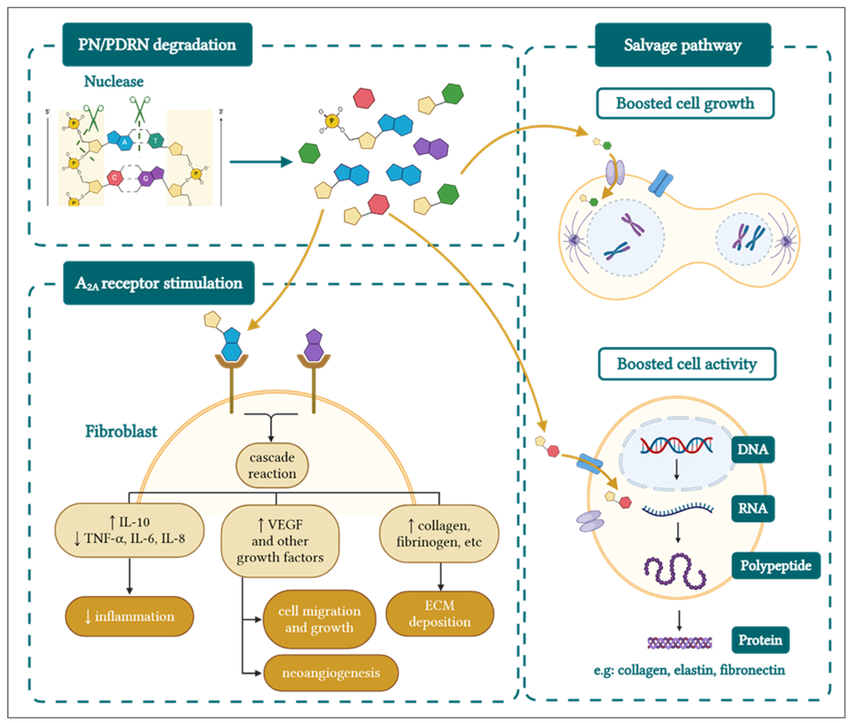
PDRN is also transitioning from niche clinical aesthetic applications to a broader role in global formulation strategy. This dual-axis approach creates a new technical standard.
If your pipeline still relies primarily on botanical 11β-HSD1 inhibitors, you are competing in a space where 20 publications appeared during 2025-2026. Nucleic acid actives provide a route into a less saturated category, but entering this space requires pharmaceutical-grade validation infrastructure that many botanical-focused firms do not currently have.
The technical barrier includes in vitro neurotransmitter assays and nanocarrier stabilization systems. These capabilities are not standard in cosmetic R&D laboratories designed mainly for botanical extraction and sensory testing.
As a result, many companies developing botanical neurocosmetics may struggle to commercialize dual-axis claims without significant investment in new infrastructure.
Why Is PDRN Moving From Clinical Aesthetics Into Mass-Market Neurocosmetics?
PDRN originated as a clinical, injection-based regenerative treatment used in wound healing and dermatological procedures.
Its move into topical cosmetics is therefore a strategic import from a clinical setting rather than an innovation that originated within conventional cosmetic formulation. Chinese biotech firms have played an important role in pushing this commercialization forward.
Beijing Tianbao Liangshan Technology published a bioactive peptide-nanocarrier synergistic anti-wrinkle serum.
This reflects a broader movement within DNA-based skincare, where product launches are increasingly integrating nucleic acid technologies into anti-wrinkle essences. Salmon-derived DNA ingredients are also moving into mass-market serums, although their use requires specific regulatory compliance for topical applications.
PDRN’s clinical background creates both an opportunity and a risk.
Existing efficacy data from medical applications can provide a useful validation shortcut. At the same time, regulators may scrutinize these ingredients more closely than traditional botanicals because they operate at the gene level.
Smaller cosmetic brands may face higher sourcing costs or even exclusion from the neurocosmetic category because of the purity and stability standards required for these ingredients.
Teams evaluating PDRN therefore need to ask an important question such as are existing cosmetic safety dossiers sufficient, or will medical-device-level validation eventually become necessary?
PDRN provides a potential shortcut to validated neuro-active claims, but the same clinical connection also makes it vulnerable to regulatory reclassification.
If regulators decide that gene-level modulation crosses the cosmetic-pharmaceutical boundary, the entire category could move into a more expensive compliance tier.
The clinical origins offer a validation advantage, but Chinese biotech firms are also developing proprietary nanocarrier and delivery systems that stabilize these nucleic acids for topical applications.
That changes the competitive barrier. The challenge is no longer limited to obtaining the active ingredient. Increasingly, it is about controlling the technology that can deliver it effectively.
Why Are Nanocarrier Delivery Systems Critical for PDRN and Sodium DNA/RNA?
PDRN and sodium DNA/RNA are difficult to use in topical skincare because nucleic acids are fragile and do not easily penetrate the skin. Their performance therefore depends heavily on how well the formulation can protect and deliver them.
This is why companies are developing specialized delivery systems. Beijing Tianbao Liangshan Technology has developed a bioactive peptide and nanocarrier anti-wrinkle serum. Ephyla has explored Pickering oil-in-water emulsions stabilized with organomodified phyllosilicates. These technologies are designed to improve the stability and delivery of neuro-active ingredients.
Botanical neurocosmetics work differently.
Our landscape identified innovations involving botanical extracts and fermentation broths prepared using aqueous, alcohol, and other extraction methods. Companies are using fermentation, enzymatic processing, hydroalcoholic extraction, and solvent-free methods to improve the activity and bioavailability of plant-derived ingredients.
These methods are relatively familiar to cosmetic manufacturers. The technical challenge is often improving the extraction or fermentation process rather than developing an entirely new delivery platform.
PDRN and sodium DNA/RNA require more specialized formulation capabilities.
Simply adding these ingredients to a serum may not be enough. The formulation needs to protect the nucleic acids from degradation, maintain their stability, and help them reach the intended area of the skin.
This creates a higher technical requirement for cosmetic manufacturers and suppliers. Companies working with nucleic acid actives may need capabilities in nanocarrier encapsulation, stabilized RNA and DNA processing, and advanced emulsion systems.
A supplier may offer PDRN or sodium DNA/RNA, but the more important issue is whether it can also provide a formulation system that keeps the ingredient stable and supports effective delivery.
Companies can also develop their own delivery technologies. This gives them greater control over the formulation and may create opportunities for new patents. However, it also requires more formulation expertise, development time, and manufacturing investment.
As PDRN and sodium DNA/RNA become more common in neurocosmetics, delivery technology could become a stronger point of differentiation than access to the active ingredient itself. Companies that can keep these actives stable and deliver them effectively may have a stronger technical and IP position.
Who Controls PDRN and Sodium DNA/RNA Patents in Neurocosmetics?
Patent activity in this area is beginning to concentrate around a relatively small group of companies, including Shanghai Lebao Daily Chemical, Shenzhen Readline Biotech, Nuode Suyuan Biotechnology, and Beijing Tianbao Liangshan Technology.
Across the bioactive peptide, DNA and RNA anti-wrinkle innovation area, Slate identified seven innovations. Only two appeared in 2024, while five were published during 2025–2026. That increase shows how quickly companies are moving into nucleic acid-based neurocosmetics.
More importantly, these companies are not working only on the active ingredients. Their innovations also cover peptide combinations, nucleic acid ratios, nanocarriers, and other delivery approaches needed to make these formulations work effectively on the skin.
For global cosmetic brands, this concentration could become a sourcing issue. If a small number of suppliers control both the active formulation and the technology needed to deliver it, brands may have fewer options when developing their own PDRN or sodium DNA/RNA products.
The contrast with botanical neurocosmetics is noticeable.
The botanical stress-relief and skin-barrier area contains innovations spread across a broader group of companies. Many of these innovations use ingredients such as GABA, ectoine, hyaluronic acid, and different botanical extracts to influence cortisol-related pathways.
Botanical neurocosmetics are becoming increasingly crowded, while nucleic acid formulations remain a smaller but more technically demanding space where IP is forming around specific compositions and delivery technologies.
If your team is planning a nucleic acid neurocosmetic product, this makes freedom-to-operate analysis important early in development. You need to understand not only who has patented PDRN or sodium DNA/RNA formulations, but also who controls the delivery systems and combinations that could be necessary to make those actives commercially viable.

Could PDRN and Nucleic Acid Neurocosmetics Face Pharmaceutical-Grade Regulation?
The shift toward gene-level modulation and receptor-targeted neurotransmitter inhibition is creating a regulatory gray zone. Topical cosmetics are using pharmaceutical-adjacent mechanisms without the validation requirements typically applied to drugs or medical devices.
The regulatory and validation pressure will shift toward pharmaceutical-grade neuro-assays. As cosmetics increasingly target specific neurological receptors like GPR158 and TRPV-1, the distinction between traditional skincare and cosmeceuticals blurs. Global regulators may move to reclassify these “high-elasticity” bioactive products, requiring more rigorous clinical efficacy data than traditional moisturizers.
The cosmeceutical middle ground may disappear, replaced by a bifurcated market where high-efficacy neurocosmetics are governed by quasi-medical oversight. The European Medicines Agency (EMA) guideline on locally applied products took effect in April 2025. The In Vitro Release Testing (IVRT) market is projected to grow from USD 106.16 billion in 2026 to nearly USD 135.76 billion by 2035, with a CAGR of 2.7% from 2026 to 2035.
Guangdong Demay New Material Technology published an in vitro method evaluating keratinocyte neurotransmitter release and neuropeptide receptor activity. This represents the kind of validation infrastructure nucleic acid actives will require.
Do not assume that nucleic acid actives can be validated using standard cosmetic safety and efficacy protocols. If your claim involves neurotransmitter modulation or gene expression, prepare to adopt in vitro neurotransmitter assays and consider whether your organization has the budget for clinical-trial-style validation. Regulatory bodies are likely to demand this within the next 2-3 years.
The regulatory gray zone currently enables rapid innovation and market entry for nucleic acid neurocosmetics. The inevitable reclassification will favor large, well-capitalized players who can afford pharmaceutical-grade validation. This creates a time-limited window for smaller entrants to establish market position before the compliance barrier rises permanently.
What Should R&D Teams Do Next With PDRN and Sodium DNA/RNA?
The unresolved tension is whether the nucleic acid neurocosmetic category can sustain its growth trajectory once regulatory bodies close the cosmetic-pharmaceutical gap and require clinical-grade validation for gene-level modulation claims.
If the compliance burden rises to match the mechanism’s pharmaceutical proximity, the category may consolidate around a few well-capitalized Chinese biotech suppliers. This could stall the innovation velocity that made nucleic acid actives commercially viable in the first place.
The technical trajectory and the regulatory trajectory are on a collision course. The outcome will determine which firms can afford to compete. Nucleic acid actives are both more effective and more regulatory-uncertain than botanical alternatives.
Teams must decide whether to invest in this high-barrier category now, while the regulatory window remains open, or remain in the commoditizing botanical tier with clearer but lower-margin pathways.
If you’re navigating this landscape, tools like Slate can help you track patent filings, identify freedom-to-operate risks, and monitor regulatory shifts in real time. Slate’s intelligence platform surfaces the kind of competitive signals and IP concentration patterns described here, so you can make informed decisions about where to invest your formulation resources before the market bifurcates further.
Turn PDRN and Neurocosmetic Signals Into Smarter R&D Decisions With Slate
With SLATE, your team can track new patent activity around PDRN, sodium DNA/RNA, neuro-active ingredients, and delivery technologies as they emerge. You can see which companies are increasing their activity, understand how their technical approaches differ, and identify areas where patent concentration could create future freedom-to-operate or sourcing risks.

If your team is evaluating a PDRN-based formulation, Slate can help you study who is developing similar compositions, which nanocarrier approaches are being patented, how the competitive landscape is changing, and where less crowded technical opportunities may still exist.
It can also help R&D teams connect patent activity with wider technology and competitive developments. Instead of finding these answers across separate patent databases, technical publications, competitor updates, and market sources, Slate brings the relevant R&D intelligence together and helps your team identify what deserves deeper investigation.
So, as nucleic acid neurocosmetics move from an emerging trend toward a more competitive and IP-intensive category, Slate can help your team decide where to invest R&D resources, which risks to investigate early, and where the next technical opportunity may be forming.
Frequently Asked Questions
What is the difference between PDRN and sodium DNA/RNA in neurocosmetics?
PDRN (polydeoxyribonucleotide) is a specific nucleic acid derivative sourced from salmon DNA, originally used in clinical wound healing and dermatological procedures. Sodium DNA/RNA refers to a broader category of nucleic acid salts used in cosmetics for neurotransmitter inhibition and structural repair. Both function as dual-axis actives that modulate neural signals while promoting collagen synthesis, but PDRN has a longer clinical track record and may face more stringent regulatory scrutiny when used in topical cosmetics.
Why are nucleic acid actives replacing peptides in anti-aging formulations?
Nucleic acid actives are not fully replacing peptides, but they offer a dual-axis mechanism that linear peptides cannot achieve: simultaneous neurotransmitter inhibition and gene-level structural repair. While cyclic peptides like pentapeptide-4 provide superior stability over linear peptides, nucleic acids like PDRN target both the neuro-signaling pathway and the extracellular matrix rebuilding process, creating a more comprehensive anti-aging effect that justifies premium positioning.
What regulatory validation is required for DNA-based neurocosmetic claims?
Current cosmetic regulations do not explicitly address gene-level modulation claims, creating a gray zone. However, the EMA’s April 2025 guideline on locally applied products signals a tightening regulatory environment. If you claim neurotransmitter modulation or gene expression effects, expect to need in vitro neurotransmitter assays and potentially clinical-trial-style efficacy data within the next 2-3 years. Standard cosmetic safety testing is insufficient for receptor-targeted neuro-active claims.
How do nucleic acid actives achieve dual-axis neurotransmitter inhibition and structural repair?
Nucleic acid actives like sodium DNA/RNA bind to specific neurological receptors such as GPR158 and inhibit neurotransmitters like acetylcholine, reducing neural signaling that contributes to expression lines. Simultaneously, they promote the expression of structural proteins like collagen and modulate gene pathways involved in skin repair. This differs from botanical actives that only block cortisol conversion via 11β-HSD1 enzyme inhibition without addressing structural damage.
What are the main IP risks in developing nucleic acid neurocosmetics?
Chinese biotech firms specifically Shanghai Lebao Daily Chemical, Shenzhen Readline Biotech, and Beijing Tianbao Liangshan Technology control the majority of patents covering sodium DNA/RNA and PDRN compositions. Independent formulation efforts may face infringement risks, forcing licensing agreements or requiring design-arounds focused on novel delivery systems rather than novel actives. Conduct a freedom-to-operate analysis before committing R&D resources to this category.
Why is nanocarrier stabilization critical for nucleic acid actives?
Nucleic acids are inherently fragile and face penetration barriers when applied topically. Without proprietary nanocarrier encapsulation or stabilized emulsion systems, raw PDRN or sodium DNA will degrade before reaching target receptors in the skin, rendering neuro-active claims unsupportable. The competitive moat in this category is shifting from the active ingredient itself to the delivery mechanism that ensures bioavailability and stability.
Will nucleic acid neurocosmetics be reclassified as pharmaceuticals?
The regulatory trajectory suggests a likely reclassification or creation of a new “cosmeceutical” tier that requires pharmaceutical-grade validation. As topical cosmetics increasingly target specific neurological receptors and modulate gene expression, the distinction between skincare and topical therapeutics is blurring. Regulatory bodies may require clinical-trial-style data for neuro-active claims, fundamentally resetting the validation burden and cost structure across the category.