
The technologies that will shape food and beverage innovation in 2027 and beyond may not appear first in food industry databases.
Most R&D teams naturally monitor food patents, scientific publications, conferences, and competitor launches. These sources reveal important developments, but they often capture technologies after they have already gained traction.
Using Slate, we analyzed patents, publications, company activity, and funding signals across adjacent industries to identify early-stage technologies with potential relevance for food innovation. The analysis showed that several technologies that could influence future food products are already being developed in pharma, cosmetics, biotechnology, and advanced materials.
Melazyme is one example. The Utah-based startup, founded in 2025 by former Perfect Day employees, raised a $2 million seed round in 2026 to commercialize a precision fermentation platform. Its initial focus is cosmetic applications, including high-purity melanin production for UV protection. The same platform also includes brazzein, a heat-stable sweet protein with potential applications in food and beverages.
For food companies, the important signal is not only the final product launch. It is the activity that happens much earlier, including patents being filed, technology platforms being developed, startups attracting funding, and manufacturing capabilities taking shape.
By the time a technology appears in a food industry announcement, the underlying IP, partnerships, and technical know-how may already be established elsewhere.
This raises an important question for R&D teams. How can they identify these signals early enough to evaluate the technologies worth tracking before they become mainstream food trends?

Why Food Companies Need to Look Beyond Traditional Food Innovation Sources
Plant cell culture technology shows how long the gap between industries can become.
Over the past decade, cosmetics companies commercialized more than 50 products using plant cell culture extracts, while food applications developed much more slowly. Food supplement ingredients such as Echigena Plus and Teoside 10 reached production scale later. Some food-focused projects, including Cocovanol and PhytoVanilla, struggled to progress because producing plant cell biomass at food-relevant volumes remained economically challenging.
The takeaway is not that food companies missed an obvious opportunity. Innovation often moves at different speeds across industries.
Cosmetics and pharma companies can sometimes validate technologies at smaller production volumes, higher price points, or through different regulatory pathways. Food companies may encounter the same technology later, once the underlying science, intellectual property, and manufacturing expertise have already matured elsewhere.
This is why cross-industry technology scouting matters. R&D teams need visibility not only into technologies already labelled as food innovations, but also into developments elsewhere that could solve future food formulation, processing, packaging, or ingredient challenges.
4 Technology Scouting Signals Food R&D Teams Should Monitor Beyond the Food Industry
Once the search moves beyond food-specific sources, the next question is what to watch.
Four signals can reveal technologies with potential food relevance two to four years before a food-specific launch.
Adjacent-classification patent filing acceleration can reveal where technical development is building before food applications become obvious.
Surface technology and coatings patents grew roughly 35% between 2016 and 2025, driven largely by automotive, electronics, and packaging demand. Food technology patents grew by close to 25% over the same period.
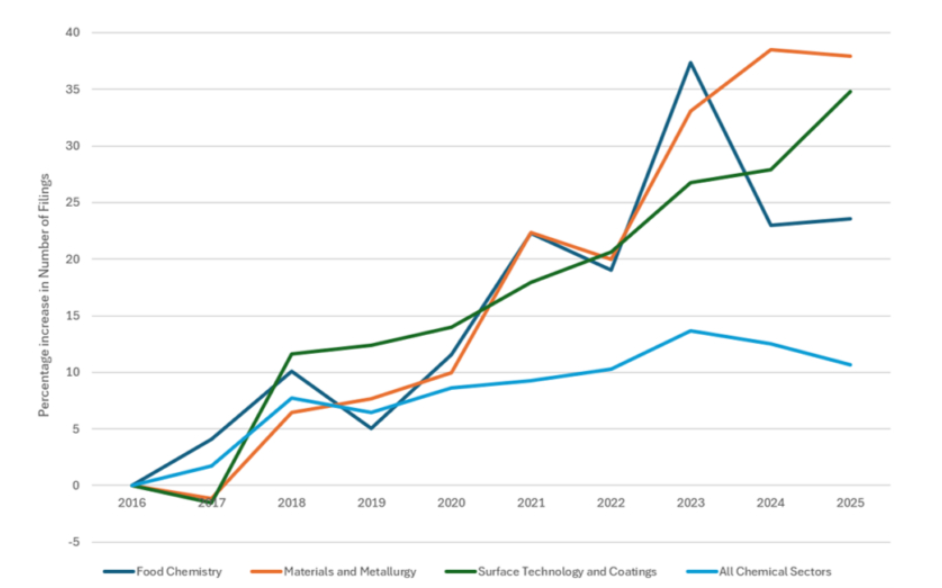
For food companies, the opportunity is not limited to patents filed specifically for food. Coatings initially developed for packaging, automotive, or electronics may offer barrier, moisture-control, or product-protection properties relevant to food packaging. Those technologies may simply sit under materials science classifications rather than food-related ones.
Pilot-plant and scale-up activity provides another signal because it shows when technologies begin moving beyond laboratory development.
In January 2025, Dr. D.Y. Patil Vidyapeeth filed a patent combining high-pressure processing with pulsed electric field treatment. The two approaches have roots in industrial sterilization and medical device processing, but the patent applies them specifically to preservative-free food shelf-life extension.
For scouting teams, combinations like this are worth watching because they show established technologies being adapted to solve food-specific problems.
Funding activity outside conventional food-tech categories can reveal technology platforms before food becomes their main commercial market.
Startups may initially be classified under biotechnology, cosmetics, synthetic biology, or industrial biotech even when their underlying technology could later support food applications. Tracking funding across these categories can help R&D teams see platforms while their applications are still evolving rather than after they have already entered the food market.
Cross-industry partnerships and manufacturing deals can indicate that a technology is becoming commercially relevant.
Every Company, a precision-fermentation egg protein producer, struck a capacity agreement with pharmaceutical company Huvepharma to quadruple production. Nestlé also partnered with fermentation biotech Helaina on infant nutrition applications.
These deals matter because they reveal more than interest in a technology. They can signal investment in manufacturing capacity, supply relationships, and commercial infrastructure. When those capabilities begin forming, the technology may be moving closer to applications that matter for food R&D.

How Food R&D Teams Can Evaluate Emerging Technologies Before Investing Resources
A patent search spanning pharma, cosmetics, biotechnology, and industrial technologies can uncover hundreds of potential candidates. Only a small share will have realistic potential for food applications.
Without a structured evaluation process, broader scouting can quickly become a longer list of interesting technologies that nobody has the time or resources to investigate.
The goal is not to track every emerging technology. It is to identify the ones with the strongest potential to become viable food innovation opportunities.
Candidate technologies can be evaluated across three practical dimensions before they move into a focused shortlist.
The first question is how close the technology is to food-grade adoption.
The regulatory pathway can significantly affect how quickly a technology reaches the market. A material or ingredient with experience in oral pharmaceutical applications may have a shorter path toward food use than a technology evaluated only for topical cosmetic applications.
The second question is whether the technology fits existing food manufacturing systems.
A promising technology still needs to work within production realities. This means understanding whether processes such as fermentation, encapsulation, or thermal treatment can work with existing equipment, ingredients, and supply chains.
Encapsulation shows how this transfer can happen. Pharmaceutical drug delivery has driven significant development of encapsulation technologies, while food and nutraceutical companies are adapting similar approaches for different applications.
Companies across the nutrition and ingredient industry, including DSM Nutritional Products, are exploring techniques such as lipid-based encapsulation and coacervation. These approaches create protective layers around ingredients to improve the stability of flavors and bioactive compounds during processing and storage.
The materials used in pharmaceutical and food applications may differ, while the underlying objective remains similar, protecting sensitive compounds and improving their performance in the final product.
This is the type of technology transfer that becomes particularly relevant when the underlying process can be adapted without requiring an entirely new manufacturing system.
The third question is whether economics work at a food-industry scale.
This is where technologies developed for pharma or cosmetics can face a major hurdle. These industries can support higher costs because products may be manufactured at gram-to-kilogram volumes with higher margins.
Food production operates at a much larger scale, often requiring ton-level manufacturing under considerably tighter cost constraints. A technology that performs well in a laboratory or premium application may therefore struggle when evaluated against food-scale economics.
Combining regulatory distance, manufacturing fit, and cost considerations helps R&D teams distinguish between technologies that deserve immediate investigation and those that are better kept on a watch list until key barriers begin to fall.
This turns technology scouting from a broad search exercise into a more focused decision process. The output is not simply a collection of emerging technologies. It is a shortlist supported by technical relevance and commercial feasibility.
The next decision is whether those opportunities warrant deeper research, partnership discussions, pilot testing, or investment. That is where a risk-adjusted R&D roadmap becomes useful.
Discover Emerging Trends & Technologies Beyond Food
Researchers rarely struggle because information does not exist. The problem is that the evidence needed to make an R&D decision is scattered across patents, scientific papers, companies, technologies, and industries that use different terminology for similar problems.
Slate, an AI-powered R&D tool brings this research into one connected workflow.
Researchers can investigate the same technical question across an integrated, cross-industry corpus without switching between separate patent databases, scientific literature platforms, company sources, and application-specific searches.
That matters when innovation crosses industry boundaries.
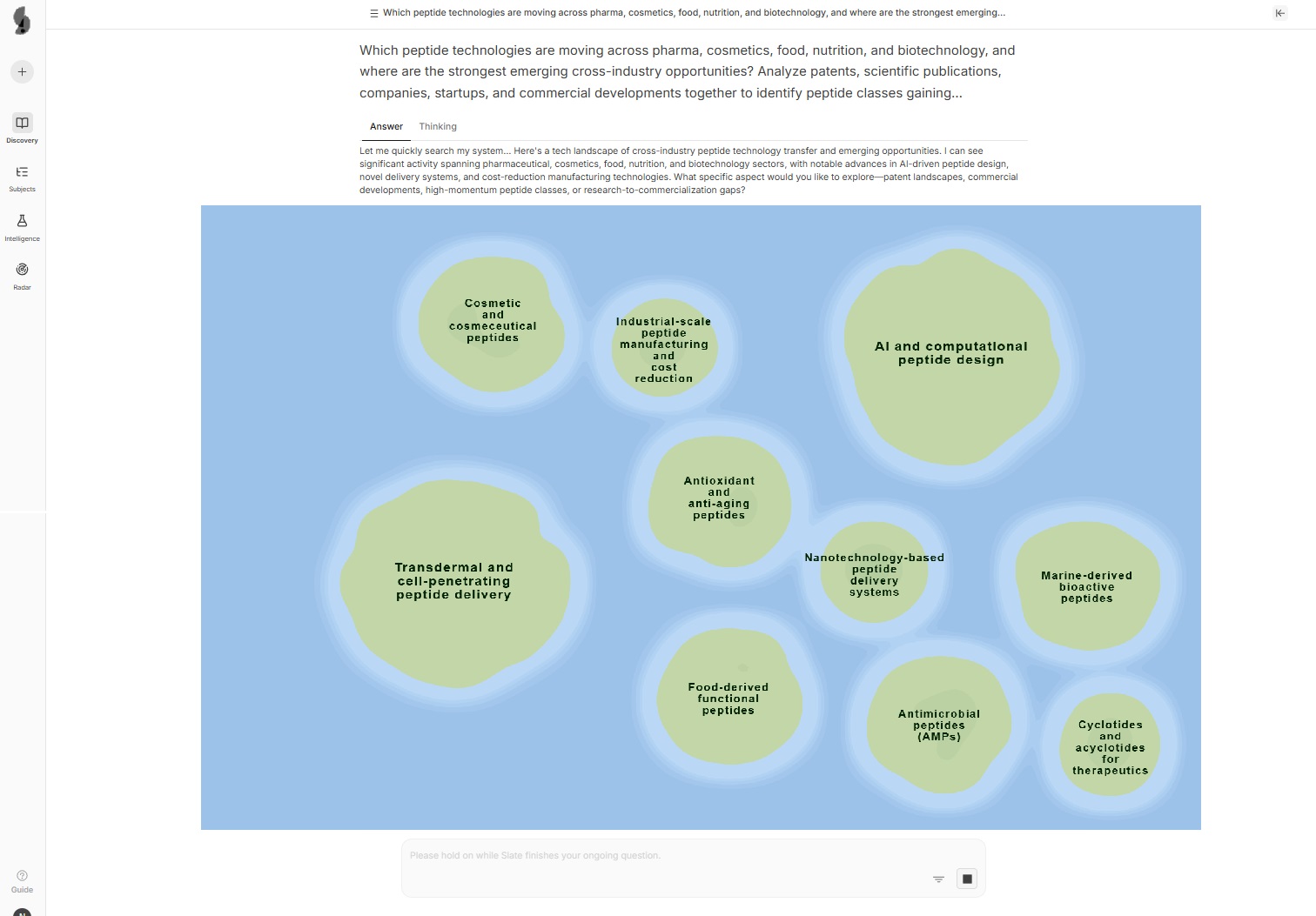
With Slate, R&D and innovation teams can
- Search across industries in one research workflow to uncover technologies being developed under unfamiliar terminology or applications.
- Connect patents, scientific literature, companies, researchers, and technology activity around the same technical question rather than evaluating each source separately.
- Trace how a technology is moving between industries and understand where research, IP, and commercialization are beginning to converge.
- Compare competing technical approaches across mechanisms, applications, maturity, and organizations working on them.
- Identify cross-industry white spaces where strong scientific or patent activity exists but commercial adoption remains limited.
- Find potential partners, startups, researchers, and patent owners connected to an emerging technology.
- Validate findings through source-backed evidence so researchers can move from an AI-generated answer into the patents and publications supporting it.
Slate is not designed to give researchers more individual pieces of information. It is designed to help them see the connections between those pieces.
The next technology worth investigating may already exist. It may simply be developing in an industry your current search has not explored.

FAQs
What is cross-industry technology scouting?
Cross-industry technology scouting looks beyond a company’s immediate sector to identify technologies, scientific approaches, patents, and companies that could solve similar technical problems. For food R&D teams, this can mean monitoring developments in pharma, cosmetics, biotechnology, materials science, and other adjacent fields.
Why should food companies monitor patents outside the food industry?
Relevant technologies may spend years developing under non-food patent classifications before a food-specific application appears. Monitoring adjacent classifications can help R&D teams identify those technologies while their IP, manufacturing capabilities, and commercial applications are still developing.
What signals can indicate that a technology may become relevant to food?
Useful early signals include accelerating patent activity, pilot and scale-up developments, startup funding, cross-industry partnerships, manufacturing agreements, and research activity around technologies that solve problems relevant to food formulation, processing, ingredients, or packaging.
How should R&D teams evaluate technologies discovered in other industries?
Three practical questions can help. Teams should assess how close the technology is to food-grade adoption, whether it fits existing manufacturing systems and ingredient supply chains, and whether its economics can work at food-industry production volumes.
How does Slate support food technology scouting?
Slate enables researchers and innovation teams to investigate patents, scientific literature, companies, and technology developments across industries. This makes it easier to trace how a technology is evolving, identify who is working on it, compare competing approaches, and find applications that may not appear in a conventional food-industry search.