Funding, specialist expertise, and laboratory capacity remain critical bottlenecks for R&D teams. However, many delays also arise from how technical information is found, shared, evaluated, and converted into decisions.
In the 2026 Innovation Research Interchange survey, 48% of R&D leaders expected their budgets to increase during the year. But additional funding creates value only when teams can convert it into better experiments and faster decisions.
Researchers spend hours searching across disconnected sources, recreating work completed elsewhere, waiting for approvals, or developing technical routes before critical assumptions and patent risks have been tested. Individually, these issues appear minor. Across multiple projects, they increase development costs, slow learning, and leave scientists with less time for meaningful experimentation.
This article examines five hidden information and decision bottlenecks that commonly slow R&D. It also outlines practical ways to address each bottleneck and make R&D decisions faster and better informed.
Bottleneck 1: Valuable Research Buried Across the Data Silos
R&D knowledge is rarely stored in one place. Researchers build individual collections of scientific papers, patents, experimental results, supplier assessments, technical notes, and market findings. Some information remains in laboratory notebooks or project folders. Other findings are buried in spreadsheets, email threads, presentations, or systems that only one team can access.
This fragmentation makes valuable research difficult to find and reuse. An R&D team repeat a literature review, test a material that another business unit has already rejected, or reassess a supplier that was evaluated several years earlier. Failed experiments and negative results are particularly likely to disappear, even though they can prevent future teams from pursuing the same unsuccessful routes.
The problem is not solved simply by moving every document into a central repository. Research can remain unusable when files have inconsistent names, outdated versions, missing metadata, unclear ownership, or insufficient experimental context. A result may state that a formulation failed without recording the concentration, process conditions, test method, or reason for failure.
Knowledge also remain dependent on individuals. When an experienced researcher changes roles or leaves the organization, part of the technical history behind previous decisions leaves with them.
How to fix it
Create a searchable research environment: Connect internal project reports, experimental data, patent analyses, supplier assessments, and external scientific literature so researchers can investigate them through one workflow.
Capture the context behind results: Record the objective, test conditions, materials, methods, outcomes, limitations, and reasons behind important technical decisions. A result without context is difficult to evaluate or reproduce.
Integrate documentation into daily work: Capture findings while the project is active rather than treating documentation as an administrative task completed at the end.
Define ownership and access: Assign responsibility for maintaining important knowledge assets and establish clear permissions so approved information can be reused across teams.
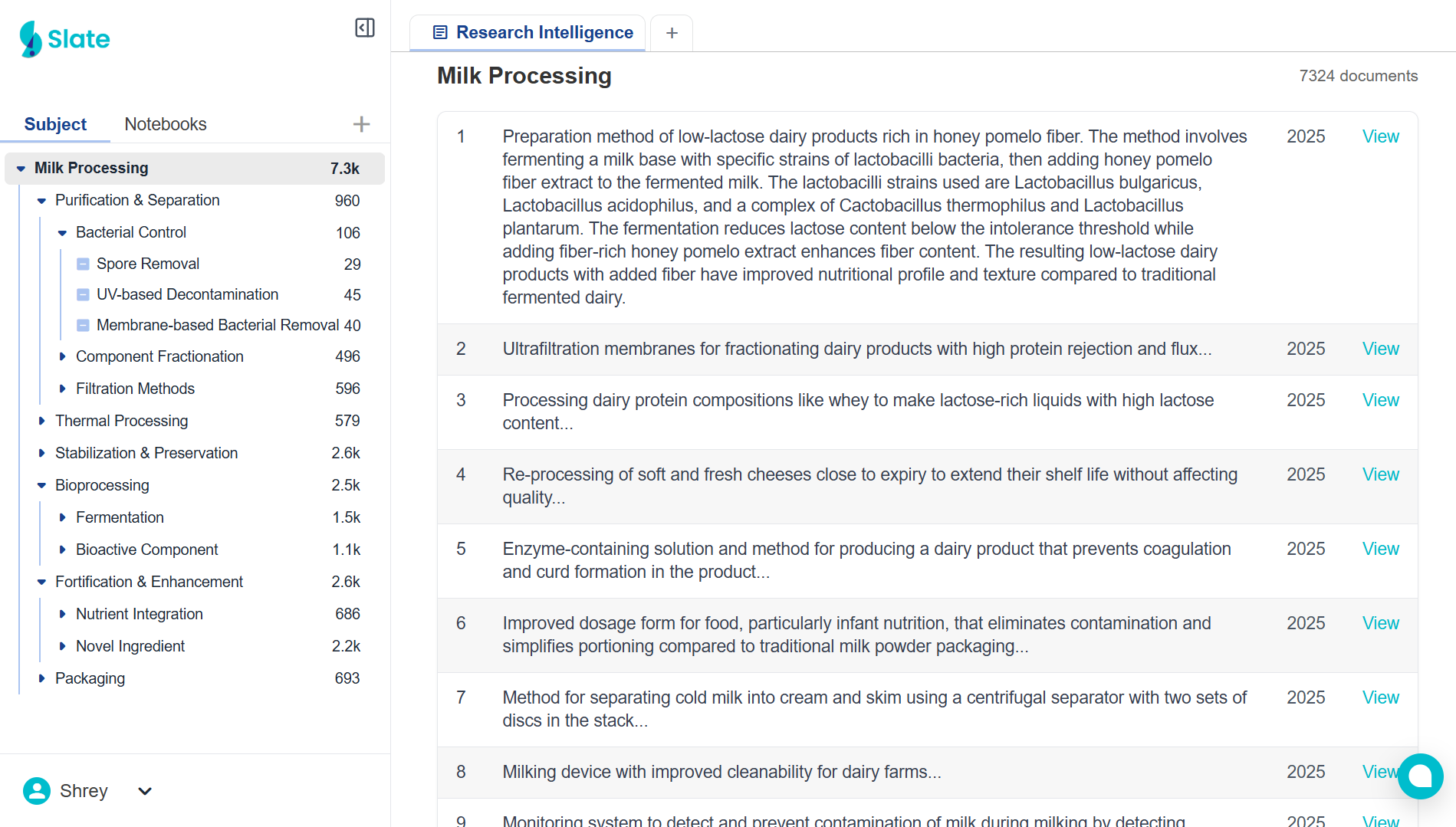
Slate provides researchers a single environment for investigating internal and external technical evidence. It allows you to centralize and organize all your research resources and intellectual property into a customized, AI-powered knowledge base that categorizes data systematically and makes it easy to access, analyze, and act upon.
When approved project reports, experimental records, supplier assessments, and technical notes are connected to Slate, teams can search them alongside patents, scientific papers, regulatory developments, and commercial signals.
Instead of returning a long list of documents, Slate organizes the evidence around the research question. It groups your institutional knowledge with current solutions, emerging technologies, compititors filing, and limitations to provide viable solution to your reearch challanges.
Bottleneck 2: Patent Risks Discovered Too Late
A solution can perform well in the laboratory and still be difficult to commercialize. A formulation contain features covered by an enforceable patent. A manufacturing process rely on a protected sequence of steps. A competitor also holds important claims in one of the markets where the product is intended to launch.
Many R&D teams review patents only after the formulation, process, or product design is largely fixed. At that stage, the organization have already invested in testing, pilot production, supplier qualification, equipment, and regulatory preparation.
If a significant patent risk is then identified, the team need to:
Reformulate the product
Change the manufacturing process
Replace a material or supplier
Negotiate a licence
Delay entry into a target market
Abandon an otherwise successful technical route
The problem is that patent intelligence entered the project after important technical decisions had already been made. It is also important to distinguish between different forms of patent research. A patent landscape shows where companies are filing and which technical areas appear crowded.
Patent monitoring identifies new applications, grants, ownership changes, and legal-status developments. A freedom-to-operate analysis examines whether a specific product or process fall within enforceable patent claims in a particular jurisdiction.
How to fix it
Screen the patent environment during concept development: Review relevant patent activity before selecting the main technical route. The objective at this stage is not to reach a final legal conclusion, but to identify potential constraints early.
Connect patent claims to technical features: Organize patents around the features that matter to researchers, such as material composition, layer structure, processing conditions, application method, and claimed performance.
Introduce IP checkpoints throughout development: Repeat the review when the team selects a technical route, freezes the formulation or design, commits to pilot production, and approaches commercialization.
Monitor changes in relevant patent families: Patent applications may be amended, granted, rejected, transferred, challenged, or allowed to lapse. A route that appears open during initial research require reassessment later.
Create a shared workflow between R&D and IP teams: Researchers can explain which technical features are essential, while patent professionals can clarify which claims require closer examination. This allows the team to explore alternatives before development choices become expensive to reverse.
Example research workflow
For the PFAS-free coating project, the team could investigate:
What are the latest patent filings (2025-26) in the cocoa butter alternatives (CBA) space? [Source]
Group patent activity by chemistry, process, substrate, or performance
Trace important claims back to their supporting patent documents
Compare patented approaches with alternative technical routes
Monitor new filings and legal-status developments
Share a common evidence base between R&D, strategy, and IP teams
This turns patent research into an early input for technical planning rather than a late-stage compliance exercise.
Slate does not provide a legal opinion or confirm freedom to operate. Final conclusions depend on claim interpretation, jurisdiction, legal status, product details, and qualified legal review. Its role is to help teams identify where patent risk exist, understand which technical features require attention, and involve patent counsel before expensive development decisions become difficult to reverse.
Bottleneck 3: Optimizing the Solution Before Testing Critical Assumptions
R&D teams are expected to develop reliable, high-performing products. However, this can lead them to refine a technical approach before confirming whether its most important assumptions are valid.
A team spend months adjusting formulation ratios, improving stability, or increasing performance without first establishing whether the solution can meet target cost, regulatory, manufacturing, or customer requirements.
This creates the appearance of progress because experiments are being completed and performance is improving. But the project still depend on an assumption that has not been tested.
For example, a PFAS-free coating deliver strong grease resistance in laboratory tests. However, the project could still fail if the coating cannot run on existing production equipment, affects paper recyclability, relies on an unavailable raw material, or costs more than customers are willing to pay.
The problem is not excessive experimentation. It is conducting detailed optimization before testing the assumptions most likely to stop the project.
How to fix it
Identify critical assumptions before optimization: List the technical, manufacturing, regulatory, supply, and commercial conditions that must be true for the project to succeed.
Prioritize assumptions by risk: Evaluate each assumption according to its uncertainty and potential impact. Test assumptions that could invalidate the project before refining lower-risk product attributes.
Use minimum evidence experiments: Design the smallest credible experiment that can support or challenge an important assumption. The objective is to reduce uncertainty, not produce a market-ready prototype.
Define decision thresholds in advance: Establish what result would justify continuing, changing direction, or stopping the project. This prevents teams from interpreting every result as a reason to continue.
Measure uncertainty reduction: During early development, evaluate progress by how much critical uncertainty the team has removed, rather than by the number of experiments completed or product features optimized.
Example intelligence question
The team could compare available approaches with the following search:
Compare PFAS-free paper coating technologies by evidence maturity. Separate laboratory proof-of-concept, pilot validation, commercial use, regulatory readiness, and manufacturing readiness. Identify the assumptions that still require testing before formulation optimization begins.
Slate compare evidence across scientific papers, patents, supplier technologies, regulatory information, company activity, and internal research. This allows the team to distinguish established findings from assumptions supported by limited or conflicting evidence.
Bottleneck 4: New Evidence Does Not Change Project Decisions Quickly Enough
R&D projects rarely progress exactly as planned. New evidence can challenge the assumptions, technical route, or commercial case behind a project.
A new study reveal a better material, while a pilot test expose a scale-up problem. A key supplier discontinue an ingredient, a competitor secure a relevant patent, or new regulations limit where the product can be used.
The R&D team recognize that the original plan is no longer the best route. However, changing direction can require revised budgets, steering committee approval, new project documentation, or several rounds of management review.
As a result, researchers continue following an increasingly weak plan because changing it takes more time and effort than continuing it. This is not only an approval problem. It is often a decision-design problem.
The challenge is visible at the portfolio level. Gartner found that 78% of R&D leaders consider improving portfolio balance a high or medium priority, yet only 53% feel confident that their organizations can achieve it. The gap suggests that recognizing the need to redirect resources is easier than building a process capable of doing it.
R&D teams lack clear rules about:
Which new evidence is important enough to trigger a review
Who can approve a technical change
How much budget a project lead can reallocate
When a project should be paused, redirected, or stopped
How quickly decision-makers must respond
What evidence is required to support the change
Without these rules, new information can be detected but fail to influence the project.
How to fix it
Define decision rights in advance: Clarify which changes project leads can make independently and which require wider approval. Minor experimental adjustments should not follow the same approval process as major changes in scope or investment.
Establish evidence-based triggers: Agree on the events that automatically require reassessment. These include failure to meet a critical performance threshold, loss of a qualified supplier, a relevant patent grant, a regulatory change, or a major shift in project economics.
Set response timelines: Define how quickly the relevant decision-makers must review new evidence. A quarterly portfolio meeting be too late when an issue affects experiments currently underway.
Use rolling project reviews: Review projects when meaningful evidence emerges rather than waiting only for fixed annual or quarterly planning cycles.
Separate project learning from project failure: A change in direction should not automatically be viewed as poor execution. Teams should be evaluated on how effectively they respond to credible evidence, not how closely they follow an outdated plan.
Record the decision rationale: Document what changed, which evidence influenced the decision, what alternatives were considered, and why the team chose to continue, pivot, pause, or stop.
Slate Radar helps R&D teams monitor relevant patents, scientific publications, regulatory developments, supplier activity, partnerships, funding, and technology launches. It proactively keeps monitoring your research area and compititor, and deliver it to your inbox.
It acts as an early-warning system for R&D teams and continuously monitors developments that could affect an active project, including patent publications, scientific research, regulatory updates, competitor activity, and emerging technology signals.
Rather than presenting each development as an isolated update, Radar can connect related signals and organize them around the project’s technical and commercial questions. A new patent, for example, can become more important when it appears alongside supplier investment, research partnerships, and hiring activity in the same technical area.
The R&D team can then see:
What has changed since the previous review
Which project assumption are affected
Which competitors or suppliers are involved
Whether the signal requires immediate attention
Which function should assess it further
Radar supports the sensing stage of R&D governance. It helps teams identify meaningful changes before they appear in an annual landscape review or become visible through a competitor’s product launch.
Bottleneck 5: Misaligned Priorities Between R&D & Business Leaders
R&D, manufacturing, regulatory, supply chain, and commercial teams often evaluate the same project through different lenses.
Researchers focus on technical performance, stability, reproducibility, novelty, and patent potential. Business teams prioritize target cost, launch timing, customer demand, available production capacity, and expected margins. Regulatory teams examine compliance pathways and permissible claims, while supply chain teams assess material availability and supplier risk.
Each perspective is valid. Problems arise when these requirements remain unspoken or enter the project at different stages.
A coating meet every laboratory target yet still prove too expensive to manufacture at scale. Even a promising material can become difficult to commercialize if only one supplier can provide it, regulatory testing delays the launch, or the project receives less attention because it appears less scientifically novel than other opportunities.
In these cases, the project does not fail because one team made a poor decision. It fails because different teams were working toward different definitions of success.
The measurement systems used by R&D organizations often reflect this disconnect. Gartner found that 35% of R&D organizations do not explicitly use metrics to measure R&D return, while another 23% rely on only one metric. Without a broader set of agreed measures, teams optimize one dimension of a project while overlooking its effect on cost, scale, regulatory readiness, or business value.
How to fix it
Define the intended outcome before selecting a technical route: Begin with the customer problem, target application, required performance, expected cost, regulatory constraints, manufacturing conditions, and launch market.
Use shared, stage-specific decision criteria: Early research should not be judged by the same measures as pilot production or commercialization. Define the evidence required at each development stage.
Separate essential requirements from preferences: Identify which conditions are non-negotiable and which can be traded against one another. A performance improvement not justify higher cost if the current solution already meets the customer requirement.
Make trade-offs visible: Record how each option performs against the agreed criteria, where evidence is weak, and which compromises the organization is willing to accept.
Update the criteria as evidence changes: Customer needs, regulations, supplier conditions, and project economics change during development. The team should revisit the definition of success when these assumptions shift.
How to evaluate progress at each stage?
Development stage
Questions the team should answer
Opportunity screening
Does the project address a meaningful customer or business need?
Technical feasibility
Can the approach meet the minimum performance requirement?
Route selection
Is the approach technically viable, legally accessible, and suitable for the intended market?
Development
Can it meet stability, regulatory, sourcing, and target-cost requirements?
Pilot and scale-up
Can it run consistently on available equipment at the required volume?
Commercialization
Does the final product meet customer needs and deliver acceptable economics?
Faster R&D Starts With Better Decisions
Most organizations assume accelerating innovation requires hiring more scientists or increasing R&D spending. Those investments certainly matter, but they rarely solve the underlying operational inefficiencies.
The biggest gains often come from removing the hidden friction that slows every project. This includes fragmented knowledge, delayed IP decisions, unnecessary optimization, slow governance, and disconnected priorities.
Organizations that systematically eliminate these bottlenecks help scientists spend less time searching, coordinating, and repeating work. Also, it provides them more time time discovering, testing, and innovating.
In modern R&D, competitive advantage is determined not only by the quality of ideas but also by how efficiently an organization turns those ideas into products.
Choose one active project and ask these five questions:
Can the team find all relevant internal and external research?
Has the team checked whether the proposed route is commercially usable from an IP perspective?
Have the largest technical and market assumptions been tested?
Can the project change direction when new evidence appears?
Do technical and business teams agree on what success means?
A “no” does not necessarily mean the project needs more people, funding, or laboratory capacity. It indicate that the team lacks the information, decision criteria, or operating processes needed to use those resources effectively.
How Slate Helps Remove Hidden R&D Bottlenecks
Slate is an AI-Powered R&D intelligence platform, helps R&D teams reduce the operational friction that slows research, delays decisions, and causes teams to repeat work.
Instead of searching across separate patent databases, research portals, startup lists, supplier websites, and internal documents, teams can investigate a technical question in one place and receive a structured, evidence-backed view.
Use Slate to bring together the relevant scientific research, patents, internal knowledge, suppliers, regulatory information, and commercial signals. Examine whether the team can identify earlier work, compare alternative routes, surface important evidence gaps, and determine what requires validation next.
With Slate, R&D and Strategy teams can:
Accelerate Discovery: Locate relevant patents, scientific literature, technology landscapes, and market signals in a single search.
Prevent Reinvention Waste: Instantly determine if a technology or experiment has already been explored internally or by an adjacent industry.
Mitigate IP Risk Early: Identify crowded patent landscapes and FTO bottlenecks before committing capital to technical development.
Standardize Evaluations: Benchmark alternative materials, suppliers, and technical pathways using clear, objective criteria.
Break Down Information Silos: Share insights seamlessly across R&D, IP, and business units so institutional knowledge stays accessible.
This helps scientists spend less time searching, coordinating, and recreating earlier work. It also gives R&D, IP, strategy, and business teams a common evidence base for deciding what to pursue, what to avoid, and where to invest next.