Biotin Environmental Fate & Ecotoxicity
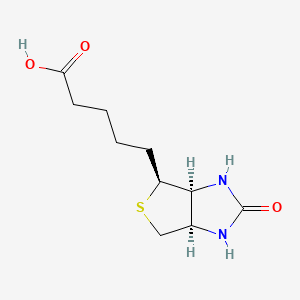
Identifiers
Functions
What is the environmental fate of Biotin?
Transport, degradation, persistence and exposure pathways
Natural Pollution Origins
Growth factor present in very minute amt in every living cell. Plays in indispensable role in numerous naturally occurring carboxylation reactions. Occurs mainly bound to proteins or polypeptides. Richest sources are liver, kidney, pancreas, yeast, and milk. Biotin content of cancerous tumors is higher than that of normal tissue
biotin acts as a coenzyme for the body's carboxylation reaction and is a factor in maintaining healthy muscle, hair, nails, and skin
BIOTIN IS PRESENT IN MOLASSES...NUTS, VEGETABLES & GRAINS. NATURALLY OCCURRING ISOMER IS D-BIOTIN; L-BIOTIN HAS NO BIOLOGICAL ACTIVITY
Where has Biotin been measured in the environment?
Measured occurrences across water, soil, sediment, air and effluent
Milk Concentrations
The current recommendation for safe and adequate daily dietary intake of biotin for infants is based on measurements of biotin concentration in human milk and calculations of biotin intake that tacitly assume that biotin content of human milk is reasonably uniform for a given subject. This assumption of uniformity was tested by examining the effects of several factors on the biotin concentration. The degree of breast emptying had little effect on biotin concentration. However, in three of five individuals studied, the biotin concentration varied significantly over 24 hr. In two of five subjects, there was a consistent difference between breasts of approximately 16%. In the first 18 day postpartum, the milk concentration of biotin increased steadily in four of the eight individuals studied, remained low in two and increased erratically in two. Rather than reaching a stable plateau in mature milk, biotin concentration varied substantially in most of the subjects. These observations provide evidence that an adequate scheme for estimating total biotin intake of the breastfed infant will require sampling from both breasts frequently over the 24-hr cycle and frequently as a function of time postpartum
Because estimates of the biotin requirement for infants currently are based on the biotin concentration in human milk, we sought to determine whether inactive biotin metabolites are present. Samples were collected for 7 weeks post partum from 15 healthy women. Biotin and the inactive metabolites bisnorbiotin and biotin sulfoxide were measured by means of a high-performance liquid chromatography avidin-binding assay. At 8 days post partum the proportion of biotin was 44%, bisnorbiotin 48%, and biotin sulfoxide 8%. Although biotin content increased post partum (p less than 0.003), the metabolites remained an important portion of the total providing evidence that accurate measurement of biotin in human milk requires an assay that is specific for biotin