Potassium Permanganate
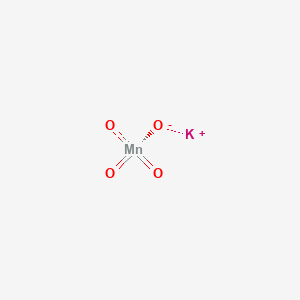
Identifiers
Hazards


Where is potassium permanganate used, and what role does it play in each application?
Potassium permanganate functions primarily as a powerful oxidizing agent, a disinfectant, and an antiseptic. Its largest use is in water and waste treatment, accounting for 80% of consumption, where it acts as an oxidant. It is also used as a bleaching agent for textiles, fibers, skins, wood, and food starch; a disinfectant and algaecide; a reagent in organic synthesis; and a fixative. In topical medicine, it serves as a germicidal, fungicidal, astringent, and keratoplastic agent. Patent filings also describe its use as a coating precursor, an anti-corrosion agent, an ethylene remover in food preservation, and an additive to improve glove permeation resistance.
Which product or formulation problem does potassium permanganate address?
Potassium permanganate addresses problems requiring oxidation, disinfection, or bleaching. In water treatment, it oxidizes contaminants. In topical applications, it provides germicidal and fungicidal action for conditions like dermatomycoses and impetigo, and its astringency helps suppress the vesicular stage of eczema-dermatitis. It solves formulation challenges by acting as a bleaching agent for materials like food starch, with a residual manganese limit of 50 ppm. In novel applications, it is claimed to solve ethylene buildup in food packaging and corrosion on magnesium alloys.
What supports the main commercial or clinical uses of potassium permanganate?
Commercial use is supported by its listing on the WHO Essential Medicines list as a topical solution for pyogenic skin infections and its registration as an active pesticide ingredient with the US EPA. Clinical use is supported by its documented therapeutic role as a topical anti-infective, though evidence notes it has limited efficacy against bacteria and fungi, requiring concentrations of 1:5000 or more for effective bactericidal action, which can be irritating. Its use in water treatment is supported by consumption data showing 80% of use is in this sector. Patent filings support its role in specialized applications like ethylene scavenging.
How is Potassium permanganate used clinically?
POTASSIUM PERMANGANATE, USP, HAS LIMITED TOPICAL EFFICACY AGAINST BACTERIA & FUNGI. CONCN OF 1:5000 OR MORE ARE NECESSARY FOR EFFECTIVE BACTERICIDAL ACTION, BUT THEY ARE IRRITATING TO TISSUES. ... SOLN OF 1:10,000 ARE USUALLY USED. HOWEVER, UP TO AN HR MAY BE REQUIRED TO KILL ... BACTERIA & SOME ... SURVIVE EXPOSURE TO THIS CONCN. FOR THIS REASON, PERMANGANATE HAS BEEN MADE OBSOLETE BY /OTHER/ ... DRUGS. BECAUSE OF THE ASTRINGENCY OF MANGANOUS & MANGANIC IONS ... SUBSTANCE IS OCCASIONALLY USED TO SUPPRESS VESICULAR STAGE OF ECZEMA-DERMATITIS. A WET DRESSING OF PERMANGANATE MAY BE EMPLOYED IN THE TREATMENT OF IVY POISONING
Which formulation trade-offs should researchers consider for potassium permanganate?
The primary trade-off is between efficacy and safety. While effective as an oxidizer and disinfectant, it is a strong irritant and corrosive, causing burns to skin and eyes, and is a nephrotoxin and hepatotoxin if ingested. Solutions must be freshly prepared, and concentrations above 1:5000, while more effective, are irritating to tissues. It is noncombustible but accelerates burning, and contact with combustible materials or sulfuric acid can cause fire or explosion. In the EU, it is restricted in cosmetics, with a ban on use in concentrations at or above 0.1% by weight.
What are the physicochemical properties of Potassium permanganate?
| Property | Value | Category |
|---|---|---|
| Physical Description | Potassium permanganate appears as a purplish colored crystalline solid. Noncombustible but accelerates the burning of combustible material. If the combustible material is finely divided the mixture may be explosive. Contact with liquid combustible materials may result in spontaneous ignition. Contact with sulfuric acid may cause fire or explosion. Used to make other chemicals and as a disinfectant, CBI; Dry Powder, Purple odorless crystals, DARK PURPLE CRYSTALS | Appearance |
| Color/Form | Dark purple or bronze-like crystals; Almost opaque by transmitted light and of a blue metallic luster by reflected air, Purple orthorhombic crystals, Bipyrimidal rhombic prisms | Appearance |
| Odor | Odorless | Appearance |
| Taste | Sweet with astringent aftertaste | Appearance |
| Solubility | Soluble in many organic solvents; also by concentrated acids with the liberation of oxygen, Soluble in acetone and methanol, Soluble in acetic acid, trifluoroacetic acid, acetic anhydride, pyridine, benzonitrile, sulfolane, In water, 6.40X10+4 mg/l @ 20 °C, 25 g/100 @ 65 °C water, Solubility in water, g/100ml at 20 °C: 6.4 (moderate) | Formulation Relevant Properties |
| LogP | 1.73 (calculated) | Formulation Relevant Properties |
| Melting Point | greater than 464 °F, Decomposes | Handling Relevant Properties |
| Density | 2.7 at 59 °F - Denser than water; will sink, 2.7 g/cu cm, 2.7 g/cm³, 2.7 @25 °C | Handling Relevant Properties |
| Vapor Pressure | Vapor pressure at 20 °C: negligible | Handling Relevant Properties |
| Stability/Shelf Life | STABLE IN AIR AND LIGHT; SOLN ARE UNSTABLE | Handling Relevant Properties |
Which formulation benchmark best contextualizes potassium permanganate, and what differs?
The most relevant benchmark is its use as a topical antiseptic, where it is compared to other anti-infective drugs. The key difference is that potassium permanganate has been made obsolete by newer drugs due to its limited efficacy and tissue irritation. In industrial contexts, its benchmark is as a bulk oxidizing agent for water treatment, where its role is well-established. In novel applications, it is benchmarked against other manganese-based compounds, such as manganese carbonate, but with the distinction of having a +7 valency, which is claimed to provide specific benefits like improved permeation resistance in gloves.