
Cosmetic R&D teams are being asked to build skin microbiome portfolios while one core question remains unresolved: do barrier repair products need live bacteria, or can non-living microbial ingredients deliver the same functional benefits?
The market has already made its near-term choice. About 90% of cosmetic products labeled “probiotic” actually contain postbiotics, and postbiotics now appear in over 40% of 2024 launches. The reason is formulation reality. Cosmetic products need preservatives to stay safe on the shelf, but those preservatives can eliminate live bacteria. Postbiotics solve that problem because ferments, lysates, and metabolites are more stable, easier to scale, and don’t need to remain alive to support barrier repair.
But that does not close the innovation question. Using Slate – AI-powered R&D intelligence platform, we mapped these six technology routes across research papers, patent filings, clinical evidence, product launches, supplier moves, and corporate R&D activity to identify which approaches are ready for formulation today and which could define the next phase of barrier repair.
6 Emerging Technologies in Skin Microbiome Barrier Repair
1. Postbiotics: Stable, Scalable, and Commercially Ready
Postbiotics are non-living microbial ingredients. They include inactivated bacteria, cell fragments (lysates), and the metabolites bacteria produce during fermentation. Because they don’t need to stay alive, they sidestep the preservation problem entirely.
Key technological developments:
- Epidermidibacterium keratini EPI-7 ferment filtrate reduced skin water loss from 16.6 to 14.5 g/m²h in a 3-week split-face clinical trial, improved hydration by 11.8%, and increased dermal density, while also shifting the skin’s bacterial community toward healthier composition
- Staphylococcus epidermidis from healthy skin produces indole metabolites (indole-3-aldehyde and indole-3-lactic acid) that activate a gene pathway (AhR/OVOL1) responsible for barrier function. These metabolites are reduced in atopic dermatitis-affected skin, making them a clear formulation target
- The same bacterium ferments glycerol to produce lactic acid, which inhibits harmful bacteria without disrupting beneficial ones, and upregulates barrier-related genes
Commercial signal: Postbiotics appear in over 40% of 2024 launches. Manufacturing costs run 15-30% lower in Asian fermentation clusters versus European precision lysate methods. The US Cosmetic Ingredient Review confirmed in September 2025 that four Lactobacillus ferment postbiotic ingredients are safe at up to 5.6% in leave-on products.
The limitation is competitive defensibility. Once a postbiotic ingredient is published or supplier-accessible, the barrier to imitation is low. Differentiation requires owning the clinical data, not just the ingredient.
2. Precision Live Biotherapeutics: Continuous Delivery Through Skin Colonization
Live biotherapeutic products (LBPs) apply specific, well-characterized bacterial strains to skin that survive, colonize, and continuously produce beneficial metabolites after application. Unlike postbiotics, they keep working beyond the initial dose.
Clinical-stage developments:
- Concerto Biosciences’ three-strain LBP (ENS-002) for atopic dermatitis was discovered using the kChip platform, which screens millions of bacterial combinations to identify precise mixtures that reduce S. aureus-driven inflammation. The Phase 1 trial dosed its first participant in November 2024 and reported positive safety data with dose-dependent improvements in disease severity
- Beiersdorf (through S-Biomedic) has patented specific Cutibacterium acnes strain combinations formulated to survive storage and replicate post-application
- DermBiont has developed human-isolated strains including Alcaligenes faecalis and Bacillus subtilis formulated with cryoprotectants for enhanced stability and efficacy.
The formulation target: Maintaining bacterial viability at 10^5 to 10^9 CFU/g through shelf storage while meeting cosmetic preservation standards. Current solutions include cryoprotectant systems, anhydrous lipid-based matrices, and two-chamber packaging that keeps live bacteria separate from water until the product is used.
Commercial signal: If solved at scale, live biotherapeutic delivery creates IP and regulatory moats that postbiotic competitors can’t replicate. The timeline is 3-5 years minimum, with significant capital exposure and no guaranteed outcome.
3. Microneedle and Hydrogel Delivery: Getting Actives Below the Surface
Conventional topical application deposits ingredients on the skin’s outermost layer. Microneedle and hydrogel platforms create physical pathways for actives to reach deeper skin layers, enabling colonization that surface application can’t achieve.
Key developments:
- Dissolvable microneedles made from polyvinyl alcohol and polyvinylpyrrolidone encapsulate live Bacillus subtilis, maintain bacterial structure, and achieve bacterial release with active growth within 5 hours of application. Demonstrated antibacterial activity against S. pyogenes, S. aureus, and C. acnes in vivo
- Double-layered microneedle patches deliver an anti-inflammatory drug (cetirizine) through dissolving tips while housing live bacteria in the backing layer. B. subtilis survived more than 9 days on skin with effective S. aureus inhibition
- Hydrogel systems functionalized with bacteriocins support encapsulation of beneficial bacteria (Lactobacillus plantarum, Prevotella histicola) with enhanced viability and immune tolerance
- A clinical study using a dissolving micro-channeling system showed significant improvements in wrinkles, hydration, dermal density, elasticity, and pore density versus serum applied without microneedles
Commercial signal: Manufacturing scalability barriers are falling. In 2025, Vaxxas received regulatory licensing for robotic aseptic microneedle manufacturing. Micron Biomedical completed Phase 1/2 trials using scalable dissolving microneedle platforms. These are pharmaceutical milestones, but the infrastructure is becoming accessible for cosmetic applications.
4. Targeted Antimicrobials: Removing Harmful Bacteria Without Disrupting the Rest
Broad-spectrum preservatives and antibiotics remove harmful bacteria but also damage the beneficial microbiome. Targeted antimicrobial strategies, primarily bacteriophages and commensal-derived bacteriocins, eliminate specific pathogens while leaving the rest of the skin ecosystem intact.
Key developments:
- A 2025 study demonstrated phage-Aloe vera gel formulations achieving a 97.11% reduction in multi-drug resistant S. aureus with 4-12 week stability in cosmetic matrices
- Staphylococcus capitis isolates produce protein factors that selectively inhibit C. acnes growth without affecting other skin bacteria, optionally combined with enzymes derived from C. acnes phage
- Eligo Bioscience has patented postbiotics engineered to express specific antimicrobial agents with targeted activity for sensitive skin
- Solabia’s Serenibiome ingredient (a fermentation-derived glycolipid) selectively inhibits S. aureus while preserving S. epidermidis. A clinical evaluation in children with mild-to-moderate atopic dermatitis showed improved skin condition after 28 days versus placebo
Commercial signal: Phyla (backed by Shiseido’s venture arm) launched a three-product phage-based acne system at Sephora following roughly $9 million in total funding, with patent coverage across the US, EU, Japan, South Korea, China, Australia, and Canada. This is the clearest example of targeted antimicrobial technology reaching mass retail.
5. Multi-Biotic Staged Restoring Systems for Holistic Rebalancing Challenge
Single-ingredient approaches often fail because skin dysbiosis involves multiple disrupted mechanisms at once. Multi-biotic systems combine prebiotics (nutrients for beneficial bacteria), probiotics (live bacteria), and postbiotics (active metabolites) in coordinated formulations. Staged protocols sequence these interventions to restore ecosystem conditions before introducing new organisms.
Key developments:
- A triple-biotic combination of inulin (prebiotic), 2-butyloctanol, and a postbiotic blend selectively inhibited E. coli, C. striatum, and S. aureus while maintaining or promoting S. epidermidis in ex vivo human skin explants, with improved barrier biomarkers alongside the microbial shift
- BiomCare’s patented staged system sequences four phases: biofilm disruption, anti-inflammatory intervention, microbial restoration, and stabilization. The logic is that beneficial organisms need prepared conditions to survive and function, not just a healthy formulation base
Commercial signal: Multi-biotic systems raise formulation complexity and development cost significantly. The trade-off is a more defensible scientific claim and a harder-to-replicate product architecture. For R&D teams, this represents a medium-term opportunity rather than a near-term launch path.
6. AI and Multi-Omics Personalization: Formulating for Individual Skin
Skin microbiome composition varies across individuals, ages, ethnicities, and geographies. AI and integrated biological data analysis (combining microbiome profiling with genetic, protein, and metabolite data) are making it possible to predict individual skin needs and match them to specific interventions.
Key developments:
- A Korean research team integrated four biophysical measurements with microbiome profiling across 726 subjects, successfully classifying them into three microbiome-based skin subtypes using 15 core bacterial genera. A CatBoost machine learning model achieved 0.96 AUC for predicting skin types from microbial composition alone (validation in diverse populations is still pending)
- Integration of genomics, proteomics, and AI enables identification of genetic variants linked to collagen degradation, oxidative stress, and inflammation, which can then inform optimized topical formulations
- Unilever has piloted a skin microbiome analyzer at Watsons in the Philippines that delivers individualized microbiome profiling with tailored product recommendations within 60 minutes
Commercial signal: The global microbiome skincare market is estimated at $1 billion in 2024, growing at roughly 14% annually toward $2.86 billion by 2032, with AI-personalized product development cited as a primary growth driver. Commercial translation is still early, but the data infrastructure is being built now by the companies that will lead this segment.
Adoption Challenges R&D Teams Should Anticipate
These technologies are advancing, but several unresolved constraints will affect development timelines and commercial viability.
- Stability under real distribution conditions. Encapsulated probiotics achieve 6.13 log CFU/g survival after 120 days in preservative-containing formulations. But products with live bacteria still require refrigerated storage at 2-8°C to maintain quality for 12 months. Room temperature storage leads to quality non-compliance within 18 months. This limits live probiotic products to premium, controlled-logistics channels and excludes most retail formats.
- No standardized testing methods. There is no industry consensus on how to measure microbiome friendliness. Sampling protocols vary (swab vs. tape vs. scrape), sequencing region selection is inconsistent, and bioinformatic analysis pipelines differ across labs. Competitive positioning currently rests on proprietary validation rather than reproducible science. As retailer and regulatory scrutiny increase, this becomes a liability.
- Regulatory fragmentation across markets. China streamlined New Cosmetic Ingredient approvals in 2025, with 102 filings in the year. South Korea prohibits live probiotics entirely, with strain-specific approvals potentially beginning in 2027. The EU’s microbiological limits effectively ban meaningful viable probiotic concentrations in cosmetics. The same R&D asset faces different commercialization pathways in each market. Postbiotics clear regulatory hurdles across all major markets. Live probiotic formulations require jurisdiction-by-jurisdiction strategies.
- Manufacturing complexity at scale. Multi-strain systems require staggered fermentation windows. One optimized four-strain cocktail needed 7 hours for one strain, 15 for another, 17 for a third, and 21 for a fourth. Industrial translation of this precision remains unvalidated. Spray-drying achieves roughly 78% process yield for encapsulated probiotics, which constrains batch throughput and raises unit costs.
- The live vs. inactivated question remains open. At least 84% of products marketed as “probiotic” don’t contain live microbes. Head-to-head clinical trials comparing live versus postbiotic approaches for barrier repair are largely absent. Until this data exists, efficacy claims for live products remain scientifically unsubstantiated relative to postbiotic alternatives.
Where R&D Teams Should Focus Next
Given the technology landscape and the unresolved challenges, here is where investment attention makes commercial sense.
Postbiotic development with rigorous strain characterization and clinical substantiation. The regulatory path is clear, but competitive differentiation requires published efficacy data beyond supplier-provided claims. EPI-7 ferment filtrate has clinical data. Bifidobacterium lysates for barrier repair have patent coverage. These are defensible positions.
Encapsulation and delivery system investment. The gap between laboratory encapsulation performance (6.13 log CFU/g at 120 days) and mass-market viability is narrowing but not closed. Companies that solve ambient-temperature stability first capture a large addressable market currently inaccessible to live biotherapeutic products. Microneedle delivery for postbiotics is an adjacent opportunity with pharmaceutical validation behind it.
Precision LBPs and AI-personalized formulations for specific skin subtypes. The regulatory and IP moats here are substantial if technical feasibility is achieved. Concerto Biosciences’ ENS-002 program is the clearest signal of where clinical validation is heading for live biotherapeutics.
Underexplored segments worth entering now: Men’s skincare (a $45 billion market by 2033 with 68% Gen Z male facial skincare adoption and almost no microbiome-specific formulations), aging skin (EPI-7 clinical data exists, commercial translation does not), and scalp microbiome products growing at 9.5% CAGR with postbiotics as the fastest-growing ingredient type at 12.6% CAGR in that segment.
How Slate Helps R&D Teams Move Faster in Skin Microbiome Research
The analysis in this article was built using Slate — AI-powered R&D intelligence platform, it connects the signals from patent filings, research papers, clinical evidence, supplier moves, and competitor activity into a single, queryable workspace. Instead of spending weeks manually mapping a technology landscape like skin microbiome barrier repair, R&D teams can surface emerging approaches, identify white spaces, and get answers to complex technical questions in hours.
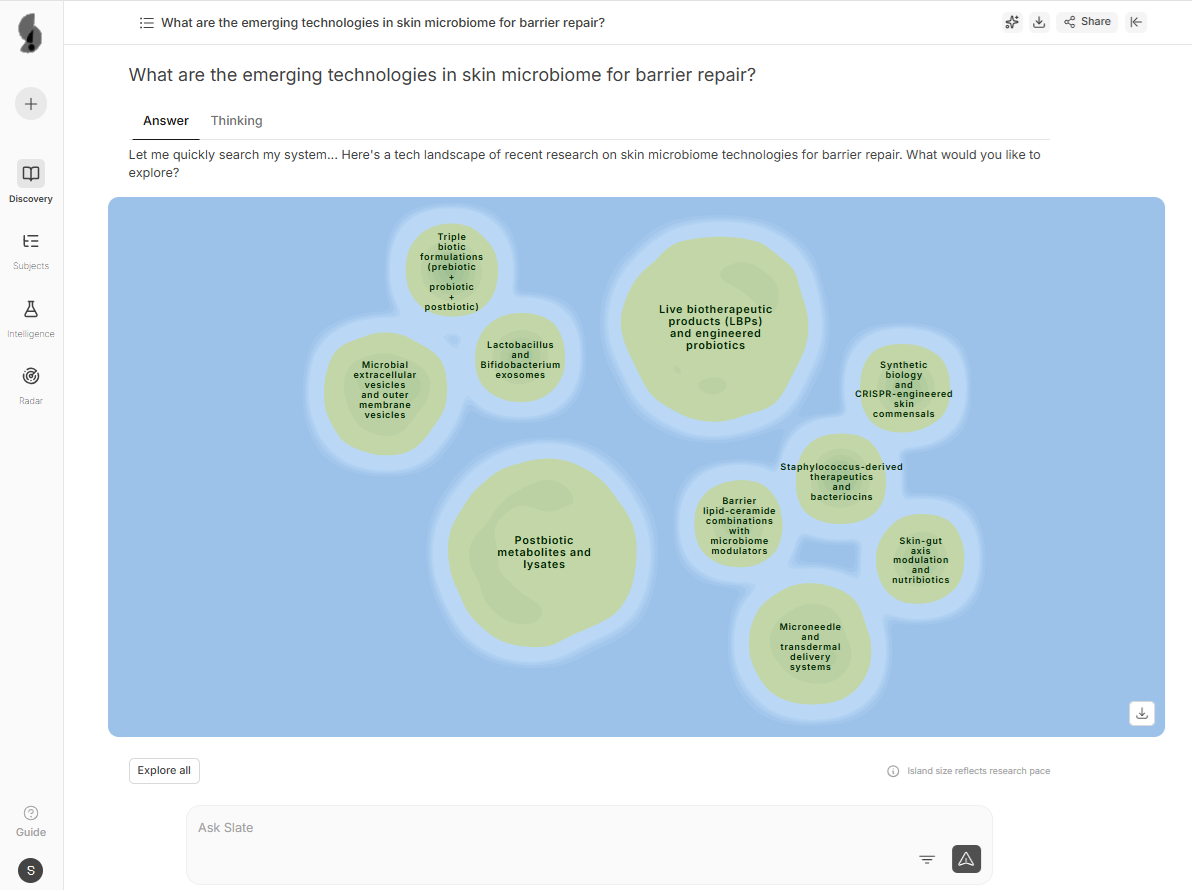
It tracks your domain 24/7 and helps you identify emerging technologies in your specific area across patents, papers, and market data.
Whether you’re evaluating postbiotic strain candidates, tracking live biotherapeutic IP, or scoping a new market entry, Slate is built to accelerate every stage of that process. If your team is navigating the next phase of skin microbiome innovation, Slate gives you the intelligence edge to move first.
In a category where science, claims, and regulation move at different speeds, Slate helps R&D teams build evidence-led product strategies faster.