Over 90% of products marketed as “probiotic” cosmetics contain no live microorganisms. Instead, they deliver postbiotics lysates, ferments, metabolites without disclosing this substitution to consumers or acknowledging it in R&D strategy discussions.
This labeling gap reveals the market has already resolved the live-versus-postbiotic question through revealed preference rather than scientific verdict, yet the industry continues to frame the technology race as open.
For R&D leaders evaluating barrier repair portfolios, this disconnect matters. If your innovation roadmap treats postbiotics as a temporary workaround pending live probiotic scale-up, you are betting against demonstrated commercial trajectory and manufacturing economics. The question is no longer which technology will win, but whether your organization understands which race it is running.
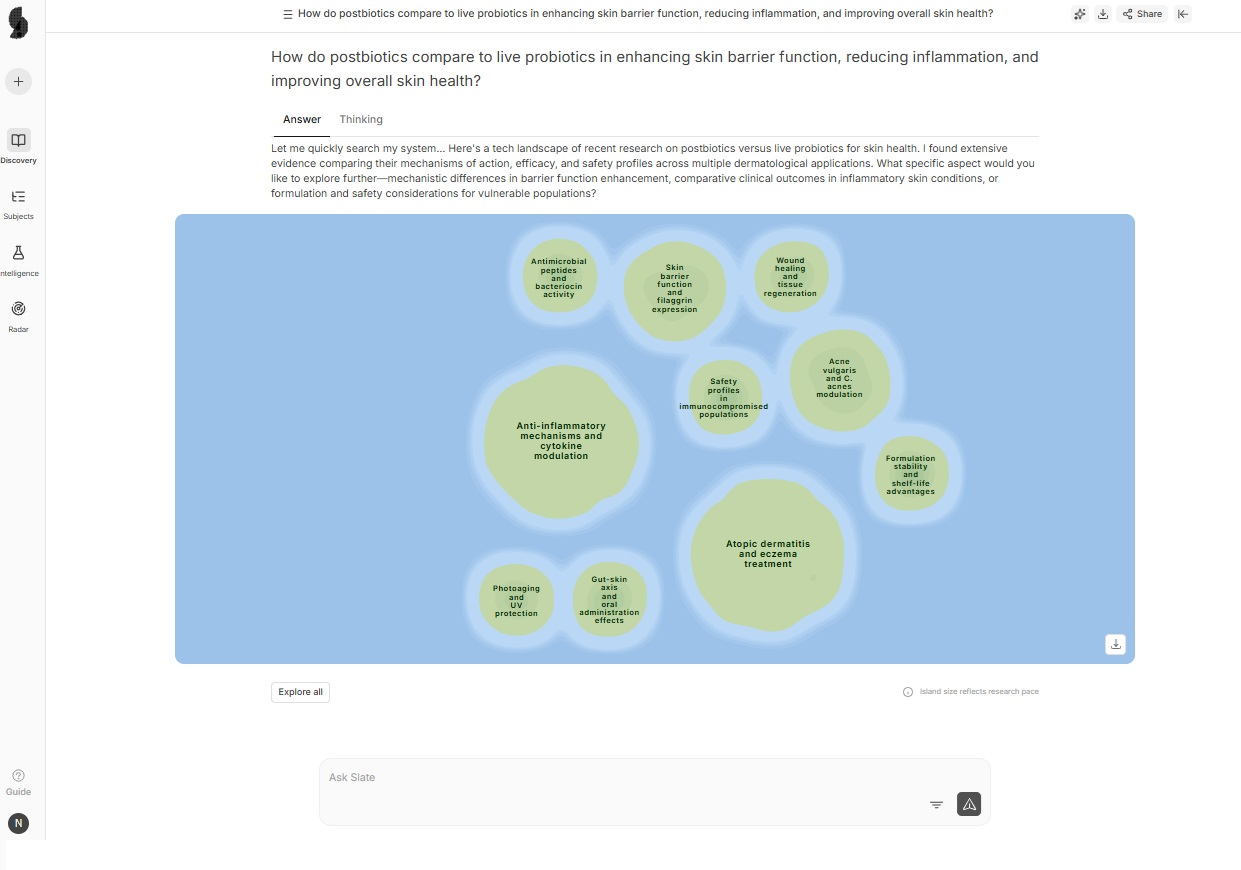
Using Slate – AI R&D intelligence platform, we analyzed the skin microbiome landscape across research papers, patent filings, product launches, supplier moves, clinical evidence, and regulatory signals. The goal was to separate credible science from category noise and identify where beauty R&D teams can still build differentiated products in barrier repair, scalp care, aging skin, men’s skincare, and microbiome-safe formulation.
Why the Skin Microbiome Barrier Repair Market Chose Postbiotics Before the Science Did
Postbiotics now appear in over 40% of 2024 microbiome skincare launches, compared to fewer than 10% containing viable bacteria meeting true probiotic definitions.
The broader $3.2 billion microecological skincare market has bifurcated from the $434.8 million microbiome-specific segment, with postbiotic fermentation filtrates commanding 15–30% lower manufacturing prices in Asian clusters than European precision lysates.
Major corporate moves reveal strategic hedging across both technologies while product pipelines skew heavily postbiotic. L’Oréal acquired Copenhagen-based Lactobio to access its lactobacillus strain biobank.
Beiersdorf purchased S-Biomedic for its clinically substantiated pro- and post-biotic activities derived from true skin commensals . Unilever deployed over 100 patents spanning microbiome research while launching products across Dove, Vaseline, and Dermalogica.
Yet commercial output tells a different story. The CIR Expert Panel cleared four Lactobacillus ferment postbiotic ingredients at up to 5.6% leave-on concentration in September 2025, establishing regulatory precedent unavailable to live formulations.
China’s NMPA processed 102 New Cosmetic Ingredient filings in 2025 alone, with streamlined pathways for fermentation-derived actives including Bifidobacterium longum/Lactose Ferment Lysate.
This is not a scientific verdict that postbiotics outperform live bacteria clinically. It is a formulation of surrender to a preservation paradox that incremental chemistry cannot solve.
The Skin Microbiome Preservation Paradox: Why Live Probiotics Remain Commercially Intractable
Cosmetic formulations require preservative systems to prevent pathogenic contamination and meet safety standards. These same preservatives eliminate the live probiotic strains intended to deliver therapeutic benefit. This is not a stability issue amenable to incremental formulation optimization. It is a category-level incompatibility between cosmetic preservation requirements and bacterial viability.
Advanced encapsulation using alginate microspheres achieves only 6.13 log CFU/g survival after 120 days in preserved bases, versus complete elimination of non-encapsulated strains. This marginal viability requires cold-chain distribution at 2–8°C that segments addressable markets toward premium channels with controlled logistics. Spray-drying encapsulation achieves approximately 78% process yield with 96.5% bacterial survival, but manufacturing complexity constrains batch throughput and elevates unit economics.
EU ISO 17516 microbiological limits mandate ≤1,000 CFU/g for most cosmetics and ≤100 CFU/g for eye-area and children’s products. These thresholds effectively preclude therapeutic probiotic concentrations, which typically range from 10⁵ to 10⁹ CFU/g in clinical studies. The preservation-viability tension is binary, not a spectrum.
The alternative to solving this paradox is bypassing it entirely. Drug-pathway products are exempt from cosmetic preservation rules. Transdermal delivery via microneedles sidesteps topical formulation altogether.
L’Oréal filed a patent on crystallized live Lactobacillus formulations using salt/protein/polysaccharide cryoprotectants, claiming 4–12 hour skin viability post-application via anhydrous matrices and two-chamber packaging separating live bacteria from aqueous phases until activation.
These approaches create strong IP moats and regulatory defensibility but require extended timelines, higher validation burdens, and premium positioning that excludes mass-market channels.
Global Regulatory Fragmentation: How Skin Microbiome Rules Reward Postbiotics and Punish Live Probiotics
Regulatory frameworks across the three largest cosmetic markets have structurally advantaged postbiotics through explicit approval pathways while creating prohibitive barriers for live bacteria in cosmetics.
China’s NMPA has streamlined New Cosmetic Ingredient approvals for fermentation-derived actives via risk-based safety evaluation reducing toxicology trial requirements. South Korea’s MFDS currently prohibits live probiotics in cosmetics entirely, with potential strain-specific approvals beginning 2027 under tightened safety frameworks.
The EU’s ISO 17516 limits and Regulation 1223/2009 absence of microbiome-specific provisions create practical barriers for live bacteria, while SCCS has not published guidance on microbiome-derived ingredients.
US MoCRA enforcement, with 9,528 registered facilities and 589,762 listed products, intensifies scrutiny of the 90% labeling gap between “probiotic” claims and actual postbiotic contents, creating truth-in-labeling exposure. The CIR Expert Panel’s September 2025 clearance of four Lactobacillus ferment postbiotic ingredients at up to 5.6% leave-on concentration establishes precedent unavailable to live formulations.
A global launch strategy for live probiotic cosmetics requires jurisdiction-specific formulations and regulatory pathways that do not converge. China accepts fermentation-derived NCI. Korea prohibits live probiotics until 2027+ strain approvals. The EU requires workarounds for ISO limits.
The US navigates borderline drug risk. This regulatory fragmentation makes global SKU economics unviable for live probiotics, while postbiotics enjoy harmonized pathways. Your commercialization timeline and market access strategy differ by 2–3 years depending on technology choice.
Live Biotherapeutic Skin Products: What L’Oréal’s Crystallized Probiotic Bet Signals for R&D Teams
Live probiotics are not dead as a technology. But the viable commercial pathways bypass the preservation paradox rather than solve it, either through drug-adjacent regulatory routes, premium formats with specialized packaging, or device-combination delivery.
Concerto Biosciences advanced ENS-002, a three-strain live biotherapeutic for atopic dermatitis discovered via the kChip platform into Phase 1b with FDA IND clearance, demonstrating dose-dependent EASI improvements and positive safety with vehicle-controlled efficacy trials planned.
Microneedle platforms encapsulating live Bacillus subtilis in dissolving PVA/PVP matrices achieve bacterial release within 5 hours and over 9-day skin colonization with anti-S. aureus activity, demonstrating intradermal delivery as an alternative to topical formulation.
Investment flows indicate sustained capital commitment.
- Alphyn raised $25 million Series B for Zabalafin Hydrogel Phase 2b for atopic dermatitis.
- OneSkin raised $20 million Series A.
- Symbiome raised $15 million total.
- DERMALA raised $6.73 million Series A co-led by J&J Innovation.
If your live probiotic roadmap assumes incremental encapsulation advances will bridge to mass-market ambient-stable cosmetics, you are pursuing a path the leading players have abandoned.
The capital is flowing toward drug-pathway biotherapeutics or premium specialized formats both of which accept rather than resist the 3–5 year timeline and regulatory burden. The strategic question is whether your organization can capture defensible value from that longer, higher-risk bet, or whether postbiotic speed-to-market better fits your portfolio risk tolerance.
Skin Microbiome White Space: The $45 Billion Men’s Market and Aging Skin Opportunity Your Competitors Are Ignoring
Postbiotics offer 12–18 month launch pathways with regulatory clarity and 15–30% lower manufacturing costs, but limited IP defensibility as fermentation processes and lysate compositions converge toward commodification.
Live biotherapeutics require 3–5 year timelines with drug-adjacent regulatory validation, cold-chain distribution segmenting to premium channels, but create strong IP moats through strain selection, delivery platforms, and clinical differentiation if successful.
Yet both technology paths have conspicuously underinvested in validated white space. Men’s skincare represents a $45 billion market with 68% Gen Z male facial skincare penetration and sebum-driven microbiome differences enabling gender-specific positioning, yet products remain over 90% female-targeted.
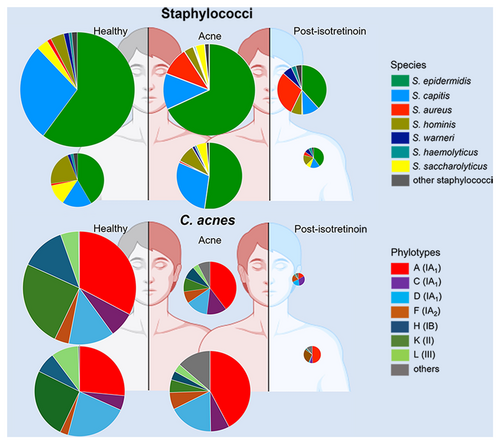
Aging skin microbiome shows validated dysbiosis biomarkers with decreased C. acnes and increased C. kroppenstedtii, and EPI-7 postbiotics demonstrate 12.5% TEWL reduction in split-face trials, yet commercial translation lags clinical readiness. Scalp microbiome products show 9.5% CAGR as the fastest-growing segment but remain technologically derivative rather than purpose-built for follicular ecology.
Your technology choice determines timeline and defensibility, but white space selection determines whether you are first-mover or late-entrant. A postbiotic men’s barrier repair line launching in 2026 captures an underserved $45 billion segment with 12-18 month speed-to-market.
An aging-skin live biotherapeutic with EPI-7 or similar validated strains accepts the 3-5 year timeline but targets a demographic cohort with spending power and clinical substantiation already complete. Both are available. Current market concentration in female facial generics reflects strategic inertia, not technical constraint.
R&D Action Checklist: 5 Portfolio Decisions to Make
Audit your microbiome portfolio against the postbiotic/live biotherapeutic timeline bifurcation. If over 30% of R&D spend assumes solving ambient-stable live probiotic cosmetics, reassess whether your roadmap pursues incremental encapsulation or bypass strategies that accept extended timelines and regulatory burden.
Pressure-test “probiotic” product claims for the 90% labeling accuracy gap. Products marketed as probiotic but containing only postbiotics face intensifying MoCRA truth-in-labeling enforcement and EU borderline drug scrutiny if claims imply microbiome modulation beyond standard cosmetic function. Flag SKUs for claim revision or substantiation upgrade before regulatory exposure.
Monitor L’Oréal’s crystallized live probiotic commercialization timeline and Concerto Biosciences ENS-002 Phase 1b clinical readouts. These represent the two viable live probiotic pathways. If L’Oréal launches without cold-chain at scale by 2027, the preservation paradox has a commercial workaround. If Concerto achieves Phase 2 efficacy, the drug pathway becomes the defensible long-term play.
Evaluate white space opportunities in men’s skincare and aging demographics where postbiotic first-mover advantage remains available. Validated sebum-microbiome differences enable gender-specific positioning, while EPI-7 type postbiotics for aging skin have completed clinical validation but lack commercial translation. Both offer 12-18 month launch pathways with lower competitive intensity than female facial generics.
Reconsider regulatory strategy if pursuing global live probiotic launches. China NCI approval for fermentation-derived postbiotics, Korea prohibition on live probiotics, EU ISO 17516 concentration caps, and US borderline drug risk create jurisdiction-specific pathways that fragment SKU economics. Postbiotics offer harmonized regulatory treatment.
The 2027 Portfolio Question Every Skin Microbiome R&D Leader Needs to Answer Now
The unresolved strategic question is whether postbiotic dominance has captured the commercially viable fraction of the microbiome barrier repair opportunity, making live biotherapeutics a niche premium/therapeutic play, or whether it has foreclosed the optionality of a technology that, if solved at scale, would create IP and regulatory moats postbiotics cannot match. The technical position achievable by 2027 ambient-stable live formulations, FDA-cleared biotherapeutics, or neither will clarify whether the preservation paradox was biologically fundamental or merely premature.
R&D portfolio allocation decisions must be made now, before that clarity arrives.
For teams seeking to accelerate this decision cycle with comprehensive competitive intelligence and technical pathway mapping, Slate offers AI-powered R&D intelligence that surfaces exactly these technology inflection points across microbiome research, regulatory filings, and patent landscapes.
The platform tracks the signals this article identifies L’Oréal’s crystallized probiotic progress, Concerto’s clinical milestones, white space emergence in men’s and aging demographics in real time, enabling portfolio decisions anchored in current data rather than retrospective analysis.
How Slate Gives R&D Teams the Competitive Intelligence Edge in Skin Microbiome Research
When L’Oréal’s crystallized probiotic patent moves from filing to clinical validation, when Concerto’s Phase 1b data lands, when China’s NMPA approves a novel fermentation-derived NCI that reshapes your ingredient sourcing these aren’t events you can afford to reconstruct retroactively from a literature review. By the time they reach a trade publication, your competitors have already responded.
Slate is built for exactly this inflection-point intelligence the kind that R&D leaders in skin microbiome need to make defensible portfolio bets:
Patent signal tracking across live biotherapeutics, encapsulation systems, and postbiotic compositions so you know when L’Oréal, Beiersdorf, Unilever, or an emerging startup files IP that reshapes the competitive map before it’s widely indexed.
Regulatory filing intelligence across NMPA, MFDS, CIR, and MoCRA frameworks so your global launch strategy reflects the actual approval landscape, not last year’s guidance documents. With 102 NCI filings in China in 2025 alone, the window between a competitor’s approval and your awareness of it is the window you cannot afford.
White space identification in underserved demographics, men’s skincare microbiome positioning, aging skin dysbiosis biomarkers, scalp follicular ecology delivered as competitive intelligence, not anecdotal market color.
The researchers and R&D leaders who capture first-mover advantage in the $3 billion barrier repair market won’t be the ones who have the best instincts. They’ll be the ones who had the best information at the moment the decision had to be made.
Explore Slate and see how AI-powered R&D intelligence turns the signals this article identifies patent filings, regulatory moves, clinical milestones, white space emergence into decisions your team can act on today.