China’s 2026 CSAR cosmetics compliance deadlines are no longer upcoming risks. They are now active requirements.
The first wave took effect on March 1, 2026, when China’s NMPA incorporated new and revised cosmetic testing methods into the Safety and Technical Standards for Cosmetics. The second wave took effect on July 1, 2026, adding four more methods, including toxicokinetic testing for previously uncharacterized ingredients.
For beauty brands selling into China, the issue is no longer whether they need to prepare. The issue is which SKUs are now exposed, which dossiers need retesting, and which product launches could face delays if the compliance gap is discovered too late.
Brands that front-load compliance may spend an estimated $15,000–$50,000 per SKU. Brands that wait until non-compliance triggers reformulation may face $50,000–$150,000 per SKU, plus a 6–18-month absence from the China market.
That difference makes CSAR readiness a portfolio strategy decision, not just a regulatory affairs task.
What CSAR Deadlines Actually Require
For regulatory affairs and product development leaders managing portfolios with more than 15% of revenue exposure to China or ASEAN, the preparation window is shorter than 9–13 months.
Lab qualification cycles for the March methods run last 3–6 months.
China’s NMPA confirmed the March 1, 2026 changes through its official standards update, which incorporates 12 new or revised testing methods into the Cosmetics Safety and Technical Standards.
The five methods directly relevant to cosmetic safety assessment from March 1 are:
- BCOP (Bovine Corneal Opacity and Permeability), an eye irritation alternative test
- kDPRA (Kinetic Direct Peptide Reactivity Assay), a skin sensitization assessment
- In vitro skin absorption, a systemic exposure estimation method
- Immunotoxicity assessment, covering immune system safety endpoints
- Oral mucous irritation test, for lip, oral care, and adjacent products
They are mandatory requirements for products submitted for registration or filing after March 1, 2026. Brands using pre-2026 test data for these endpoints will be required to retest upon submission.
For labs not yet qualified for these methods under NMPA-recognized accreditation, qualification cycles run 3–6 months. Any brand that hasn’t started lab coordination for these five methods is already operating inside a compressed window.
The July 1 deadline is confirmed by NMPA Announcement No. 5 of 2026, issued January 12, 2026. Four additional methods take effect:
- BrdU-FCM local lymph node assay, an optimized skin sensitization method using flow cytometry
- Toxicokinetic testing for previously uncharacterized ingredients, the highest-impact addition for brands using novel botanical, fermentation-derived, or biotech actives
- Revised human skin patch test protocol
- Revised human safety in-use test protocol
The toxicokinetic requirement is the sleeper risk in the July set. It applies specifically to new cosmetic ingredients lacking established systemic exposure data.
Brands working with postbiotic actives, fermentation-derived peptides, or any novel botanical complex that hasn’t been characterized under NMPA’s framework are most exposed.
Pre-screening ingredient portfolios for this gap now, before the July deadline, determines which SKUs require new studies and which can proceed on existing dossiers.
Running in parallel with both China deadlines is Indonesia’s October 17, 2026, mandatory halal certification requirement for all cosmetics, mandated under Government Regulation No. 42/2024.
The BPJPH certification process itself takes 28–43 working days once documentation is complete, but the document preparation phase (ingredient compliance review, halal assurance system establishment, supply chain verification, manufacturing facility audit) adds several months of lead time. Industry guidance recommends securing certification by August 2026 at the latest to allow the 60-day buffer needed for label compliance and final registration.
When combined with the BPOM product notification, the effective preparation timeline for Indonesia is 6–12 months. For brands that haven’t started, the window is closing.
One additional signal to flag: China’s May 2026 CBEC (cross-border e-commerce) enforcement tightening is running on the same calendar. CBEC has historically provided a lower-friction China entry pathway, but it does not substitute for NMPA testing compliance, and brands relying on CBEC to defer NMPA-standard safety dossier preparation are compounding their risk exposure.
The Front-Loading Math: Why Proactive Compliance Costs Less Than It Looks
The financial case for front-loading is direct. These cost ranges are analytical estimates from industry benchmark data, not audited figures, but the directional gap is real and material.
| Compliance Scenario | Timeline Impact | Estimated Cost per SKU | Strategic Implication |
| Front-loading: synchronized global launch with China-ready formulation | +3–6 months for general cosmetics; +6–12 months for special cosmetics | $15,000–$50,000 | Avoids reformulation cascade; positions for first-mover advantage |
| ASEAN-harmonized formulation (China CSAR + Indonesia Halal + Philippines ACD) | +12–18 months | $25,000–$75,000 | Unlocks 630 million ASEAN consumers; defensible against regional competitors |
| Retroactive reformulation (non-compliance trigger) | 6–18 months market absence per SKU | $50,000–$150,000 | Revenue gap compounds against rising domestic competition |
The retroactive range includes costs for product withdrawal, reformulation, re-registration, and supply chain requalification. For a 20-SKU portfolio with mixed CSAR risk exposure, retroactive non-compliance is a $1M–$3M unbudgeted liability, plus a China market absence that arrives precisely when domestic brands are consolidating share.
Chinese domestic beauty brands have held majority share in China for several consecutive years, strengthening the risk that any foreign-brand market absence becomes a handover of shelf space and consumer habits.
The third cost scenario, the ASEAN-harmonized formulation at $25,000–$75,000 per SKU, reframes the compliance investment entirely. A single formulation platform compliant with China CSAR, Indonesia’s mandatory halal certification, and the Philippines ACD annex grants market access to 630 million consumers across three distinct regulatory jurisdictions. On a per-consumer-reached basis, this is a market-access investment with a calculable return, not a cost center.
The competitive moat dimension: China’s NMPA requires a 3-year safety monitoring period for newly registered high-risk ingredients, including novel preservatives, UV filters, whitening agents, and novel postbiotic or fermentation-derived actives. During this monitoring period, only the registrant (or companies explicitly authorized by the registrant) may use the ingredient in the Chinese market.
Brands that front-load ingredient notifications for next-generation actives don’t just comply. They lock competitors out of using those actives in China for three years.
This transforms the registration investment from a compliance cost into a market position. It’s the argument that converts the front-loading decision from a regulatory obligation into a strategic offensive move, and it’s the argument most regulatory and product teams haven’t yet made to their commercial leadership.
A Portfolio Segmentation Framework for the March and July 2026 Compliance Decisions
The compliance investment cannot be uniform across a portfolio. Priority should be determined by three variables.
Variable 1: CSAR Risk Classification
China’s CSAR separates cosmetics into two tiers with distinct pathways:
- Special cosmetics (hair growth, whitening, sunscreen, anti-hair loss, permanent wave) require full NMPA registration: 12–24 months and $15,000–$50,000+ per SKU. These SKUs are most affected by the March/July testing method updates because any re-registration triggered by method non-compliance requires a full registration renewal.
- General cosmetics require filing: 3–6 months and $5,000–$15,000 per SKU. Filing is faster, but products submitted after March 1 must include compliant test data for the newly mandated methods.
The May 1, 2025, full safety assessment report requirement, which NMPA already enforces, means any brand still operating on simplified reports is non-compliant and should treat the March 2026 testing method update as the second compliance event in an ongoing sequence.
Variable 2: Testing Method Vulnerability
Segment the ingredient portfolio by exposure to the newly mandated methods. The highest-risk ingredients for the March set are those with sensitization potential assessed using older methods (e.g., traditional guinea pig assays rather than kDPRA) and those with limited characterization of skin absorption. The highest-risk ingredients in the July set are novel actives, including fermented peptides, postbiotic lysates, and botanical complexes, for which toxicokinetic data are incomplete.
Botanee, the parent company of Winona, appears to be moving early on China’s new cosmetic ingredient registration window. GreyB’s internal analysis flags 20+ new cosmetic raw material registrations linked to Botanee/Winona ahead of the 2026 CSAR testing updates, suggesting a strategy built around compliance readiness and ingredient exclusivity.
Variable 3: ASEAN Halal Exposure
Map which SKUs are targeted at Indonesia with active efficacy claims. Products making anti-aging, microbiome balance, or intimate care efficacy claims in Indonesia require BPOM product information files plus halal certification. The October 2026 deadline applies to all cosmetics sold in Indonesia, not just those making efficacy claims. Products with efficacy claims also require separate substantiation documentation, extending the total preparation time.
Recommended Action Plan
Immediate: Run a CSAR Gap Audit
Identify all SKUs submitted or planned for NMPA registration or filing after March 1, 2026. Check whether existing data covers BCOP, kDPRA, in vitro skin absorption, immunotoxicity, and oral mucous irritation under NMPA-recognized methods. Flag any SKU using older safety data for retesting.
Q3 2026: Screen Novel Actives for Toxicokinetic Risk
Review all novel botanical, fermentation-derived, biotech, postbiotic, and peptide-based ingredients. Identify where systemic exposure data is missing or not aligned with the July 1, 2026 requirements. Commission studies for high-value SKUs first.
Q3 2026: Prepare Indonesia Halal Documentation
For Indonesia-targeted SKUs, verify ingredient halal status, supplier documentation, manufacturing controls, and label implications. Do not wait until the certification filing stage. The documentation work is usually the bottleneck.
Q3–Q4 2026: Decide Which Ingredients Deserve Early Registration
Identify high-value novel actives that could support product differentiation in China. Assess whether early notification or registration could secure the 3-year ingredient advantage before competitors move.
Ongoing: Build a Regional Compliance Platform
Treat China CSAR, Indonesia halal, and ASEAN product notification as connected decisions. The goal is not to make one SKU compliant in one market. The goal is to build formulations that can move across high-growth Asian beauty markets with fewer redesign cycles.
Key Takeaways
- March 1, 2026 is confirmed. NMPA’s official standards update incorporates 12 new testing methods, including BCOP, kDPRA, in vitro skin absorption, immunotoxicity, and oral mucosal irritation, all of which are mandatory for products submitted after that date. Lab qualification cycles take 3–6 months.
- July 1, 2026 is confirmed. NMPA Announcement No. 5 of 2026 (issued January 12, 2026) mandates four additional methods, including BrdU-FCM local lymph node assay and toxicokinetic testing for previously uncharacterized ingredients (the highest-impact update for brands using novel biotech or fermentation-derived actives).
- Retroactive reformulation costs an estimated 2x–10x as much as front-loading. Analytical estimates place the cost of retroactive reformulation at $50,000–$150,000 per SKU, with a 6–18-month market absence. Front-loading runs $15,000–$50,000 per SKU. For a 20-SKU non-compliant portfolio, the unbudgeted retroactive liability reaches $1M–$3M.
- Indonesia’s October 17, 2026 halal mandate is running in parallel. The BPJPH certification process takes 28–43 working days once the documentation is ready, but preparing the documentation can take months. Industry guidance recommends submitting by August 2026 at the latest. Non-compliant products face market exit from a 270-million-consumer market.
- China’s 3-year ingredient exclusivity window is a competitive moat, not just a compliance step. Brands that front-load novel ingredient notifications lock competitors out of using those actives in China during the monitoring period. Brands that wait forfeit that exclusivity to whoever moves first.
The March and July 2026 deadlines are firm. The preparation window to avoid retroactive reformulation costs and capture the 3-year ingredient exclusivity available to first movers is measured in weeks for some SKUs, not months.
How Slate Helps Beauty Teams Stay Ahead of Compliance Risk
The March and July 2026 CSAR updates show why regulatory monitoring cannot sit at the end of the product development cycle.
For beauty brands managing China and ASEAN exposure, the challenge is not only tracking new rules. It is knowing which ingredients, claims, SKUs, suppliers, and launch markets are affected before the cost of correction rises.
SLATE, an AI-powered R&D intelligence platform helps R&D, regulatory, and innovation teams connect these signals early. It tracks regulatory updates, ingredient filings, safety requirements, market activity, and competitor movement in one place, so teams can see where a portfolio is exposed and where early action can create an advantage.
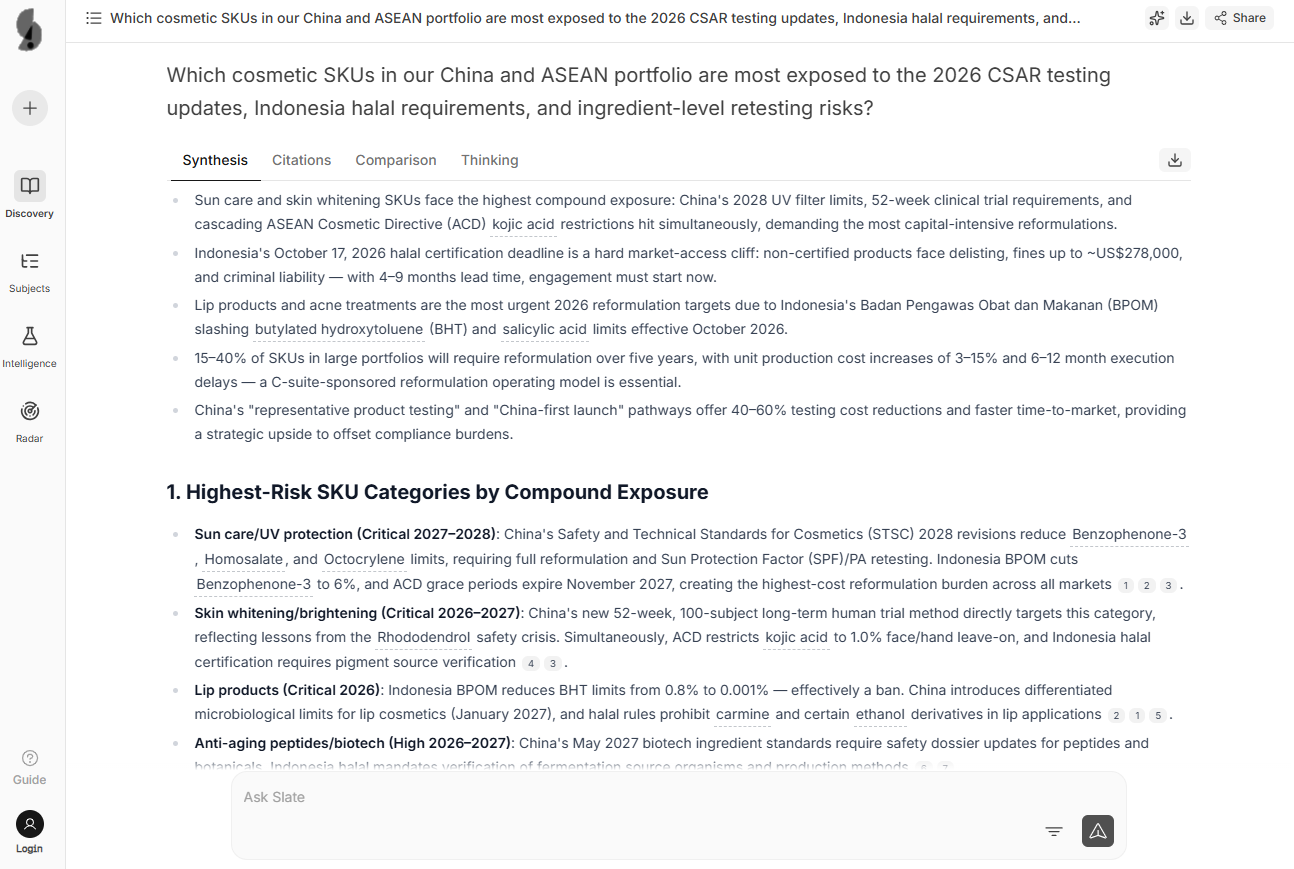
For CSAR readiness, this means identifying SKUs that may need new test data, spotting ingredients exposed to toxicokinetic review, comparing China requirements with ASEAN market-access needs, and prioritizing which reformulations or registrations deserve investment first.
The brands that win in this environment will not be the ones that react fastest after a compliance issue appears. They will be the ones that see the risk while it is still a planning decision.
Explore Slate to map regulatory exposure across your cosmetics portfolio before the next launch, filing, or market-entry decision.