
If you sell anything packaged in the EU, the clock is ticking, and it’s getting louder by the day. The Packaging and Packaging Waste Regulation (PPWR), officially Regulation (EU) 2025/40, entered into force on February 11, 2025, and will apply from August 12, 2026, replacing the 30-year-old Packaging Directive across all 27 EU member states.
And almost nobody is exempt. Manufacturers, importers, distributors, and e-commerce operators placing packaging on the EU market all need to assess their obligations, and that net extends to fulfillment providers, marketplaces, and small online sellers shipping into Europe.
So what actually changes? Everything about how packaging is designed and documented: recyclability, recycled content, labelling, reuse systems, empty-space ratios, and overall waste reduction all come under one roof.
In today’s guide, we’ll walk you through PPWR compliance guide & related information. Let’s delve into it.

What is PPWR & Why Does it Matter?
Simply put, PPWR is the EU’s new packaging law. It sets rules for how packaging is designed, labelled, used, collected, reused, recycled, and disposed of. It replaces the older Packaging and Packaging Waste Directive and creates one common framework across all 27 EU member states.
The key shift is that PPWR is a regulation, not a directive. A directive sets goals and lets each country decide how to apply them through national laws. A regulation applies directly across the EU. This means businesses will not need to follow 27 different national versions of the same core rule.
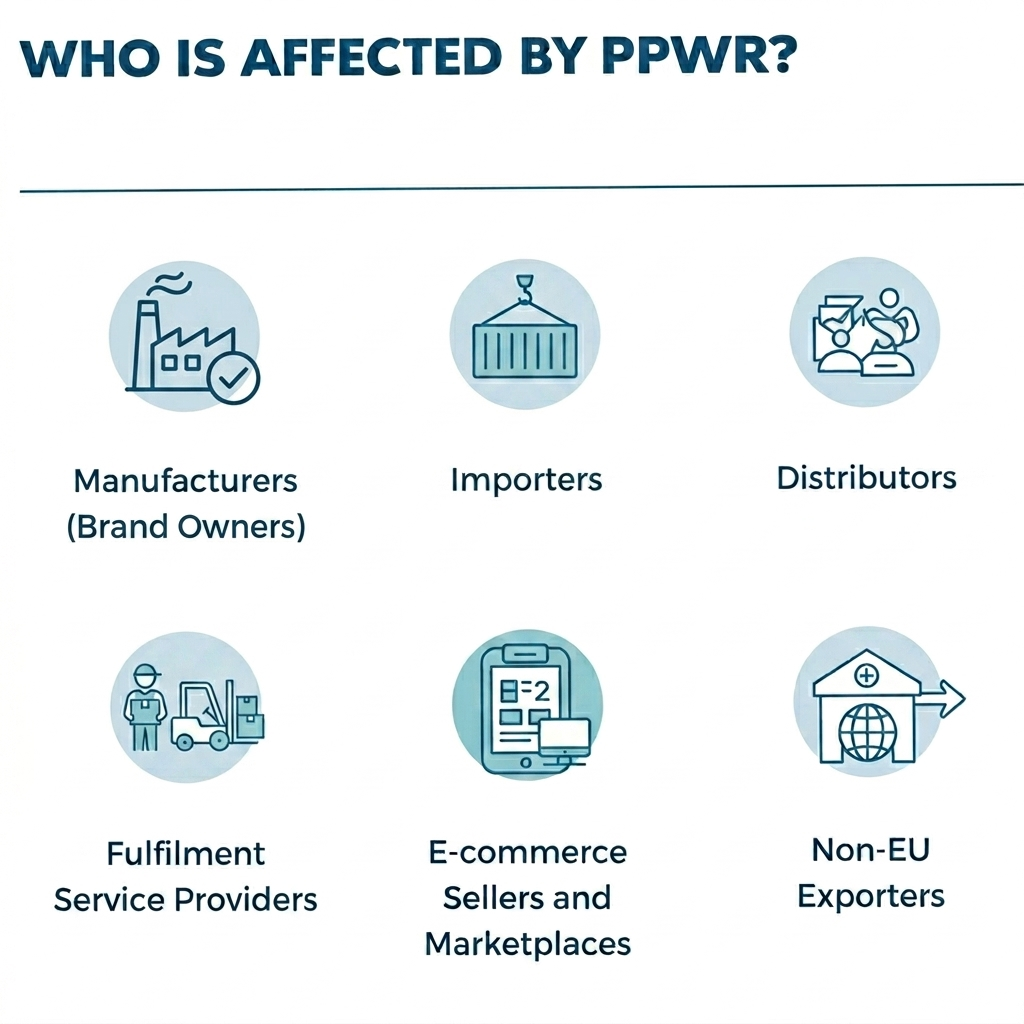
For companies, PPWR turns packaging into a compliance and market-access issue. Any business placing packaged goods on the EU market, including brands, manufacturers, importers, distributors, e-commerce sellers, fulfilment providers, marketplaces, and non-EU exporters, will need to ensure its packaging meets PPWR requirements.
| Why does it matter? | What does it mean for your business? |
| It applies across the packaging chain | PPWR covers packaging placed on the EU market, regardless of material, sector, or origin. This includes retail, industrial, e-commerce, transport, and household packaging. |
| It affects market access | Packaging that fails PPWR requirements may create shipment delays, customer disputes, supplier issues, or rejected goods. Compliance is no longer only a sustainability concern. |
| Targets packaging waste at source | Companies will need to reduce unnecessary layers, oversized packs, excess material, & empty space instead of relying only on recycling claims. |
| It changes packaging design decisions | By 2030, packaging placed on the EU market must be recyclable by design. |
| It raises recycled content expectations | Plastic packaging will need to meet recycled content requirements over time. This will require better supplier data, traceability, & proof of material composition. |
| Makes labelling stricter | Disposal, sorting, reuse & return information will need to become clearer & consistent. Brands may need to update labels across product lines & markets. |
| Affects eCommerce packaging | Oversized boxes and excessive fillers will come under closer scrutiny. Fulfilment teams will need to review box sizes, void-fill use, & packaging automation rules. |
| Increases the burden of proof | Businesses will need technical documentation, supplier declarations, material data, & declarations of conformity. Claims will need evidence behind them. |
Key Objectives of PPWR
At its core, PPWR packaging compliance is built around a few clear goals: reducing packaging waste while making packaging easier to reuse, recycle, and manage across the EU. It is not only about changing materials. It is about changing how packaging is designed, used, documented, collected, and recovered.
1. Cut packaging waste at the source
PPWR sets progressive packaging waste reduction targets, requiring member states to achieve a 5% reduction by 2030, 10% by 2035, and 15% by 2040, compared to 2018 levels. This isn’t about recycling more; it’s about generating less packaging in the first place.
2. Make every piece of packaging recyclable
One of the headline goals is to make all packaging on the EU market recyclable in an economically viable way by 2030. That means packaging must be designed so all of its parts can be used for something else afterward, instead of valuable material being dumped or burned.
3. Push recycled content back into the loop
The regulation also aims to safely increase the use of recycled plastics in packaging, and plastic packaging must be made in part from recycled content, with increasing targets set for 2030 and 2040.
4. Minimize packaging
No more layers of useless packaging or filler pellets in deliveries: the goal is small, light packaging without empty space. Article 10 specifically requires packaging to be minimised, and excessive packaging materials, weight, and volume must be avoided to reduce waste generation.
5. Standardize labelling so sorting actually works
The aim is no more confusing labels or complicated colour codes; people should be able to see what packaging is made of, where to bin it, and how to return it for reuse.
6. Scale up reuse and refill systems
Deposit and return systems will be boosted as part of the push toward reusable packaging models, particularly for beverage containers and transport packaging.
7. Reduce reliance on virgin raw materials
The broader rules aim to minimise the quantities of packaging and waste generated while lowering the use of primary raw materials directly supporting the EU’s resource-efficiency goals.
8. Anchor everything in the circular economy and climate targets
Ultimately, the goal is to foster the transition to a circular, sustainable, and competitive economy, and the regulation sits at the centre of the EU’s broader push toward its 2050 climate neutrality target.
Taken together, these objectives explain why PPWR feels so sweeping compared to the old directive; it’s not tweaking packaging rules at the margins, it’s redesigning the entire lifecycle of packaging from production to disposal.
Who Is Affected by PPWR?
Here’s a breakdown of who falls where; and what that actually means for each.
Manufacturers (Brand Owners)
A manufacturer under PPWR is defined as the company that designs or commissions packaging and places it on the EU market under its own name or trademark and there can only be one manufacturer per supply chain.
This is where the heaviest obligations sit: issuing the EU Declaration of Conformity, holding technical documentation, and ensuring packaging meets design, substance, and labelling requirements.
Producers and brand owners must also complete EPR registration in every EU member state where their products are sold, carrying financial obligations in every market where the product appears.
Importers
An importer is any company that brings complete packaging or packaged products into the EU from a third country movement within the EU makes you a distributor. Article 18 requires importers to verify supplier Declarations of Conformity, retain them for 5 to 10 years, and respond to authority requests within 10 days.
Here’s the catch many businesses miss: importers who sell under their own brand trigger Article 21, effectively becoming manufacturers with full Declaration of Conformity and conformity obligations.
Distributors
Distributors are responsible for checking packaging compliance, but not for the underlying documentation; they must verify labels and refuse to sell non-compliant items. They are defined as companies that make packaging available on the market but are not the manufacturer, importer, or producer. A lighter obligation on paper, but the practical risk is real stocking non-compliant packaging exposes distributors to enforcement action just as much as anyone else in the chain.
Fulfilment Service Providers
Fulfilment service providers companies that provide warehousing, packaging, addressing, and dispatching services are explicitly named as economic operators under PPWR. If you pick, pack, and ship on behalf of brands, you’re in scope.
E-commerce Sellers and Marketplaces
E-commerce is one of the sectors most impacted by PPWR packaging compliance, facing substance, design, labelling, packaging minimisation, and EPR obligations in every EU market they sell into. Marketplaces facilitating sales of packaged goods into the EU carry obligations too; the regulation does not let platforms off the hook simply because they are intermediaries.
Non-EU Exporters
Geography is no shield. All companies that place packaging or packaged goods on the market in the EU are affected, regardless of size, sector, or distribution channel, including importers from non-EU countries. A US, UK, or Asian brand selling packaged goods into the EU whether directly or through distributors must ensure their packaging meets PPWR requirements, or risk goods being rejected at the border.

Key Compliance Requirements of PPWR
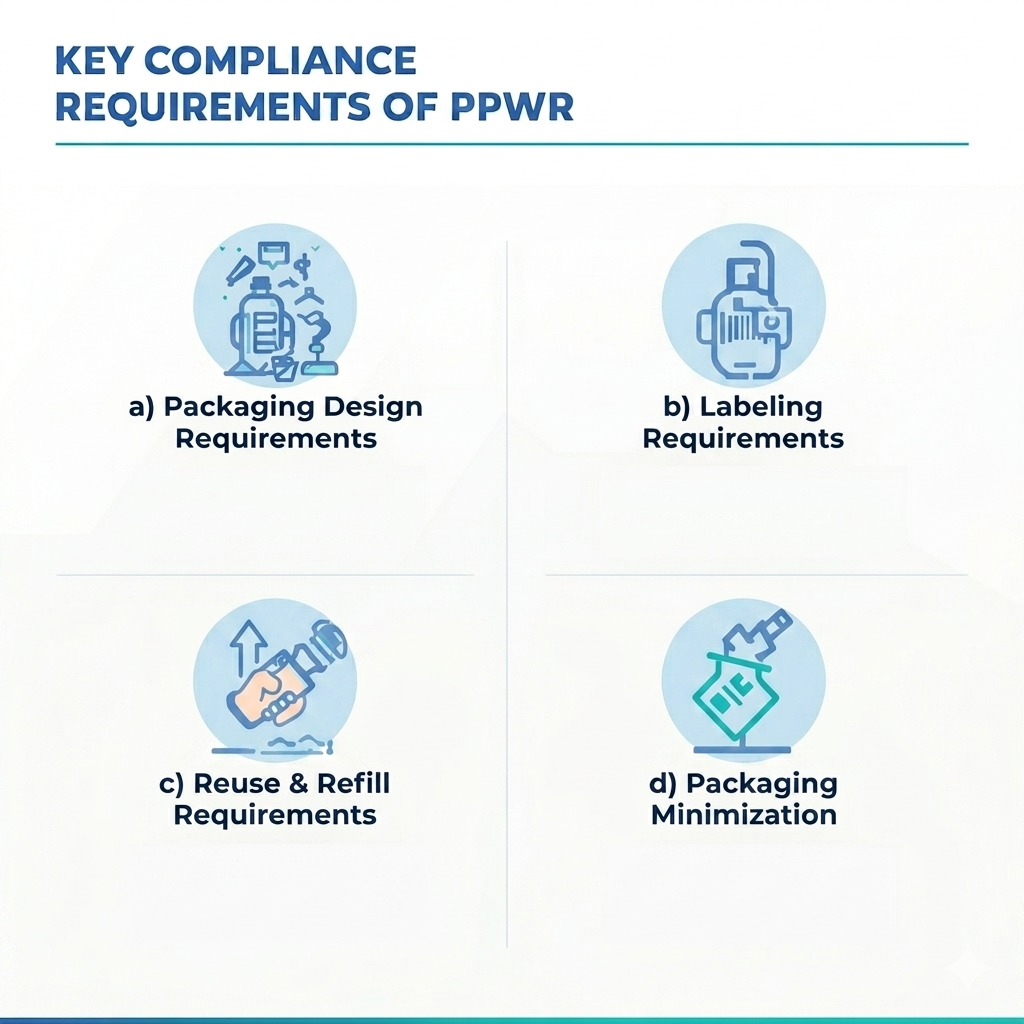
PPWR’s packaging compliance requirements span the entire packaging lifecycle, but for most businesses, four areas demand the most immediate attention: design, labelling, reuse/refill, and minimization. Here’s what each one actually involves.
a) Packaging Design Requirements
PPWR will change how packaging is designed and engineered. Companies need to check the full packaging system, not just the main material. Coatings, inks, adhesives, labels, closures, laminates, barriers, prints, and additives can all affect compliance.
Key design checks include:
- Recyclability by design: By 2030, packaging placed on the EU market must be recyclable in an economically viable way. Businesses need to check whether each pack can be sorted, separated, and recycled in practice.
- Packaging components: Compliance should cover the full pack, including labels, closures, coatings, adhesives, barriers, inks, and additives. One non-recyclable component can affect the recyclability of the entire pack.
- Recycled content: Plastic packaging will need to meet minimum recycled content targets from 2030. Requirements may vary by packaging type and contact sensitivity, especially for food-contact and pharmaceutical packaging.
- Restricted substances: Packaging must contain no, or only minimal amounts of, harmful substances. This applies to the packaging material and its components, including prints, coatings, labels, and adhesives.
- PFAS in food-contact packaging: Food-contact packaging will face specific PFAS concentration limits from August 2026. Brands should check coatings, grease-resistant layers, water-resistant treatments, and supplier declarations.
- Heavy metals: Existing limits for lead, cadmium, mercury, and hexavalent chromium continue to apply. Companies should keep supplier declarations and material test data ready.
- Compostable packaging: Compostable packaging should only be used where PPWR allows or requires it. Companies should avoid assuming that “compostable” automatically means compliant.
- Harmonised standards: Relevant standards, such as EN 13428:2004 for source reduction, can support compliance. However, businesses should monitor updates as PPWR implementation develops.
For businesses, the practical step is to run a technical design review for every packaging format before August 12, 2026. A pack may look sustainable packaging, but it can still create compliance risk if one coating, label, adhesive, barrier, or additive prevents recycling or weakens the evidence file.
b) Labeling Requirements
PPWR aims to make packaging labels clearer and more consistent across the EU. The goal is to help consumers understand what the packaging is made of, how it should be sorted, whether it can be reused, and where it should be returned.
Key labelling checks include:
- Material composition labels: Packaging will need harmonised labels showing what material it is made from and how it should be sorted. These labels are expected to replace confusing or inconsistent national symbols across EU markets.
- Sorting and disposal instructions: Labels should clearly tell consumers where the packaging should go after use. This means brands will need to review binning instructions, recycling symbols, and disposal claims across product lines.
- Reusable packaging labels: Reusable packaging will need clear information on reuse potential, return points, collection systems, and proper handling. QR codes may be used to provide additional details where required.
- Digital labels and QR codes: PPWR allows or requires digital information in certain cases, such as QR codes or similar data carriers. These may link to details on material composition, recyclability, reuse, collection, or return systems.
- Deposit return markings: Packaging covered by deposit return systems may need specific markings so consumers know where and how to return it.
- Small packaging formats: Very small packaging may be allowed to use a QR code or digital data carrier where there is not enough physical space for full label information.
- Language requirements: Label information and linked digital content should be available in the language required for the EU market where the product is sold.
- No misleading sustainability claims: Labels, symbols, or claims must not mislead consumers about recyclability, reusability, compostability, recycled content, or overall environmental performance.
- Durability and visibility: Labels and QR codes should be clear, visible, and difficult to remove. Brands should avoid placing key compliance information where it can fade, peel off, or become unreadable.
- National label clean-up: PPWR is expected to reduce reliance on different national labelling systems. Brands selling across multiple EU countries should map current labels and prepare for harmonised EU rules.
For businesses, the practical step is to create a label inventory for every packaging format before August 12, 2026. This should include material symbols, disposal instructions, recycling claims, reuse information, QR codes, deposit markings, and country-specific label variations. The aim is to remove confusing labels, prepare for harmonised EU requirements, and ensure every claim can be backed by evidence.
c) Reuse & Refill Requirements
PPWR encourages businesses to move away from single-use packaging where reuse or refill models make practical sense. But a pack cannot be called reusable just because it is stronger, refillable once, or made from durable material. It must be designed to work within a real reuse system.
Key reuse and refill checks include:
- Reusable by design: Packaging should be designed for multiple trips, rotations, or uses without losing its function, safety, or quality.
- Return or collection system: Businesses need a clear way for the packaging to come back after use. This could include return points, take-back systems, deposit schemes, or collection through business partners.
- Cleaning and reconditioning: Reusable packaging should be capable of being cleaned, repaired, refilled, or reconditioned where needed before being used again.
- Consumer instructions: Labels or digital information should tell users how to return, refill, reuse, or handle the packaging correctly.
- Reuse-system details: For reusable packaging, businesses may need to provide information on the reuse system, collection points, and return process through a QR code or similar digital carrier.
- Tracking of reuse cycles: Companies may need a way to monitor how often packaging is reused, especially for transport packaging, refill systems, and returnable formats.
- Return incentives: Deposit systems or other incentives may be needed to make sure packaging actually comes back and is reused, rather than discarded after one use.
- Reuse labelling: From February 2029, reusable packaging is expected to carry a harmonised label showing that it is reusable, with additional reuse and collection information available digitally.
- Sector impact: These requirements matter most for food service, beverages, cosmetics, household care, e-commerce, transport packaging, and refill-based retail models.
- No weak reuse claims: Companies should avoid calling packaging reusable unless they can prove both parts: the packaging is fit for repeated use, and a working reuse system exists behind it.
For businesses, the practical step is to create a reuse assessment for every packaging format marketed as reusable, refillable, returnable, or deposit-based. The assessment should cover the pack design, number of expected reuse cycles, return route, cleaning or reconditioning process, consumer instructions, and evidence that the system works in practice.
d) Packaging Minimization
PPWR makes packaging minimisation a compliance requirement, not just a cost-saving exercise. Companies need to reduce packaging weight, volume, and empty space to the minimum needed for product protection, safety, hygiene, transport, shelf life, and legal information.
Key minimisation checks include:
- Weight and volume reduction: Packaging should not use more material than needed. Businesses need to review whether each pack can be made lighter, smaller, or simpler without affecting product safety or performance.
- Empty-space control: Grouped packaging, transport packaging, and e-commerce packaging will need to meet stricter empty-space rules. From 2030, the maximum empty-space ratio is expected to be capped at 50% for these formats.
- E-commerce packaging: Online sellers and fulfilment providers should review box sizes, mailers, void-fill use, cushioning rules, and automated packing systems. Oversized boxes and excess fillers may create compliance risk.
- Fillers count as empty space: Materials such as paper cuttings, air cushions, bubble wrap, foam, wood wool, and loose-fill chips should not be treated as a workaround. They can still count toward empty space.
- No misleading pack volume: PPWR targets packaging features that make a product look bigger than it is. This includes double walls, false bottoms, unnecessary layers, and oversized outer packaging used mainly for appearance.
- Sales packaging review: For sales packaging, companies should assess whether the pack size and material use are justified. Until updated PPWR methods are finalised, standards such as EN 13428:2004 can support source-reduction assessments.
- Format restrictions from 2030: Some single-use packaging formats listed under PPWR may be restricted from 2030. Businesses should identify affected formats early, especially in food service, hospitality, fresh produce, and small single-use packs.
- Evidence file: Companies should keep a minimisation file for each major packaging type. This should explain why the chosen size, weight, wall thickness, material, and empty space are necessary.
For businesses, the practical step is to run a packaging minimisation review across all SKUs before August 12, 2026. The review should flag oversized packs, unnecessary layers, excessive void fill, double walls, false bottoms, and packaging formats that may need redesign before 2030.
Timeline & Implementation Phases
PPWR will not apply all at once. The regulation starts with the main ppwr compliance date in 2026, but several requirements phase in over the following years. This gives businesses time to redesign packaging, update labels, collect supplier data, and build the documentation needed to prove compliance.
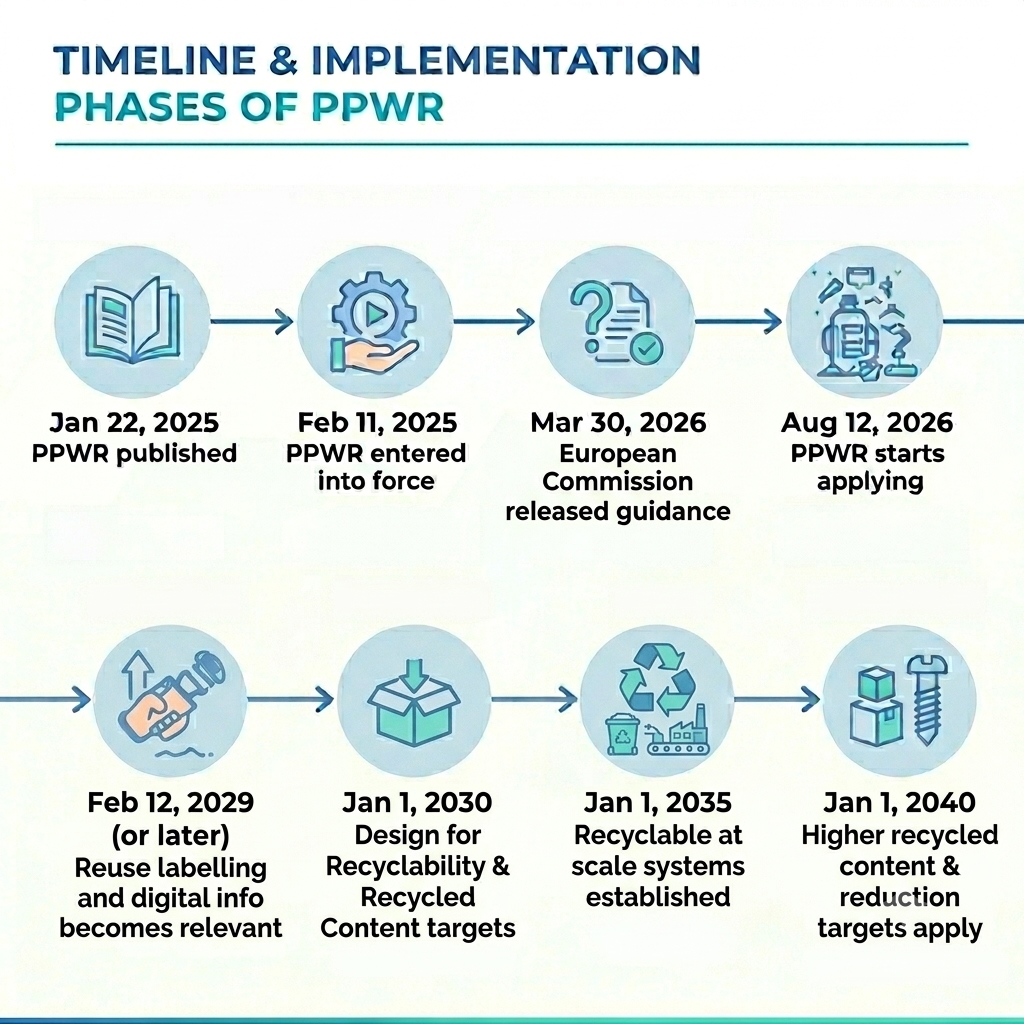
| Timeline | What Happens? |
| January 22, 2025 | PPWR was published in the Official Journal of the European Union |
| February 11, 2025 | PPWR entered into force |
| March 30, 2026 | The European Commission published guidance and FAQs to support implementation |
| August 12, 2026 | PPWR generally starts applying across the EU |
| August 12, 2028 (or later) | Harmonised labelling requirements begin applying, depending on the timing of implementing acts. |
| February 12, 2029 (or later) | Reuse-related labelling and digital information requirements become more relevant for reusable packaging. |
| January 1, 2030 | Major requirements begin: design for recyclability, recycled content targets for plastic packaging, packaging minimisation, empty-space limits, and restrictions on certain single-use formats. |
| January 1, 2035 | Packaging must be recyclable at scale through established collection, sorting, and recycling systems. |
| January 1, 2040 | Higher recycled content thresholds and long-term packaging waste reduction targets apply |
Step-by-Step Guide to Prepare for PPWR Packaging Compliance
With the timeline now mapped out, here’s how to actually turn it into an action plan. Here are some steps needed to happen before August 2026, others can be sequenced over the next few years.
Step 1: Audit your Current Packaging Portfolio
Start by cataloguing every packaging type you place on the EU market: sales packaging, grouped/multipack, transport, and e-commerce shipping materials. For each, document the material composition, weight, volume, and any existing certifications. This audit becomes the foundation for everything else, since most PPWR obligations are assessed at the SKU/packaging-type level, not at the company level.
Step 2: Map your Obligations by Role
Your responsibilities differ depending on whether you’re the manufacturer (brand owner), importer, or distributor. If you’re importing from outside the EU, you inherit responsibility for verifying labelling and compliance documentation. Identify which role applies to each product line some companies are manufacturers for certain SKUs and importers for others.
Step 3: Assess recyclability against design-for-recycling criteria
Evaluate each packaging type against the recyclability requirements that will determine its grade (A-C acceptable from 2030, A-B only from 2038). Flag any materials, components, adhesives, or inks that could block recyclability; this is where most redesign work originates, and it has the longest lead time.
Step 4: Check substance compliance now
Since PFAS restrictions and tightened heavy metal limits apply from August 12, 2026, this is the most time-sensitive item. Test or obtain certifications for food-contact packaging and any materials that might contain restricted substances. This can’t wait for the broader 2030 deadlines.
Step 5: Calculate and address empty space ratios
Measure empty space across sales, grouped, transport, and e-commerce packaging. Identify formats that rely on double walls, false bottoms, unnecessary layers, oversized boxes, or excess void fill. These features can create packaging minimisation risks under PPWR and should be reviewed as part of the packaging redesign process.
Step 6: Review and update recycled content levels
For plastic packaging, start tracking current recycled content percentages against the targets that apply from January 1, 2030 (with differentiated targets for food-contact vs. non-food-contact packaging). If you’re not yet sourcing recycled materials, begin supplier conversations now recycled material supply chains take time to establish.
Step 7: Prepare your Declaration of Conformity and technical documentation
Every packaging type needs an EU Declaration of Conformity under Article 39, plus supporting technical documentation, ready by August 12, 2026. Assign ownership of this documentation internally and build a system to keep it current as packaging designs change.
Step 8: Plan your labelling overhaul
Even though harmonised labels don’t land until August 2028 (material composition) and February 2029 (reusability), the data infrastructure needs to exist well before then. Start building an SKU-level database of material composition, recycled content, and disposal information now, since this data will feed both physical labels and QR-code digital carriers.
Step 9: Register with relevant EPR schemes
Register with Producer Responsibility Organisations (PROs) and national packaging registries in each EU member state where you place packaging on the market. Note that some EPR-linked digital labelling requirements can become mandatory at the national level from February 2027.
Step 10: Build reuse/refill systems where applicable
If any packaging is marketed as reusable, ensure it meets the Article 11 design criteria (applying from 12 August 2026) and start planning for collection points and reuse-system infrastructure, since reusability labelling becomes mandatory from February 2029.
Step 11: Monitor implementing and delegated acts continuously
Several key methodologies: recyclability grading, empty-space ratio calculations, recycled content verification are still being finalized through rolling implementing acts. Assign someone (internally or via a compliance partner) to track Commission updates so your documentation stays current as specifics solidify.
Step 12: Document everything for audit-readiness
Build a centralized compliance file per packaging type containing test results, certifications, supplier declarations, and the Declaration of Conformity. This is what regulators or customers may request, and retroactive documentation is far harder than building it in real time.
PPWR Compliance: Common Challenges Businesses Face
Even with a clear roadmap, PPWR compliance isn’t simple in practice. Here are the friction points businesses are running into most.
Supply chain dependency and lead times. Recycled content, recyclable materials, and substance-compliant packaging all depend on suppliers and recycled material supply chains, in particular, are still maturing. A business ready to redesign packaging can still be stuck waiting on a supplier who isn’t ready to provide compliant inputs at scale.
Cost of redesign across large SKU portfolios. For companies with hundreds or thousands of SKUs, redesigning packaging for recyclability, adjusting dimensions for empty-space limits, and reformulating materials to meet substance restrictions adds up fast both in direct redesign costs and in re-testing, re-certifying, and updating artwork.
Regulatory uncertainty from pending implementing acts. A meaningful chunk of PPWR recyclability grading methodology, empty-space ratio calculation methods, harmonised pictogram designs, recycled content verification is still being defined through delegated and implementing acts arriving through 2027-2028. Businesses have to make design and investment decisions now, without full certainty about the exact technical specifications they’ll eventually need to meet.
Coordinating across multiple roles and jurisdictions. A company might be a manufacturer for some products and an importer for others, with different obligations attached to each role. On top of that, EPR registration has to happen separately in each EU member state where packaging is placed on the market multiplying administrative work.
Data infrastructure gaps. Harmonised labelling and digital data carriers require SKU-level data on material composition, recycled content percentages, and disposal instructions data that many companies simply don’t have centralized or standardized today. Building this database is often a bigger lift than the labelling redesign itself.
Balancing functionality with minimization rules. Reducing empty space and packaging weight can’t compromise product protection, especially for fragile, perishable, or high-value goods. Finding designs that meet both the empty-space caps and practical shipping requirements often takes multiple redesign iterations.
Keeping pace with a moving regulatory target. PPWR isn’t a “comply once” regulation; it phases in obligations from 2026 through 2040, with national-level guidance documents (like the Commission’s March 2026 FAQ) continuing to refine interpretation. Compliance teams need an ongoing monitoring process, not a one-time project.
Cross-border consistency vs. national legacy systems. While PPWR is designed to harmonize labelling EU-wide, transitions away from established national systems (like France’s Triman or Germany’s Grüner Punkt variants) can create friction, infringement disputes, and temporary periods where businesses must navigate both old and new requirements simultaneously.
- What does PPWR mean specifically for food and beverage packaging given the PFAS ban?
- How does PPWR affect e-commerce specifically both for parcels and void fill?
- What are the PFAS restrictions, and which food-contact packaging is affected?

Benefits of Early PPWR Compliance
Acting before deadlines force your hand isn’t just about avoiding penalties; it’s a genuine competitive advantage. Here’s why.
Early PPWR preparation is not just about avoiding penalties. It gives businesses more control over packaging strategy, supplier choices, cost planning, and customer trust before the market gets crowded with urgent compliance work.
1. Stronger control over packaging decisions
Companies that start early can choose better materials, test alternatives properly, and redesign packaging without being forced into rushed decisions. This leads to packaging that is not only compliant but also more practical for logistics, shelf life, branding, and consumer use.
2. Better negotiating position with suppliers
As PPWR deadlines get closer, demand for recyclable materials, recycled content, PFAS-free coatings, and compliant packaging formats will rise. Early movers can qualify suppliers sooner, compare options, secure capacity, and negotiate from a stronger position instead of accepting whatever is available at the last minute.
3. Lower total cost of transition
Early compliance allows businesses to align packaging changes with normal redesign cycles, product launches, artwork updates, and supplier renewals. This helps avoid duplicated work, emergency testing, express production runs, and costly short-term fixes.
4. Faster response to retailer and marketplace requirements
Retailers, marketplaces, and B2B customers are likely to ask suppliers for PPWR evidence before regulators do. Businesses with packaging data, declarations, and supplier proof already in place can respond faster to customer audits, tenders, onboarding checks, and compliance questionnaires.
5. More credible sustainability claims
PPWR will make vague packaging claims harder to defend. Early preparation gives companies the evidence needed to support claims around recyclability, recycled content, reuse, refill, compostability, and waste reduction. This helps turn sustainability messaging into something measurable and defensible.
6. Improved packaging efficiency
Packaging minimisation can reduce material use, shipping volume, storage needs, and waste handling. For e-commerce and high-volume product lines, even small improvements in pack size or weight can create meaningful operational savings across the supply chain.
7. Easier long-term compliance management
PPWR requirements will continue to tighten through 2030, 2035, and 2040. Companies that build packaging data systems, supplier evidence workflows, and review processes now will find it easier to adapt as new requirements, standards, and technical rules are introduced.
8. Stronger competitive position
PPWR readiness can become a commercial advantage. Businesses that can show clear compliance evidence may become preferred partners for retailers, distributors, marketplaces, and customers that want lower regulatory risk in their supply chains.
How SLATE Helps Teams Build a PPWR-Ready Packaging Strategy
Preparing for packaging compliance PPWR is not only about reading the regulation. Businesses need to track packaging materials, supplier capabilities, recyclability trends, recycled content options, restricted substances, reuse models, and competitor packaging shifts across multiple markets. This is where SLATE can help teams move from scattered research to structured decision-making.
SLATE, an AI-powered R&D intelligence platform can support packaging, R&D, innovation, sustainability, and regulatory teams by helping them monitor emerging packaging technologies, supplier activity, patent filings, material innovations, and competitor moves in areas such as recyclable packaging, mono-material structures, PFAS-free coatings, recycled plastics, refill systems, and e-commerce packaging optimisation.
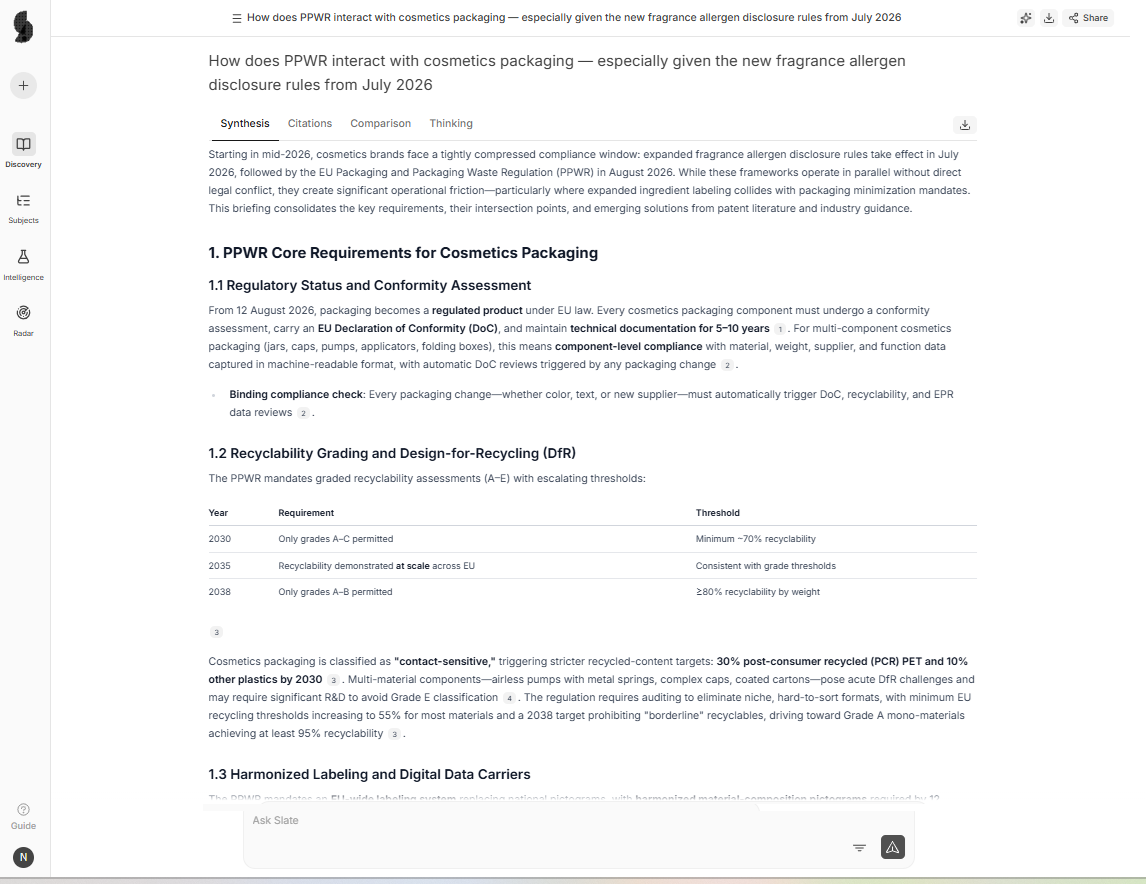
Instead of relying on spreadsheets, email chains, and disconnected research files, teams can use SLATE to organise packaging intelligence in one place. They can track what competitors are developing, which technologies are gaining traction, what materials are being explored, and where innovation is moving ahead of PPWR deadlines.
For companies preparing for PPWR packaging compliance, this can support faster decisions around packaging redesign, supplier scouting, technology benchmarking, and future-ready material selection. SLATE does not replace legal or regulatory review, but it can give teams the research-backed intelligence they need to act earlier, reduce blind spots, and build a stronger packaging compliance roadmap.