
Over 40% of 2024 skincare launches featured microbiome-related ingredients. Yet approximately 90% of products labeled as “probiotic” actually contain postbiotics (ferments, lysates, filtrates) with no live bacteria present.
That gap is not just a labeling inconvenience. It is an active regulatory exposure that is getting harder to ignore as FDA enforcement under MoCRA (Modernization of Cosmetics Regulation Act) intensifies in 2025 and EU truth-in-labeling frameworks tighten.
Before your next launch, here is what the technology landscape actually looks like, where the regulatory lines sit, and what your team should prioritize.
We used Slate — GreyB’s AI-powered R&D intelligence platform to map the skin microbiome landscape across patent filings, scientific literature, clinical evidence, regulatory guidance, brand claim activity, and supplier moves. Slate connects signals across the full innovation chain from early-stage research to commercial positioning so teams can see not just where the science is heading, but where the regulatory exposure already lives.
The Six Technologies Driving Innovation Right Now
1. Postbiotics: The Technology Winning in Market
Postbiotics are non-viable microbial ingredients: inactivated bacteria, cell lysates, and fermentation byproducts. They do not need to be kept alive, they survive standard cosmetic preservation systems, and they clear regulatory hurdles across most major markets.
The clinical evidence is real. A ferment filtrate from Epidermidibacterium keratini (EPI-7), a skin-native bacterium, showed a 12.5% reduction in transepidermal water loss (TEWL) versus 1.7% for placebo in a randomized split-face trial, alongside a 5.6% improvement in elasticity and 4.7% increase in dermal density after three weeks.
Staphylococcus epidermidis strains from healthy skin produce indole metabolites (indole-3-aldehyde and indole-3-lactic acid) that activate a pathway called AhR/OVOL1, which switches on genes that build the skin barrier. These same metabolites are reduced in patients with atopic dermatitis.
The manufacturing advantage: Postbiotic production costs 15-30% less in Asian fermentation clusters compared to European precision lysate methods. In September 2025, the US Cosmetic Ingredient Review panel confirmed four Lactobacillus ferment ingredient types are safe at concentrations up to 5.6% in leave-on products. This gives formulators a concrete, defensible reference point for the US market.
The competitive risk: Postbiotics offer 12-18 month launch pathways, but they are easy to replicate. Regulatory clarity comes at the cost of differentiation. If your pipeline is entirely postbiotic, ask whether your claims are defensible beyond ingredient novelty.
2. Live Biotherapeutic Products (LBPs): High Upside, High Complexity
Live biotherapeutic products use actual living bacteria, specifically strains native to human skin, rather than their byproducts. The hypothesis is that live organisms can colonize skin, continuously produce beneficial metabolites, and modulate the local immune environment in ways postbiotics cannot.
The lead clinical signal comes from Concerto Biosciences’ ENS-002, a three-strain live biotherapeutic for atopic dermatitis. It received FDA IND (Investigational New Drug) clearance, completed Phase 1 with positive safety data and dose-dependent improvement in EASI scores (a standard eczema severity measure), and vehicle-controlled efficacy studies are planned.
Beiersdorf’s acquisition of S-Biomedic in 2022 and L’Oréal’s acquisition of Lactobio in December 2023 both targeted proprietary strain libraries and discovery platforms, not just finished formulations.
The formulation barrier: Cosmetic preservation systems kill live bacteria. Encapsulated strains using alginate microspheres have achieved 6.13 log CFU/g survival after 120 days in preserved bases. L’Oréal filed a patent on crystallized live probiotic formulations claiming 4-12 hours of skin viability post-application and reduced cold-chain dependence. Both remain laboratory or premium-niche achievements, not mass-market solutions.
EU cosmetic microbiology limits (ISO 17516) cap total aerobic bacteria at 1,000 CFU/g for most products and 100 CFU/g for eye-area or children’s products. Those limits make viable probiotic concentrations commercially unworkable under standard cosmetic frameworks. South Korea prohibits live probiotics in cosmetics outright.
What this means for R&D: LBPs represent a 3-5 year pipeline play, not a near-term launch. If you invest here, you need both a strain-specific clinical rationale and a scalable formulation path. The companies that solve encapsulation at manufacturing scale will build IP moats that postbiotic competitors cannot easily cross.

3. Advanced Delivery Systems: Getting Active Ingredients Past the Surface
Standard topical application struggles to deliver microbiome-active ingredients beyond the outermost skin layer (the stratum corneum). Two delivery platforms are changing that.
Dissolving microneedles are tiny dissolvable structures that create temporary microchannels in skin. Microneedles made from polyvinyl alcohol/polyvinylpyrrolidone can encapsulate live Bacillus subtilis, release bacteria within 5 hours of application, and enable colonization in preclinical models, while maintaining antibacterial activity against S. aureus and C. acnes.
A clinical study using a dissolving micro-channeling system (without microbes, but with serum infusion) showed significant improvements in crow’s feet wrinkles, hydration, dermal density, elasticity, and pore density versus serum alone. This validates the delivery mechanism for skin bioactives. Postbiotic-specific applications in microneedle formats still need dedicated validation.
Hydrogel encapsulation systems have demonstrated effective delivery of beneficial bacteria including Lactobacillus plantarum with enhanced viability and immune tolerance. When combined with agents that disrupt bacterial biofilms, these systems can selectively clear pathogens while protecting commensal bacteria.
On the manufacturing side, Vaxxas received TGA (Australia’s equivalent of FDA) licensing in 2025 for robotic aseptic microneedle manufacturing. This signals the platform is moving toward industrial scalability.
For R&D teams: Microneedle delivery requires pharmaceutical-grade manufacturing infrastructure. The commercial path is longer and costlier, but the differentiation is substantial. Monitor pharmaceutical partnerships and licensing routes rather than trying to build this capability entirely in-house.
4. Targeted Antimicrobials: Removing the Bad Without Disrupting the Good
Broad-spectrum antimicrobials (traditional preservatives and antibiotics) disrupt the whole skin microbiome. The targeted antimicrobial category uses two precision tools to avoid that.
Bacteriophages are viruses that infect and kill specific bacterial species. Phyla (Phi Therapeutics), backed by Shiseido’s LIFT Ventures, launched a three-product acne phage system at Sephora. Their approach kills acne-causing C. acnes strains while leaving other skin bacteria intact. A 2025 study showed a phage-Aloe vera gel formulation achieved 97.11% reduction in multidrug-resistant Staphylococcus aureus with 4-12 week stability in cosmetic matrices.
Bacteriocins and endolysins are proteins produced by commensal bacteria that kill specific pathogens. Staphylococcus capitis isolates produce factors that selectively inhibit C. acnes without affecting other skin flora. Engineered postbiotic compositions expressing these agents are now appearing in patent filings from companies like Eligo Bioscience.
Regulatory note: Bacteriophage-containing products are in a grey zone in most markets. Phyla has filed patents across the US, Japan, South Korea, China, Australia, Canada, and the EU, suggesting the company is preparing for jurisdiction-specific regulatory navigation. Your regulatory team should map this landscape before any phage development program begins.
5. Multi-Biotic and Staged Restoration Systems: Treating Dysbiosis as an Ecosystem Problem
Single-ingredient approaches, whether a probiotic strain or a postbiotic extract, often fail because skin dysbiosis (bacterial imbalance) is not a single-deficiency problem. The ecosystem is disrupted across multiple dimensions simultaneously.
A triple-biotic formulation combining inulin (a prebiotic fiber), 2-butyloctanol, and a postbiotic blend demonstrated selective suppression of E. coli, C. striatum, and S. aureus, while maintaining or increasing S. epidermidis (a protective commensal). This was validated in ex vivo human skin explants with improved barrier biomarkers.
BiomCare’s patented multi-stage system sequences four interventions: biofilm management, anti-inflammatory support, microbial restoration, and stabilization. Each step targets a different phase of the barrier repair process.
Why this matters for claims: Multi-biotic systems are harder to substantiate than single-ingredient claims. You will need in vivo or ex vivo data on the combined effect, not just data on individual components. Retailers and regulators are asking for this.
6. AI-Driven Personalization: Matching Formulations to Individual Microbiome Profiles
Individual skin microbiomes vary substantially by age, ethnicity, geography, and skin condition. A single formulation cannot be optimal for everyone, and increasingly the data backs this up.
Korean researchers developed a classification system that maps microbiome profiles to skin types using 16S rRNA sequencing (a method for identifying bacteria by their genetic material) combined with biophysical skin measurements. Analyzing 950 subjects, a machine learning model called CatBoost predicted skin type from microbial composition with 0.96 AUC (a near-perfect accuracy score). The system identified 15 core bacterial genera that reliably differentiate aging groups.
Pond’s (Unilever) piloted a Skin Microbiome Analyzer in partnership with Watsons in the Philippines that offers individualized microbiome profiling with tailored product recommendations within 60 minutes.
The commercial gap: No company has yet built a mass-market product line that formulates to these microbiome-based skin subtypes. The data exists. The clinical rationale is solid. The product execution is not yet there.

Where Regulatory Risk Is Concentrated
The Claims Problem
Three claim types carry the highest regulatory risk across markets:
1. “Restores microbiome balance” or “corrects dysbiosis”: Under EU Regulation 1223/2009, products that claim to restore or modify physiological functions risk classification as drugs, not cosmetics. The UK Advertising Standards Authority ruled against Unilever’s Baby Dove campaign in January 2021 for claims that products “nourish” the skin microbiome, because in vitro data alone was insufficient without human data in the target population.
2. “Probiotic” labels on postbiotic products: About 90% of products marketed as probiotics do not contain live organisms. MoCRA’s 2025 enforcement infrastructure includes mandatory adverse event reporting, facility registration (9,528 active registrations), and product listing (589,762 unique entries). Truth-in-labeling exposure is real.
3. Barrier repair + microbiome combination claims: FDA has issued over 50 warning letters during 2014-2019 targeting unapproved drug claims in personal care. Claims implying disease treatment or modification of physiological function (including barrier repair framed as therapeutic) are the primary trigger.
The Jurisdiction Map
| Market | Live Probiotics | Postbiotics | Key Constraint |
| EU | Practically banned (max 1,000 CFU/g limit) | Permitted, standard safety assessment | No health claims under Reg. 178/2002 |
| US | No explicit ban, but claims-sensitive | Permitted; 4 Lactobacillus ferment types confirmed safe up to 5.6% (CIR, Sep 2025) | MoCRA enforcement 2025 |
| China | Streamlined NCI approvals; 102 new ingredient filings in 2025 | Bifidobacterium lysates approved; fermentation filtrates approved | Risk-based NCI pathway favors innovation |
| South Korea | Prohibited in cosmetics | Permitted | Potential live probiotic approvals from 2027 |
| Japan | No explicit ban if claims stay within cosmetic scope | Permitted | 56 accepted efficacy claims; no microbiome-specific list |
What Your R&D Team Should Do Next
Given the technology landscape and the unresolved challenges, here is where investment attention makes commercial sense.
Postbiotic development with rigorous strain characterization and clinical substantiation. The regulatory path is clear, but competitive differentiation requires published efficacy data beyond supplier-provided claims. EPI-7 ferment filtrate has clinical data. Bifidobacterium lysates for barrier repair have patent coverage. These are defensible positions. In vitro data alone will not hold under retailer or regulatory scrutiny. You need human trial data, ideally randomized controlled studies with metagenomic endpoints.
Encapsulation and delivery system investment. The gap between laboratory encapsulation performance (6.13 log CFU/g survival at 120 days) and mass-market viability is narrowing but not closed. Companies that solve ambient-temperature stability first capture a large addressable market currently inaccessible to live biotherapeutic products. Microneedle delivery for postbiotics is an adjacent opportunity with pharmaceutical validation behind it. The pharmaceutical infrastructure is already scaling, with Vaxxas receiving TGA manufacturing approval in 2025.
Precision live biotherapeutics and AI-personalized formulations for specific skin subtypes. The regulatory and IP moats here are substantial if technical feasibility is achieved. Concerto Biosciences’ ENS-002 program is the clearest signal of where clinical validation is heading for live biotherapeutics. A machine learning model analyzing 950 subjects has already achieved 0.96 AUC accuracy in predicting skin type from microbiome composition. No commercial product line has been built around these subtypes yet.
Underexplored segments worth entering now. Men’s skincare is a $45 billion market by 2033, with 68% of Gen Z males now using facial skincare products and almost no microbiome-specific formulations in the market. Aging skin has real clinical backing (EPI-7 data, validated inflammaging biomarkers) but almost no commercial translation. Scalp microbiome products are the fastest-growing segment at 9.5% CAGR, with postbiotics as the fastest-growing ingredient type in that category at 12.6% CAGR. First-mover advantage in all three segments remains open.
The Bottom Line
The technology is ahead of the claims infrastructure. Most markets have not built regulatory frameworks that match the pace of microbiome science, and that creates both risk and opportunity.
Postbiotics give you speed and regulatory clarity. Live biotherapeutics give you defensibility, if you can solve the formulation problem. Targeted antimicrobials and advanced delivery open differentiated positioning in premium channels. Multi-biotic systems and AI personalization set up the next generation of substantiated claims.
The companies that will win this category are the ones that match the right technology to the right timeline, build claims substantiation early, and treat regulatory strategy as a design input rather than a launch-stage problem.
How Slate Helps R&D Teams Move Faster
The analysis in this article was built using Slate – AI-powered R&D intelligence platform that helps R&D teams move faster by turning scattered technology, patent, market, and regulatory signals into clear innovation choices. In fast-moving areas like skin microbiome science, teams cannot afford to spend months tracking postbiotics, live biotherapeutics, delivery systems, claims risks, and emerging white spaces across regions.
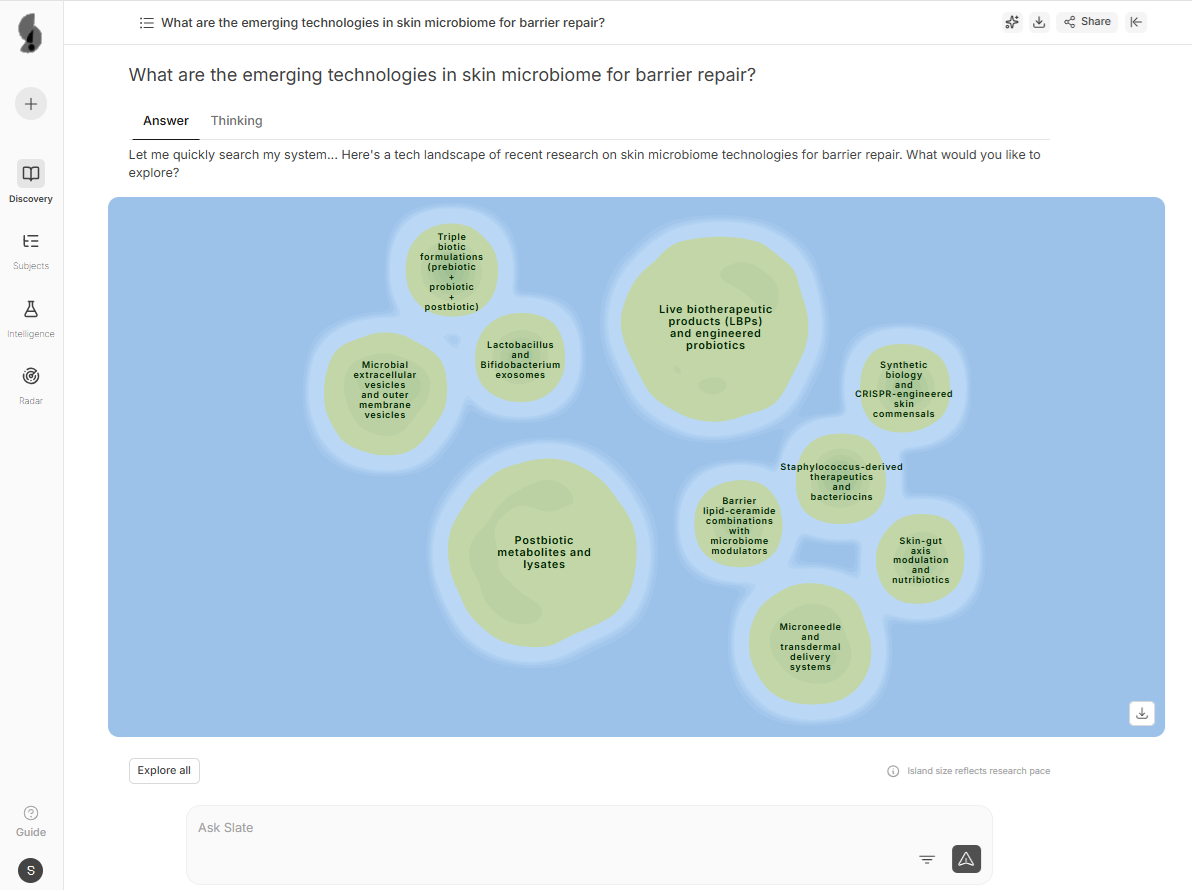
Slate brings these signals into one view, helping teams spot which technologies are ready for near-term launch, which need deeper validation, and where competitors are building IP strength. Instead of reacting late to regulatory shifts or copying crowded ingredient trends, R&D teams can use Slate to prioritize defensible opportunities, validate claims early, and build stronger product pipelines with more confidence.