
More than 35% of new skincare launches in 2024 used probiotics, prebiotics, or postbiotics. Barrier repair and hydration made up about 41% of microbiome cosmetic applications. Broader microecological skincare reached about $3.2 billion and is expected to grow at 8.3% CAGR through 2032.
Yet most R&D teams still crowd around the same ideas: barrier repair, hydration, sensitive skin, and postbiotic claims. These are valid areas, but they don’t capture the full opportunity.
The stronger white spaces now sit inside the technologies that can make microbiome skincare more precise, stable, and commercially defensible.
Using Slate – AI R&D intelligence platform, we analyzed the skin microbiome landscape across research papers, patent filings, product launches, supplier moves, clinical evidence, and regulatory signals. The goal was to separate credible science from category noise and identify where beauty R&D teams can still build differentiated products in barrier repair, scalp care, aging skin, men’s skincare, and microbiome-safe formulation.
Skin Microbiome White Spaces That Can Shape the Next Wave of Barrier Repair
1. Men’s Skincare: The Largest Untapped Opportunity
The global men’s grooming market was valued at $15.75 billion in 2024 and is projected to reach $45.89 billion by 2033 at 12.7% CAGR. Only 52% of men currently use skincare, compared to 76% of women. That gap represents roughly $20 billion in the unrealized addressable market.
The generational signal is clear: 68% of Gen Z males aged 18–27 now use facial skincare. This isn’t a passing trend. It’s a structural shift in category behavior that will compound over the next decade.
The microbiome science supports differentiation here, not just repositioning. Men’s skin is biologically distinct. Systematic reviews across 57 studies confirm men exhibit higher sebum production driven by androgens, greater skin thickness, and lower skin surface pH, predominantly below 5 versus above 5 in women. Men also show lower transepidermal water loss (TEWL) up to age 50, indicating more intact baseline barrier function. These differences translate to a distinct microbiome ecology, particularly sebum-driven bacterial communities and shaving-induced barrier compromise, neither of which is addressed by current microbiome formulations.
Current microbiome products are almost entirely female-targeted. No major brand has built a purpose-built male microbiome line. That is the white space.
2. Aging Skin Microbiome: Clinically Validated, Commercially Ignored
The aging skin microbiome is one of the few areas in this field with both strong clinical data and almost no commercial translation.
What the research shows: aging skin undergoes characteristic microbiome shifts, with decreased Cutibacterium acnes, increased Corynebacterium kroppenstedtii, and a functional decline from 160 active gene ontology terms in young skin to just 3 in aged skin. The Facial Aging Index links inflammation pathways positively to chronological age (R≈0.20, p≈2.4e-05) and anti-aging biosynthesis pathways negatively (R≈−0.29 to −0.31, p<1e-10). The correlation is statistically robust.
The most commercially relevant data point: Epidermidibacterium keratini EPI-7 postbiotics demonstrated 12.5% TEWL reduction versus 1.7% placebo (p<0.001), elasticity improvement of +5.6%, and dermal density increase of +4.7% in a randomized split-face trial. This is clinical-grade evidence for a microbiome-derived active in aging skin.
EPI-7 has the data. It does not have the products. The inflammaging-microbiome axis, where dysbiosis accelerates visible aging through inflammatory pathway activation, is clinically substantiated but commercially underdeveloped. For R&D teams with existing anti-aging pipelines, this is a near-term integration opportunity, not a long-horizon research bet.
3. Scalp Microbiome: Fastest Growth, Weakest Science
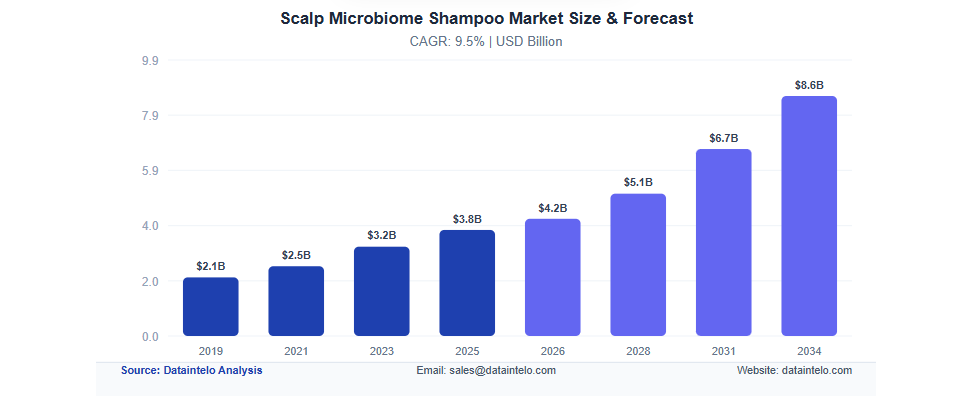
The scalp microbiome shampoo market was valued at $3.8 billion in 2025 and is projected to reach $8.6 billion by 2034 at 9.5% CAGR. Within ingredients, postbiotics are growing fastest at 12.6% CAGR, driven by their stability advantages in rinse-off formats.
Clinical evidence supports the category: 8 weeks of microbiome-targeted shampoo use has been shown to increase scalp microbial diversity by up to 43% and reduce inflammatory markers by 36%.
The problem is that most scalp microbiome products are technically derivative of facial formulations. The scalp has a distinct ecology: higher sebum density, follicular depth, hair fiber interaction, and a different bacterial and fungal profile than facial skin. Cosmax’s Dandriome work points toward what purpose-built scalp science looks like, addressing the co-occurrence of hair loss and seborrheic dermatitis through microbiome rebalancing rather than single-mechanism antifungal approaches.
This is the fastest-growing segment in the category, and most products in it aren’t built for it. That’s a formulation opportunity with a well-established consumer education pathway already in place.
4. Ethnic Skin Variations: A Research Gap Hiding in Plain Sight
Ethnic differences in skin barrier function and microbiome composition are well-documented in the literature. They are nearly absent from product design.
African American skin shows lower baseline TEWL (5.6 ± 2.2 g/m²/h) and more intact barrier function but lower ceramide levels. East Asian and Caucasian skin show weaker barriers with higher TEWL. Cameroonian skin has significantly higher microbial richness and diversity than Japanese skin. Chinese skin shows enriched Enhydrobacter populations distinct from Western microbiomes. The South Asian male scalp microbiome is the most divergent composition across all ethnic groups studied.
Hispanic/Latinx and South Asian populations remain understudied despite representing substantial and growing markets. No microbiome brand has built formulations grounded in ethnicity-specific barriers or microbiome profiles.
The opportunity here is partly scientific and partly commercial. Populations with distinct microbiome and barrier profiles, who are currently being served with formulations designed for a different skin type, are a ready audience for targeted positioning backed by real differentiation.
5. Underexplored Strains: Three Specific Gaps
Beyond consumer segments, the research points to three strain-level white spaces with commercial potential.
EPI-7 (Epidermidibacterium keratini). The clinical data is already described above. Commercial deployment is nearly absent. This is a first-mover situation with validated efficacy data waiting for a formulation team to act on it.
Yanomami microbiome strains. The skin microbiome of Yanomami communities, representing pre-industrial microbial diversity, harbors genera largely absent in Western populations: Dietzia, Kocuria, Micrococcus, Brevibacterium, Brachybacterium, Deinococcus, Yimella, and Janibacter. These are “lost” commensals that may confer barrier-protective functions absent in industrialized skin microbiomes. This is an early-stage bioprospecting opportunity, analogous to the work done on gut microbiome diversity in hunter-gatherer populations, but almost entirely unexplored for skin.
Malassezia-mediated lipid postbiotics. Malassezia yeasts, already resident on human skin, convert omega-3 and omega-6 fatty acids into anti-inflammatory lipid mediators in situ. Instead of delivering unstable pre-formed lipid actives, formulations could deliver polyunsaturated fatty acid (PUFA) substrates and let resident Malassezia produce the bioactives directly on skin. The stability advantage is significant. The personalization angle, where output varies based on individual Malassezia colonization density, is novel. No commercial products have been built around this mechanism.
6. Cross-Industry Tech Transfer: Two Infrastructure Opportunities
Two technologies from adjacent industries are mature enough for cosmetic microbiome applications but haven’t been formally adapted.
Microneedle delivery platforms. Pharmaceutical dissolving microneedles made from hyaluronic acid, polyvinylpyrrolidone, or polyvinyl alcohol create transient microchannels in skin for enhanced dermal deposition. A dissolving micro-channeling system (DMCS) in clinical testing showed significant improvements in wrinkle depth, skin hydration, dermal density, elasticity, and pore density versus serum alone. Pharmaceutical transferosome-loaded microneedle patches achieved 2–3x higher active accumulation at application sites with reduced systemic exposure. Manufacturing scalability is no longer the barrier: Vaxxas received TGA licensing in 2025 for robotic aseptic microneedle manufacturing, and Micron Biomedical completed Phase 1/2 trials in 2024 using scalable dissolving microneedle platforms.
The gap: postbiotic-specific microneedle applications have not been validated for cosmetic use. The infrastructure is ready. The formulation work is not done.
Precision fermentation from the food industry. The food industry has developed precision fermentation infrastructure, using engineered microorganisms to biosynthesize high-value compounds at scale, that is underused in cosmetic microbiome ingredient production. Yarrowia divulgata strain 1485 demonstrates what’s possible: a single fermentation co-produces erythritol, pigment, bioemulsifier, and skin moisturizer. Whey-based alginate microspheres encapsulate probiotics at 78% efficiency with 30-day viability in preservative-containing formulations, using food-industry feedstocks. The production economics and feedstock availability already exist. The commercial translation into cosmetic-grade microbiome actives has not happened at scale.

Adoption Challenges Across Every Skin Microbiome White Space
The white spaces are real. The barriers to entering them are also real and consistent across every segment.
No standardized testing methodology. There is no consensus on how to sample skin microbiome (swab vs. tape vs. scrape), which 16S rRNA hypervariable region to sequence (V1-3 vs. V4), or which bioinformatic pipeline to use. Synthetic skin bacterial communities show only 65.6% concordance with human trial responses. This means every efficacy claim currently rests on proprietary validation rather than reproducible science. That’s a vulnerability that will concentrate as retailer and regulatory scrutiny increases.
Regulatory fragmentation by market. China has streamlined New Cosmetic Ingredient approvals, with 102 NCI filings in 2025 alone. South Korea prohibits live probiotics in cosmetics entirely and restricts terms like “microbiome balancing.” The EU’s ISO 17516 limits of ≤1,000 CFU/g effectively ban meaningful viable probiotic concentrations. Identical R&D assets face radically different commercialization pathways depending on jurisdiction.
The 90% labeling gap. Approximately 90% of products labeled as “probiotic” cosmetics actually contain postbiotics, including lysates, ferments, or filtrates, rather than live microorganisms. MoCRA, in full enforcement since 2025 with 9,528 registered facilities and 589,762 product listings, mandates 15-day serious adverse event reporting and includes expanded surveillance infrastructure. Truth-in-labeling exposure is rising for any brand making live bacteria claims.
Individual microbiome variability. Skin microbiome composition varies significantly across individuals, geographies, and age groups. Universal product claims become scientifically hard to defend without stratified clinical trials, which raises development costs for niche segments. This is especially relevant for ethnic skin and aging skin applications, where the science supports segmentation but the clinical investment to substantiate segment-specific claims is higher.
The stability problem isn’t fully solved. Encapsulation advances have achieved 6.13 log CFU/g survival after 120 days in preserved bases. L’Oréal’s crystallized live probiotic patent claims 4–12 hour skin viability. But these remain laboratory or premium-niche achievements. Cold-chain requirements (2–8°C priority, 8–15°C acceptable) still segment addressable markets toward controlled logistics channels, which rules out most mass-market retail.
What R&D Teams Should Do Next: Plan for Skin Microbiome Innovation
Prioritize EPI-7 and scalp for near-term pipeline integration. EPI-7 has split-face randomized clinical data with statistically significant results. Scalp microbiome has an established consumer education pathway, growing category momentum, and a clear differentiation gap between current products and what the biology actually requires. Both can move on 12–18 month timelines using postbiotic formats with established regulatory pathways.
Build a men’s microbiome positioning brief now, before a competitor does. The sebum-microbiome biology is documented. The Gen Z behavioral shift is measurable. The current competitive landscape has no serious male-targeted microbiome player. This is first-mover territory with a $20 billion penetration gap behind it.
Invest in proprietary validation infrastructure. Given the absence of standardized testing protocols, the companies that build defensible internal methodologies, whether metagenomic sequencing pipelines, ex vivo skin explant systems, or validated clinical biomarker panels, will have competitive advantages that are difficult to replicate. Proprietary validation is currently the only basis for differentiated claims.
Evaluate precision fermentation and microneedle partnerships. The food industry fermentation infrastructure and pharmaceutical microneedle manufacturing platforms are both further along than cosmetic-grade microbiome delivery. Cross-industry licensing or co-development agreements could compress development timelines significantly compared to building from scratch.
Track Korea’s strain-specific approval timeline. South Korea’s Ministry of Food and Drug Safety has signaled potential strain-specific approvals beginning 2027 and tighter safety evaluations by 2031. This is the most significant near-term regulatory unlock for live probiotic formulations in a major Asian market. LISCure Biosciences’ February 2025 MFDS approval of Mobiome, the first scientifically validated probiotic ingredient for hair health as a functional cosmetic, is the first precedent. Watch it closely.
Monitor Concerto Biosciences’ ENS-002 regulatory path. Concerto’s Phase 1b for ENS-002, a three-strain live biotherapeutic for atopic dermatitis, has reported positive safety data and dose-dependent improvements in EASI scores. Vehicle-controlled efficacy studies are planned. The FDA IND clearance and subsequent Phase 1b results are the most advanced regulatory signal available for how live biotherapeutic products for skin will be evaluated. This sets the framework for any R&D team considering the live probiotic route.
The Core Strategic Tension
Postbiotics offer 12–18 month launch pathways with regulatory clarity but limited competitive defensibility. Live biotherapeutic delivery, if solved, creates intellectual property and regulatory moats at the cost of uncertain technical feasibility and extended capital commitment.
The white spaces described here sit mostly in the postbiotic lane in the near term, with the exception of Yanomami bioprospecting and Malassezia-mediated in situ production, which require longer development arcs. That’s actually the practical entry point: use postbiotic formats to establish position in men’s skincare, aging skin, and scalp care now, while building the longer-term pipeline around novel strains, precision delivery, and live biotherapeutics.
The field has over-invested in incremental extensions for established demographics. The segments where first-mover advantage is still available are clearly identified. The question for R&D leadership is how much of the current portfolio allocation reflects genuine strategic choice versus accumulated inertia.
How Slate Helps R&D Teams Make Faster, Smarter Innovation Calls
Most R&D teams don’t need more information. They need faster ways to find what matters, check if it’s credible, and decide what to do next.
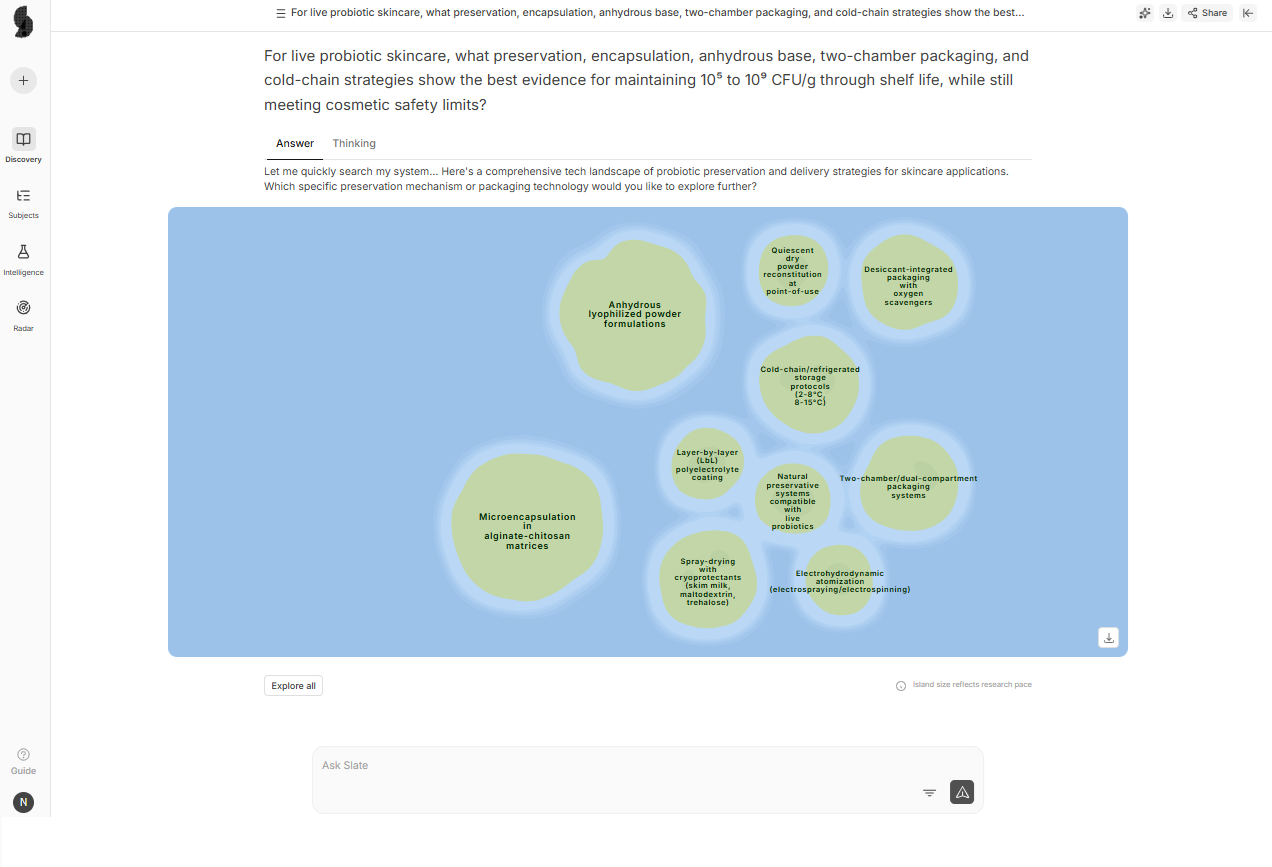
SLATE – AI R&D Intelligence platform helps teams move from scattered research to clear direction. It scans papers, patents, technical reports, regulations, market signals, and competitor activity, then helps connect them into practical R&D decisions.
Researchers can compare technologies, validate claims, find weak evidence, and spot cross-industry ideas without spending weeks on manual review. R&D heads can see which areas are crowded, which white spaces are worth pursuing, and which bets fit short-term launches versus long-term innovation. Business leaders can assess whether a technology has the right market, regulatory, and commercial path before funding it.
Slate doesn’t replace R&D teams. It gives them sharper intelligence, faster. For teams under pressure to launch faster, reduce risk, and find the next growth area, Slate helps turn research overload into better decisions.
The practical value is simple: researchers spend less time searching, R&D heads get clearer direction, and leadership gets stronger confidence on where to invest.
Researchers can compare technologies, validate claims, find weak evidence, and spot cross-industry ideas without spending weeks on manual review. R&D heads can see which areas are crowded, which white spaces are worth pursuing, and which bets fit short-term launches versus long-term innovation. Business leaders can assess whether a technology has the right market, regulatory, and commercial path before funding it.
Slate doesn’t replace R&D teams. It gives them sharper intelligence, faster. For teams under pressure to launch faster, reduce risk, and find the next growth area, Slate helps turn research overload into better decisions.
The practical value is simple: researchers spend less time searching, R&D heads get clearer direction, and leadership gets stronger confidence on where to invest.